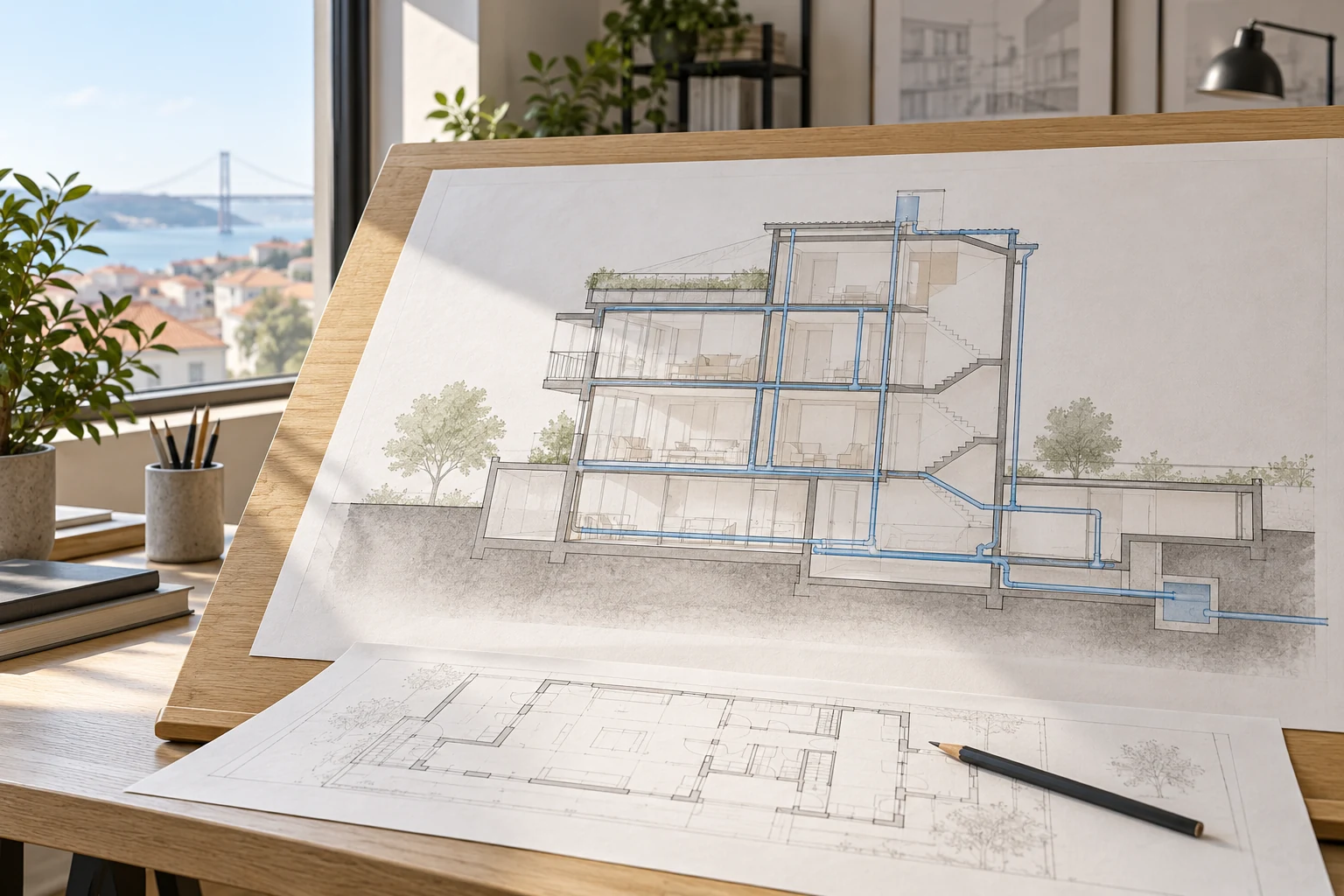

Organising construction means knowing who directs execution, who monitors the programme and how decisions pass between the client, designers and contractors. Technical direction, management and coordination need clear roles, even when they form part of the same process.
Your enquiry should identify the stage of the works, the services already appointed and the support you need. The proposal should explain the roles undertaken, who is responsible, the records to be kept and the arrangements for site support, while distinguishing supervision on the client’s behalf and health and safety coordination.
Request a proposal for your worksTechnical direction, management and coordination: distinct roles
Technical direction of the works (direção de obra)
Under Portugal’s Law No. 31/2009, technical direction of the works covers directing construction and coordinating the construction contractor’s production activities. The proposal should identify whether this is the role required, who will undertake it and their relationship with the contractor carrying out the work. The commercial title of a management service does not, on its own, explain that responsibility.
Construction management
Management may cover organising the programme, reporting on progress, tracking outstanding decisions and monitoring changes, within the defined scope. It is important to identify the documents to be used, who can decide each matter and how the effects of decisions on the planned work will be recorded. Monitoring cost and programme information is not a guarantee of the outcome.
Coordination of activities and those involved
Organisational coordination addresses the relationship between activities, contractors, supplies and the client’s decisions. It can help prepare the sequence of work, identify dependencies and direct questions that affect other tasks to the right person. It should be clear who receives each question and who resolves it, without assigning every technical role on the project to the coordination contact.
Working with supervision, design and safety coordination
Construction supervision on the client’s behalf has its own scope for monitoring and checking the works. The management and coordination service should explain how it communicates with that role, without presenting the day-to-day organisation of the works as supervision already appointed or carried out.
When a question involves interpreting or changing the design, the communication process should involve the relevant designers and identify the documents concerned. Meeting notes or a programme update do not replace the technical clarification needed for the decision.
Construction health and safety coordination also has its own scope. The proposal should identify how that role works with construction, supervision and management, in line with the requirements applicable to the works. Required roles do not become optional because they fall outside a particular commercial service; how they are provided needs to be clear. Several scopes may be included in one proposal, with the roles and responsible parties clearly identified.
Planning and reporting on progress
The programme should start from the defined work and available information: the designs and reference versions, planned activities, decisions still to be made, supplies and access arrangements. The management scope may include organising this information and identifying tasks that depend on an approval, a delivery or the completion of another activity.
During construction, records can distinguish what was planned, what has been completed and what needs a decision. Updates should identify assumptions and unresolved issues so that a forecast is not mistaken for a confirmed commitment. The service should specify how progress will be presented and how often the information will be updated.
Decisions, changes and cost information
A decision record should make clear the issue, the affected document or work, the person to consult and the status of the response. When a change is proposed, distinguish the idea under consideration from the solution clarified and approved by the relevant parties, and from the work covered by the agreed terms.
If the scope includes cost information, the source of the figures, the version being used and changes still to be assessed should be identified. Quantity take-offs, bills of quantities and estimates can be arranged as a defined service. An estimate helps inform decisions, but it is not the contractual price for carrying out the works. The effects of a change on cost and the programme need to be assessed and recorded in the context of the project.
Attendance, records and completion of the service
The approach to site attendance and communication should suit the scope of the works and the responsibilities undertaken. Visits, meetings, communication channels and records should be clarified; the name of a management or coordination service does not imply permanent attendance on site.
Depending on the service, deliverables may include an updated programme, meeting records, a list of issues and decisions, information on changes and a record of outstanding matters. The proposal should identify which of these are included and who receives them.
At the end of the stage being supported, the record of outstanding matters should distinguish unfinished work, decisions still needed and documents yet to be gathered. Delivering a management report does not, by itself, mean that all works have been accepted or that all technical and administrative documentation is complete.
What to send so the proposal can be defined
Give the location, the type and approximate scale of the works, the current stage and your preferred timing. Identify the client, the companies carrying out or due to carry out the work and the professionals already involved. Explain which services have been appointed and when you would like support to begin.
Share available designs, contracts or proposals for the works, programmes, bills of quantities and records. Note outstanding decisions, occupancy or access constraints and any existing cost information. Explain whether you need technical direction of the works, management support, organisational coordination or a defined combination of these scopes, so the proposal can address the specific need.
Related services
Areas we serve
We welcome enquiries in Lisboa, Oeiras, Cascais, Sintra, Amadora, Odivelas and Loures. Availability and the feasibility of the work are assessed for each enquiry.
View the areas we serveFrequently asked questions
What is the difference between technical direction and construction management?
Technical direction concerns directing execution. Management organises the programme, information and decisions within the defined scope. The roles may work together, but the enquiry should identify the role needed and who will undertake it; having a manager does not, on its own, establish who is responsible for technical direction of the works.
Does construction management include supervision and health and safety coordination?
They should not be assumed to be automatically included in management. They have their own scopes and need to be identified and coordinated with the other people involved. The proposal should explain how the roles required for the works are provided, without treating them as interchangeable or dispensable.
Can there be one contact to organise communication?
A contact can be defined to gather questions, track responses and organise meetings. That process should preserve clarity about who makes decisions, clarifies the design, carries out the work or checks it. A central contact does not mean that one person takes on all those responsibilities.
Does the service mean someone will be on site every day?
Daily attendance should not be assumed from the service name. Visits, meetings and other ways of following the works should be defined to suit the project and the responsibilities undertaken, clarifying when attendance is planned and how matters needing a response will be communicated.
Can I request support after the works have started?
You can make an enquiry identifying progress, the people currently responsible and the available records. The scope will need to take account of when the service begins and what can be observed or documented at that stage. Support starting now should not be presented as retrospective verification of all earlier work.
Does construction management guarantee the completion date and final cost?
The programme and cost information help track decisions and changes, but do not, on their own, guarantee a completion date or final price. The proposal and construction terms should identify commitments, assumptions and how changes will be handled, distinguishing forecasts from contractually agreed figures or dates.
What support do you need to organise and monitor the works?
Describe the planned work, its current stage, the available documents and the parties already appointed. Identify the roles you need so the proposal can define the scope, working relationships and records.
Tell us about your works