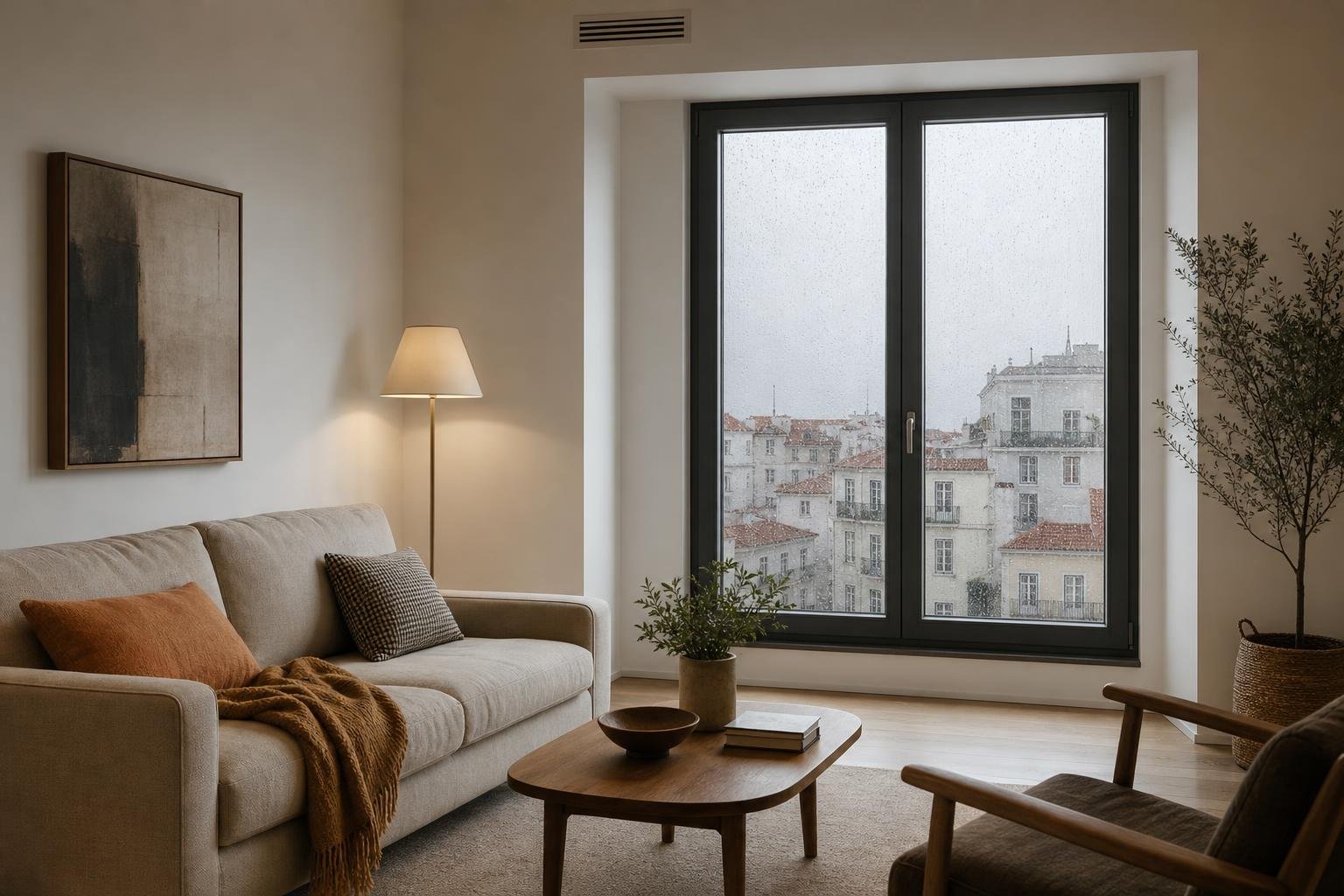

A well-chosen insect screen lets you open windows on warm nights without turning ventilation into an invitation for insects, but it must suit the window frame, shutter and everyday use of the room. In Lisbon, where heat stored during the day can make bedrooms uncomfortable by evening, the most useful option is usually one that still allows the window to open, be cleaned and close normally. Before ordering, establish where the screen sits, how it is removed and whether it affects shutters, interior shutters, security grilles or a necessary exit.
Contents
- Why screens belong in a ventilation plan
- Which system suits each window
- What to measure before requesting a quote
- Ventilation is not about leaving every gap open
- Mistakes that make a simple solution expensive
- When maintenance is enough and when to call a professional
Why screens belong in a ventilation plan
An insect screen does not cool a home on its own. Its value is that it removes a practical barrier to opening windows when outdoor air is more favourable, especially early in the morning or at night. IPMA recorded a provisional high of ten heatwaves in mainland Portugal during 2026, which makes it more useful to take advantage of cooler hours without leaving the home exposed to mosquitoes. Read the IPMA update on Portugal’s 2026 heatwaves for that context.
Portugal’s health authority recommends protecting doors and windows with insect screens where possible, alongside removing outdoor containers that hold standing water. A screen therefore complements maintenance of gutters, plant saucers, balconies and patios; it does not replace that routine. See the DGS guidance on preventing mosquitoes at home.
For a west-facing bedroom, the useful sequence is straightforward: limit sun during the afternoon, open once the façade is no longer in direct sun, then close in the morning before outdoor temperatures rise again. If the room relies on airflow through the hallway, avoid permanently shutting down that route; coordinate the decision with interior doors and the home’s ventilation path.
Which system suits each window
Do not choose from a catalogue image alone. Start by checking the sash movement, handle position, shutter guide and clear width of the opening.
- Fixed screen: suitable for a window that rarely needs to act as a passage or outdoor access point. It is simple, but should be removable for cleaning and maintenance.
- Roll-up side or vertical screen: useful for balcony doors and windows used every day. It needs properly measured housing, guides and clearances; confirm that the handle will not strike it.
- Sliding screen: can work with sliding windows if there is a dedicated track and the solution does not obstruct drainage or access for cleaning the runners.
- Pleated screen: often useful on frequently used doors, although it needs accurate alignment to avoid jamming or sagging.
On older timber windows, avoid drilling until the thickness and condition of the frame are understood. With thermally broken aluminium or PVC, do not casually pierce profiles, seals or drainage areas. A poorly positioned fixing can lead to noise, water ingress or a window that no longer adjusts correctly.
What to measure before requesting a quote
Measure the usable opening, rather than only the opening visible from indoors. Open the window to its normal position and check room for the screen, for a hand on the handle and for cleaning. Photograph all four corners, the sill, shutter guides and any external grille as well.
- Record width and height at three points; older walls and frames are often out of square.
- State whether the sash opens inward, outward, tilts or slides.
- Check whether the shutter can lower with the window open and whether the shutter box already has cracks or draughts.
- Confirm whether the screen must move aside to wash exterior glass or access a balcony.
- In children’s rooms, check that the operating mechanism is out of reach or does not create an unnecessary loose cord.
This check matters more than choosing an exceptionally fine mesh. The screen needs to stop insects while leaving the window easy to live with. If windows are being replaced, include the screen, shutter, air inlet and reveal finish in the same design instead of adding accessories afterwards.

Ventilation is not about leaving every gap open
A comfortable home needs renewed air, yet ventilation needs a route. The rules applicable to homes set out air admission through main rooms and extraction through service spaces such as kitchens and bathrooms; they also require solutions that do not compromise healthy indoor conditions. Read the ventilation requirements published in the Diário da República.
In practice, an insect screen is not a reason to cover planned grilles, completely seal a windowless bathroom or switch off an extractor fan. Indoor air quality includes ventilation, temperature and humidity, as explained in the ADENE glossary. Persistent odours, steam that does not clear, mould or window condensation may require cleaning, mechanical extraction, an air inlet or a moisture diagnosis—not a new screen.
On quiet nights, begin by opening the cooler façade and create a moderate route to another room. In places affected by heavy noise, dust or outdoor smoke, adapt the time and extent of opening. A screen keeps insects out; it does not filter fine particles or solve pollution and noise. In flats with a concrete balcony slab, it is also worth checking for cold areas where the slab meets the façade before attributing all condensation to the window; see why concrete balconies can create thermal bridges.
Mistakes that make a simple solution expensive
The most common mistake is ordering a screen without considering the shutter. A front-mounted screen may stop the blind from lowering fully; a screen installed inside the reveal may clash with an inward-opening sash; an adhesive screen may make it hard to replace a seal or repair the frame.
- Do not cover drainage holes in the sill or frame profiles.
- Do not fix guides over failed sealant, loose render or timber showing decay.
- Do not overstretch the mesh: it loses resilience, marks easily and may tear at corners.
- Do not treat a torn screen with tape as a durable repair on a heavily used window.
- Do not rely on a screen as fall protection; that requires purpose-designed safety measures.
It is also worth avoiding an arrangement that requires fully opening the screen every time the shutters need to close. During a renovation, ask for a front elevation and section detail before ordering. That makes it possible to confirm the screen’s position relative to the frame, shutter and external finish.
When maintenance is enough and when to call a professional
Dust, pollen and grease reduce airflow and make mesh more visible. Vacuum with a soft brush or wash according to the material instructions, without aggressive solvents or pulling at wet mesh. Clean guides, tracks and sills as well; a window that already rubs can become worse when debris builds up.
Call a professional where installation requires drilling window profiles, changing a grille, working with integrated shutters, carrying out external work at height or correcting water ingress around the opening. If the aim is to improve summer comfort across the room, use the opportunity to assess external shade, airtightness and the airflow route instead of treating each window in isolation.
For wider works, Obra Lisboa can help bring windows, shutters, ventilation and finishes into one coordinated renovation scope.
Key takeaways
- Choose the screen around window and shutter movement, rather than mesh type alone.
- Measure the usable opening and confirm cleaning, drainage and balcony access before ordering.
- Use night ventilation when outdoor air is cooler, without blocking grilles or extraction routes.
- Remove standing water and keep the mesh clean so that it remains effective and discreet.
If you are renovating bedrooms, windows or a balcony, include insect screens in the opening survey and window-frame detail from the start. Ask Obra Lisboa for a renovation proposal that coordinates ventilation, shading and finishes before products are ordered.
Sources and further reading
- DGS guidance on preventing mosquitoes at home
- ventilation requirements published in the Diário da República
- IPMA update on Portugal’s 2026 heatwaves
- ADENE glossary
Editorial image; it does not depict an Obra Lisboa project.

Obra Lisboa