A parking space only adds real EV-charging flexibility if it genuinely belongs to the flat, has a workable electrical route and does not create a power-capacity or condominium problem. Before making an offer on a Lisbon apartment, treat this as part of the property review alongside floor area, condition and likely building works. The aim is not to promise an immediate installation; it is to identify the documents, technical limits and decisions that could affect you after completion.
Contents
- Does the parking space actually belong to the flat?
- What shows that an installation may be feasible?
- Can the condominium stop an installation?
- How can you assess cost without making up a figure?
- Which documents separate potential from reality?
- When should you pause or call for technical support?
Does the parking space actually belong to the flat?
Start with title documents, not the sales plan or listing description. The bay may be an autonomous unit, a parking or storage area attached to the flat, a common area for exclusive use, or simply an informal day-to-day arrangement. Those arrangements have different consequences for the sale, access and any future installation.
Request the land-registry record, tax record and horizontal-property title. Check the bay number, level, area and associated annexes, then compare them with what you see on site. A neighbourly swap may appear harmless until you need to install infrastructure or sell the property. Lisbon City Council can also issue certified copies of documents held in municipal files, including documents relating to horizontal property and use licences, through its certificate or certified-copy service.
- Photograph the bay identification and garage entrance.
- Check whether columns, ramps or gates restrict manoeuvring.
- Establish whether the space is enclosed, covered or open within a common area.
What shows that an installation may be feasible?
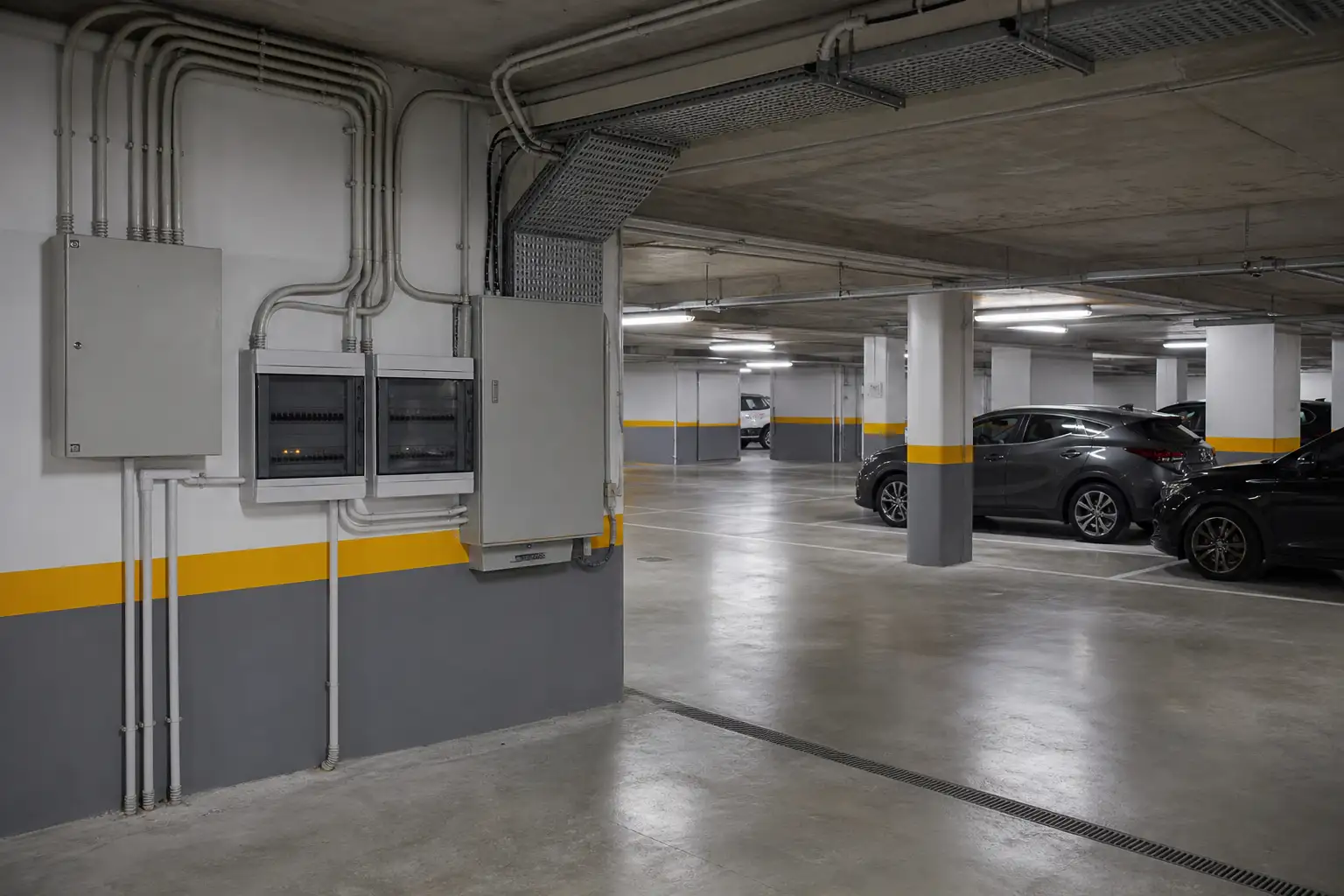
Look for facts rather than statements such as “EV pre-wiring”. Ask to see the common-area electrical panel, service cupboards, cable routes and the approximate distance between the relevant meter or panel and the bay. A short route does not guarantee capacity; a long route does not make a solution impossible. What matters is whether there is space, suitable protection, a cable route and a way to carry out the work without crossing critical areas without coordination.
For new buildings and major renovations falling within the legal conditions, energy rules set infrastructure and power requirements for charging in certain car parks. In an existing building, however, the presence of a socket at the bay does not prove it is suitable for regular charging. The installation must comply with applicable technical rules and be carried out by a responsible electrical technician or installer, as set out in Ordinance No. 220/2016.
Do not decide solely around the vehicle you own today. Ask whether the expected solution can manage available power and measure consumption clearly, particularly where several owners may eventually charge in the same garage.
| Item | Useful question | Warning sign |
|---|---|---|
| Ownership of the bay | Is it identified in the flat's documents? | Number or area does not match the viewing |
| Electrical route | Are there cable routes or technical spaces to the bay? | Cables would cross access routes with no defined solution |
| Panel and power | Is current technical information available? | No one knows the available capacity |
| Condominium | Are there chargers, rules or previous requests? | Recurring disputes or pending electrical works |
Can the condominium stop an installation?
In an existing building, Portuguese law allows an owner, tenant or lawful occupier to install, at their own cost, an EV charging point or socket that meets technical requirements. Where the installation uses or crosses a common part, prior written notice must be given to the condominium manager at least 30 days before the intended installation date. Objection is not unrestricted: it is limited to specified cases, including an equivalent shared solution or an effective risk to people, property or the building’s architectural character.
Read the framework itself in Decree-Law No. 90/2014, but do not mistake it for an electrical design. The building may have capacity constraints, difficult routes, gates, ventilation issues or practical rules for garage works. Request recent meeting minutes, condominium rules, the annual budget and information on planned electrical works. This material can also reveal extraordinary costs that may compete with your investment budget.
Before proceeding, review which condominium documents to request before renovating. The principle is the same: establish what has been decided, what is under discussion and who is responsible for common parts.
How can you assess cost without making up a figure?
Do not set a work budget from a ten-minute viewing. Request a technical assessment that separates four components: panel and protective devices, cable route, charging equipment and any work in common areas. Include reinstatement work, openings through building fabric, coordination with the manager and the way energy will be measured or billed.
To compare proposals, give every contractor the same information: bay photographs, available drawings, panel locations, estimated route length, known contracted power and building rules. An incomplete request produces incomparable prices and exclusions that only emerge later. The approach used for requesting comparable renovation quotes also works for this focused task.
Use two scenarios in your purchase decision: one where the bay remains parking only, and another where you allow for a later electrical installation. If the second is essential to you, make it a due-diligence condition before releasing a reservation or increasing the deposit.
Which documents separate potential from reality?
Where it exists, the housing technical file may describe the technical and functional features of a residential building when construction, reconstruction, extension or alteration was completed. Sellers or agents must make it available for consultation where applicable, according to the IMPIC guidance on the housing technical file. It does not replace a current electrical review, but it can help identify systems and understand the building’s age.
Also request the energy certificate. ADENE states that the certificate is mandatory in property transactions and rates the property’s energy-efficiency potential. Use it to understand the flat’s envelope and systems; do not assume that its rating confirms electrical capacity in the parking area. The ADENE information on energy certification helps define that limit.
- Collect documents for both the flat and the parking bay.
- Request minutes, rules and information on electrical works.
- Arrange a technical garage visit before deciding.
- Record outstanding checks and the deadline for resolving them in writing.
When should you pause or call for technical support?
Pause before assuming that it can simply be solved later if there is no access to the electrical panel, if improvised cabling is visible, if documents do not identify the bay or if the manager cannot explain how energy use and responsibilities are allocated. These points do not automatically make the property unsuitable; they mean the offer should reflect genuine uncertainty.
There is an important difference between buying a home that can accommodate an improvement and paying a premium for a feature that has not been confirmed. In Lisbon, where a parking space can strongly influence a purchase, documenting that difference protects your allowance for later works. If there are also planning files, garage alterations or unclear records, first review what to request when buying in Lisbon with a pending planning file.
The practical next step is straightforward: gather documents and photographs before the offer, obtain a technical reading of the electrical route, then decide how much value you attach to the parking space.
Key takeaways
- Confirm ownership and identification of the bay in documents, not only in the listing.
- An existing socket does not prove that the bay is ready for regular EV charging.
- Condominium minutes, rules and electrical information belong in due diligence before the deposit.
- Request a technical assessment that separates route, protection, power capacity and energy metering.
If you are buying to renovate or want to prepare the flat after completion, Obra Lisboa can help organise the technical scope, documents and quote requests so that you can make clearer decisions before works begin.
Sources and further reading
- Decree-Law No. 90/2014
- Ordinance No. 220/2016
- IMPIC guidance on the housing technical file
- certificate or certified-copy service
- ADENE information on energy certification
Editorial image; it does not depict an Obra Lisboa project.

Obra Lisboa