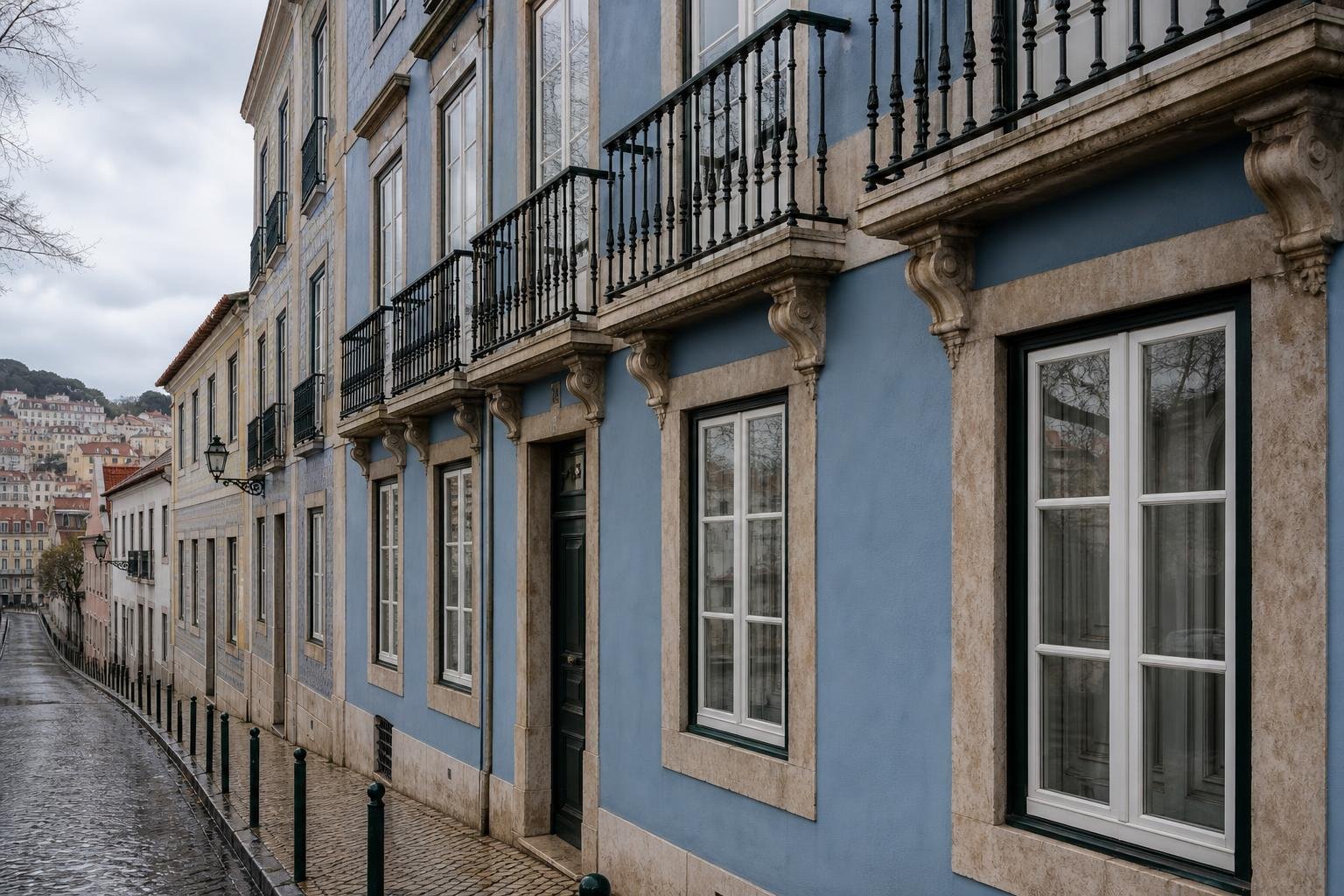

For an older building, a sound maintenance plan starts by separating what must be repaired now from what needs a formal decision, design input or a check with the council. Without that distinction, a minor water ingress can wait too long, a simple job can proceed without a record, and façade work can be commissioned before the necessary approval is confirmed.
For a condominium, the useful plan is not a generic defect list. It is a short, current record supported by photographs, identifying the likely source of the issue, the risk, the affected area, the decision still needed and the next action.
Contents
- Map the common parts and identify signs that should not wait
- Separate routine conservation, urgent repairs and improvements
- What should be written into the meeting minutes?
- When should you check the planning position in Lisbon?
- Plan access, waste and the street before the start date
- Set a simple annual cycle without treating every issue as equally urgent
Map the common parts and identify signs that should not wait
Walk through the building before requesting prices. Check the roof, gutters, downpipes, façades, railings, balconies, stairs, stairwell, basement, external doors and visible services. Record the date, exact location, two or three photographs and what can actually be seen; do not turn a suspicion into a technical conclusion.
A stain near a top-floor ceiling, for example, may come from the roof, a gutter, a downpipe, a façade crack or condensation. The record should say “stain after rain beside the east wall”, rather than “roof leak”, until that cause is confirmed.
Treat loose façade elements, rust with spalling concrete, an unstable guardrail, water near electrical panels, sewage backflow, hazardous steps and active water ingress as high priorities. Where people may be at risk, keep them away from the area, restrict access and promptly seek appropriate technical support or emergency assistance.
Separate routine conservation, urgent repairs and improvements
A necessary repair does not become less necessary because it is out of sight. The key is to identify its nature before taking it to the owners’ meeting or appointing a contractor.
- Routine conservation: repairing degraded pointing, clearing a gutter, replacing a displaced roof tile or repainting compatibly once the underlying cause has been resolved.
- Indispensable and urgent repair: work that, within a short period, prevents or limits damage to the building, property or people’s safety.
- Improvement or alteration: adding something that changes performance, use, appearance or the existing configuration, such as a new lightweight cover, a significant change to railings or new equipment fixed to the façade.
Law 8/2022 clarifies that urgent repairs are those needed, within a short period, to remove defects in common parts that may cause or worsen damage or put people at risk. The same reform of the horizontal-property regime states that, unless another rule applies, costs for conserving and using common parts are borne by the owners at the time of the decision, in proportion to their ownership shares. Read the legal text in Law 8/2022 on horizontal property.
| Situation | Practical decision | Minimum record |
|---|---|---|
| Blocked gutter with no visible damage | Schedule cleaning and check drainage during the next rainfall | Location, photographs and cleaning date |
| Water entering a flat during rain | Limit damage, obtain a diagnosis and notify the administrator | Time, weather, affected area and action taken |
| Loose façade finish | Restrict access and obtain an urgent technical assessment | Wide and close photographs, floor level and access |
| New cover or externally visible fixed element | Confirm condominium approval and planning position before appointing | Minutes, drawings, materials and location |
What should be written into the meeting minutes?
The minutes should allow the decision to be put into effect without reopening the main discussion. “Roof repair approved” is not enough if there are competing quotes, enabling works or a need to enter flats.
State the identified problem, the area, the approved quote or spending limit, included and excluded work, the cost allocation, authority for the administrator to appoint, the expected timetable and access conditions. If the cause has not been confirmed, approve a limited inspection or opening-up investigation first; do not approve a broad repair based only on a photograph.
The administrator must retain and make available to owners the notices addressed to the condominium. Decree-Law 268/94 also requires a common reserve fund for building-conservation costs, with each owner contributing at least 10% of their share of the other condominium expenses. That balance can help fund the work, but it does not replace a decision setting out what is to be done.
When maintenance needs access to homes, use the minutes to state how visits will be arranged, who accompanies contractors and how finishes will be reinstated. To allocate each party’s role during works, see our guide to a renovation responsibility matrix.

When should you check the planning position in Lisbon?
Many conservation works simply maintain the building in its existing condition and may be exempt from prior planning control. That does not remove obligations relating to safety, condominium approval, public-space occupation or heritage protection.
In Lisbon, conservation work on a listed building, a building under listing procedure, or one within a listed group or site may require a licence. Municipal guidance also says that, where the work affects common parts such as a façade, balcony or roof, the application must include minutes authorising the work. Check the documents and constraints on the council page for licensed conservation works.
Do not assume that the word “conservation” automatically authorises changes to materials, design, colour, profiles, railings or exterior elements. In a building with tiled façades, cornices, distinctive windows or a protected location, confirm the diagnosis and repair method before placing the order.
Plan access, waste and the street before the start date
Small works can fail through lack of space for materials, inadequate protection to the entrance hall or unsafe façade access. Decide where deliveries are unloaded, which route materials take, how lifts or stairs are protected, where waste is stored and who checks the daily cleaning of shared areas.
If the work needs scaffolding, a skip, a crane or any other occupation of pavement or carriageway, confirm the municipal procedure before installation. Lisbon City Hall explains that public-space occupation can require a licence or notice even for work exempt from planning control, and that an information board is required on the occupied area. Read the rules for public-space occupation during exempt works.
Give residents useful advance notice: dates, hours, restricted areas, contacts and any need to access terraces, storage rooms or flats. Notice does not replace approval where approval is required; it does reduce locked doors, stalled materials and avoidable disputes.
Set a simple annual cycle without treating every issue as equally urgent
Organise the plan around four moments: inspection after winter, preparation before the rainy season, review of minor defects through the year, and a meeting with costed decisions. At each stage, deal first with safety and water ingress; then tackle conservation that prevents larger damage; finally assess improvements.
- Update the issue map and remove duplicates.
- Request a diagnosis where the source is unclear.
- Turn the diagnosis into comparable work scopes with explicit exclusions.
- Take an executable decision to the meeting, rather than an intention.
- Keep quotes, minutes, before-and-after photographs, invoices and warranties in the condominium file.
If the work involves teams and materials moving through the building, our article on a utility shut-off plan for a renovation helps prepare water, electricity, gas and access before the first day.
The aim is not to remove every uncertainty from an old building. It is to stop a predictable repair becoming urgent because observation, decision-making and records were missing.
Key takeaways
- Record visible symptoms before assigning a cause or approving a repair.
- Use the minutes to define scope, cost or limit, access, responsibility and the next action.
- The common reserve fund can finance conservation but does not replace a clear resolution.
- Check planning constraints and public-space requirements before setting up site equipment or changing exterior elements.
If your condominium needs to turn scattered issues into a clear work scope, ask Obra Lisboa for a proposal for the intervention, with the decisions and access arrangements that should be settled before work starts.
Sources and further reading
- Law 8/2022 on horizontal property
- Decree-Law 268/94
- licensed conservation works
- public-space occupation during exempt works
Editorial image; it does not depict an Obra Lisboa project.

Obra Lisboa