

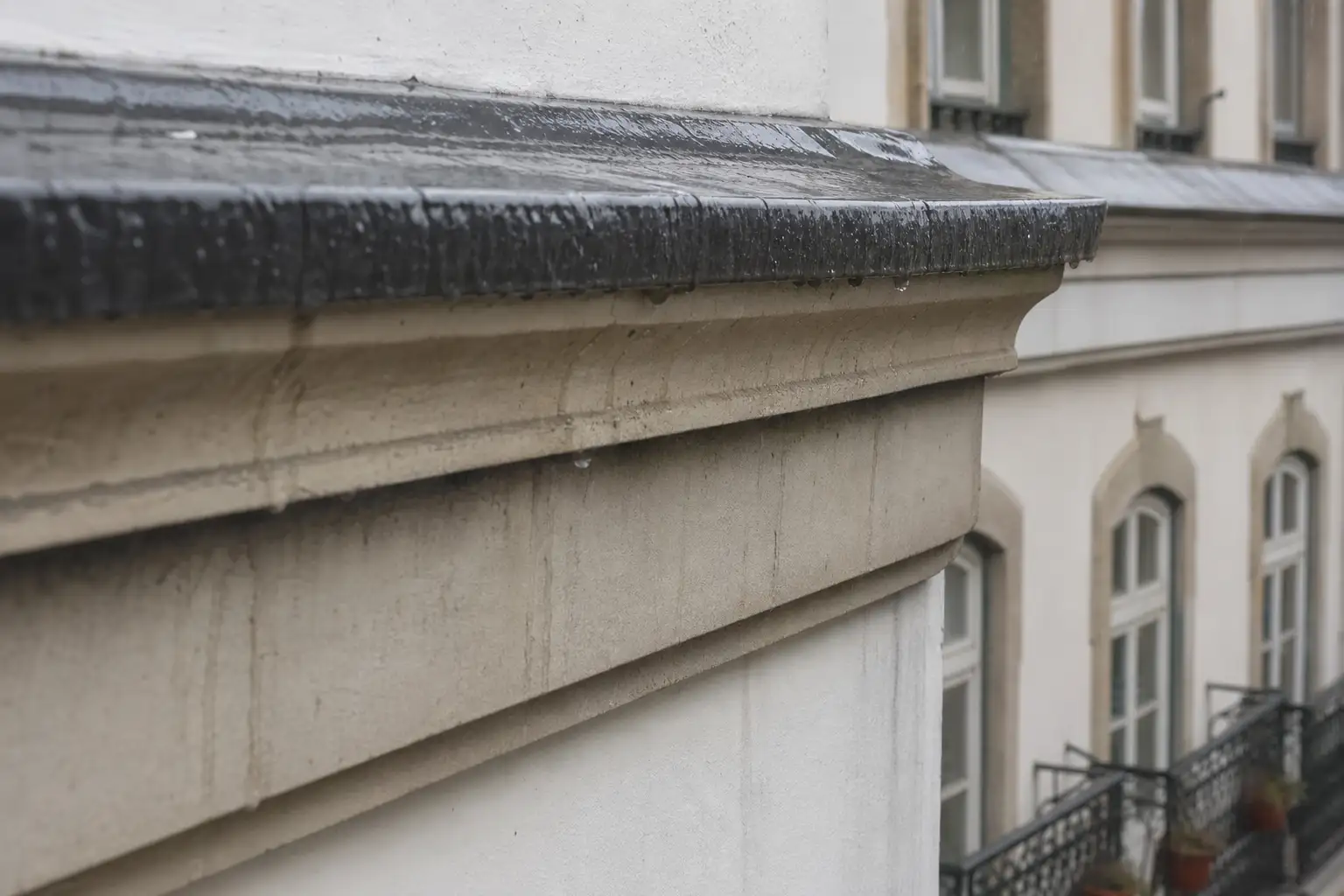
A cornice protects a façade by interrupting rainwater run-off and throwing water clear of the wall plane. On an older Lisbon building, this projecting feature may look decorative, yet it acts like a small roof: it limits repeated washing of render, protects mouldings and creates a clear break between the wall and water arriving from above. When it fails, painting is not the first repair; the water route and intended drainage route need to be understood first.
Contents
- What is a cornice, and where will you find one?
- Why can a small projection change how a wall performs?
- The drip groove: the hidden detail that stops streaking
- Which signs suggest the cornice is no longer doing its job?
- How to repair it without turning the façade into a sealed surface
- What to ask for before approving façade works
What is a cornice, and where will you find one?
A cornice is a projecting horizontal band that finishes a façade near the roof, above a storey or between distinct parts of a building. In Lisbon it is often formed in moulded mortar, stone or prefabricated elements, alongside friezes, parapets and eaves. Its upper face receives rain; its underside should keep that water away from the wall.
The principle is straightforward: water follows gravity, but it also clings to surfaces. When a detail ends flush with the façade, water can curl around its edge and run down the render. A sufficient projection and a groove on the underside help break that route. This is why historic buildings often have horizontal elements that appear more substantial than decoration alone would require.
In sensitive historic settings, the original composition matters. The Baixa Pombalina safeguarding guidance approaches façades as a combination of materials, openings and details, rather than a flat surface to be covered by a generic treatment.
Why can a small projection change how a wall performs?
During rainfall, a façade receives water directly and also water flowing down from higher parts of the building. Without a projecting detail, the water film repeatedly crosses the same joints, cracks and pores in the finish. A cornice reduces the area wetted below it and limits how much water reaches windows, railings and ornaments.
The benefit is greatest on elevations exposed to wind-driven rain. The IPMA climate normals for Lisbon/Tapada show that autumn and winter account for an important share of annual rainfall. That does not make a cornice waterproofing; it makes water management more resilient when the roof, gutters and downpipes work together.
There is also a useful visual effect. The shadow cast by the projection makes the division between façade planes easier to read. Replacing it with a flat layer of render can remove both physical protection and a proportion that organised the elevation.
The drip groove: the hidden detail that stops streaking
Many cornices have, or should have, a small continuous groove on their underside close to the outer edge. This is a drip groove. When water tries to return beneath the projection, it reaches the cut and falls before it can reach the wall.
It is an unobtrusive mechanism, but it depends on continuity. A section filled with mortar, heavy paint or a badly shaped repair may recreate a bridge for water. Before arranging repainting, inspect the piece from below where it is safe to do so, ideally after light rain. Look for dark tracks beneath the cornice, drops returning to the façade or areas where the profile seems to have disappeared.
The same logic applies to window sills and other exposed edges. If windows are being replaced, coordinate the work with window reveals: foam, tape or mortar? so that solving water entry at one point does not create another at the junction with the façade.
Which signs suggest the cornice is no longer doing its job?
Not every stain beneath a cornice is caused by the cornice itself. A blocked gutter, displaced roof tile, open parapet joint or badly directed outlet may be responsible. Even so, several signs justify a technical assessment:
- horizontal cracking where the cornice meets the wall;
- loose render, especially on the underside;
- stains that return after rain along the same line;
- salt deposits, peeling paint or rust marks around metal elements;
- loose fragments, distortion or plants growing from joints.
Where there is a risk of material falling onto the street or a balcony, do not scrape or wash the feature from a domestic ladder. Keep people away from the area and seek an assessment. Prevention also starts above the façade: review eaves, gutters and downpipes before assigning all blame to the visible edge.
How to repair it without turning the façade into a sealed surface
The right sequence is to remove the source of water entry and then repair the damage. Covering cracks with thick paint or applying sealant across the front of a cornice can trap moisture in the substrate, obscure the profile and make later repairs harder.
- Take wide and close photographs, including the roof and nearby downpipes.
- Establish whether water is arriving from above, crossing a joint or tracking over the detail itself.
- Ask for the repair to reproduce the appropriate slope, projection and drip groove.
- Match the repair mortar to the older substrate; an excessively rigid mortar can crack or perform poorly on an older wall.
- Check run-off before final painting, without pressure-washing vulnerable areas.
Where work affects the roof, façade or rainwater systems, it may require specific design input and planning treatment. Lisbon City Council lists rainwater systems, structural design and thermal performance among the specialist projects that may apply depending on the works; check the specialist-projects guidance for the relevant case.
What to ask for before approving façade works
A useful proposal should say more than “repair and paint cornice”. It should identify the areas to be treated, access method, likely water source, substrate preparation, mortar, final profile and arrangements to protect pedestrians, windows and retained elements.
Also request a simple profile drawing or image. It is the easiest way to check that the detail will still throw water clear of the wall. In a condominium building, the façade is generally a shared responsibility: bring photographs, the extent of damage, any falling-material risk and a proposal connecting roof, drainage and wall repair to the decision. This avoids approving a coat of paint for a problem that begins above it.
A cornice performs properly when it remains part of a complete system: a watertight roof, clear drainage, sound joints and a façade able to dry between rainfall events.
Key takeaways
- Inspect the underside of a cornice: a drip groove stops water returning to the wall.
- Do not treat staining beneath a cornice as a paint issue until the roof, gutters and downpipes have been checked.
- A repair should retain or recreate the profile, projection and slope that carry water away from the façade.
If your façade has staining, cracking or deteriorated cornices, gather photographs after rain, including the roof and water outlets. Obra Lisboa can help define a rehabilitation scope with clear works, compatible materials and coordinated site stages.
Sources and further reading
- IPMA climate normals for Lisbon/Tapada
- specialist-projects guidance
- Baixa Pombalina safeguarding guidance
Editorial image; it does not depict an Obra Lisboa project.

Obra Lisboa