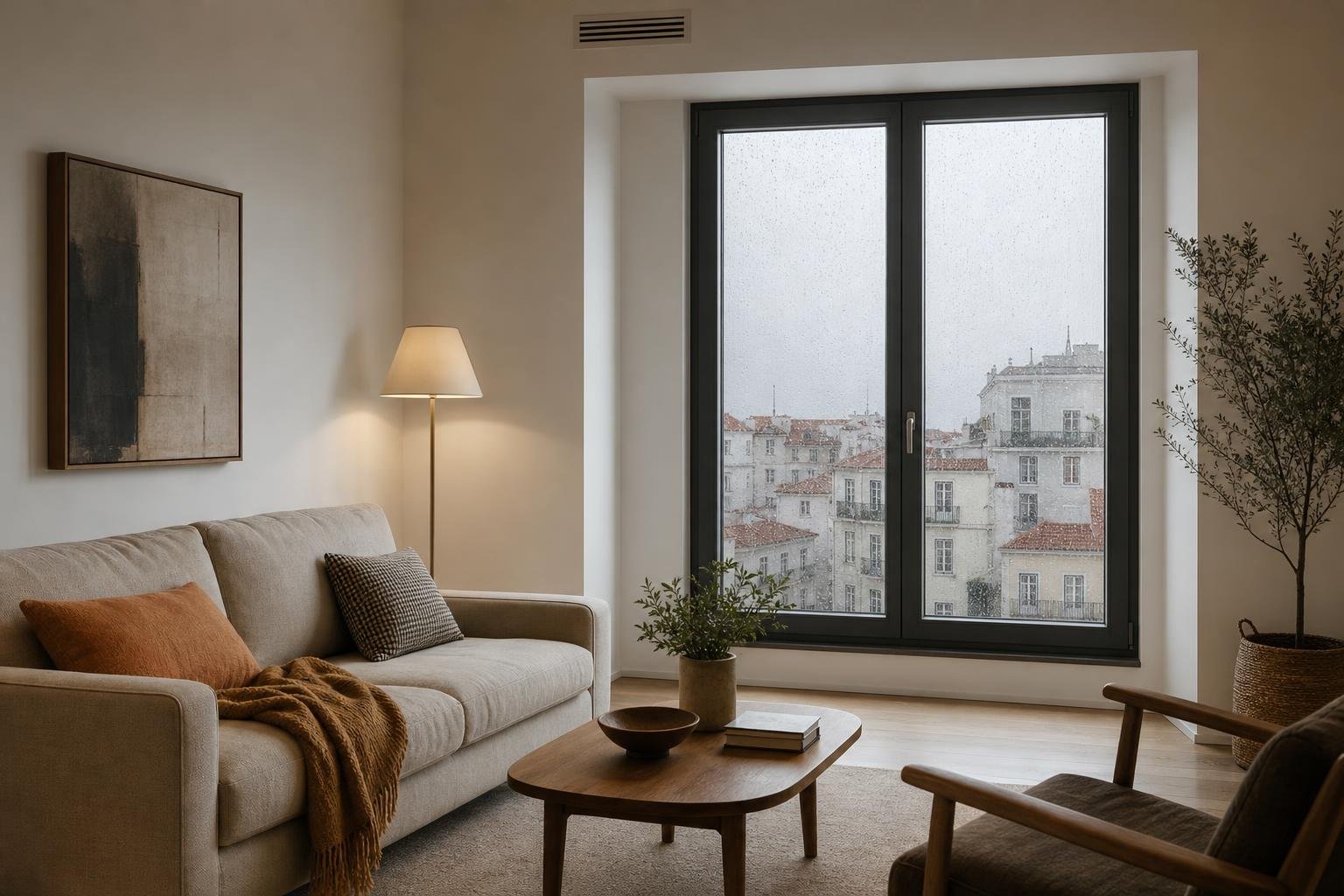
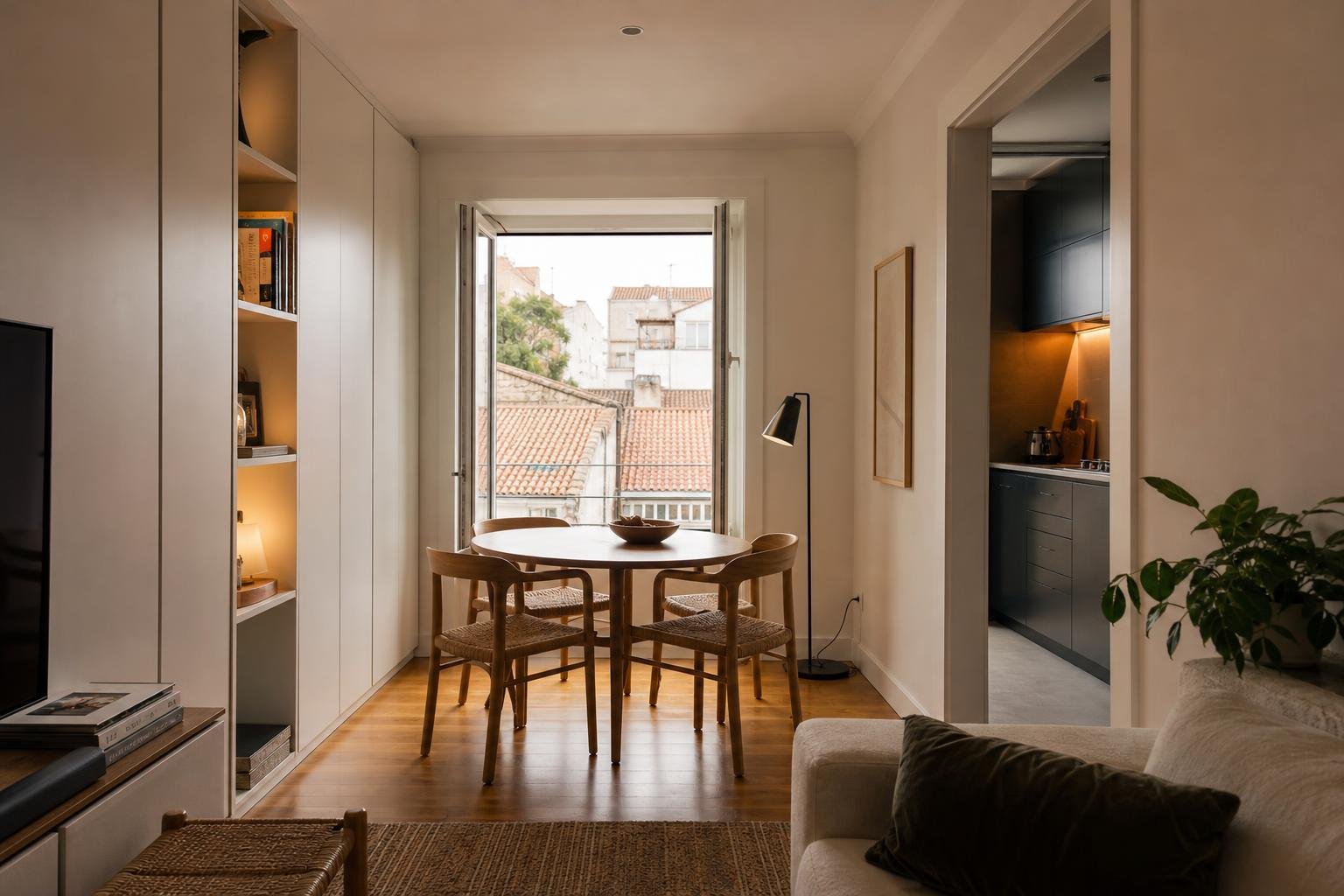
A home workspace stays cooler when the desk is moved out of direct sun, external shading is used before the room heats up and ventilation follows the outdoor temperature. In Lisbon, this matters most in south- and west-facing living rooms, where a computer, monitor and sunlight through glazing can make a few working hours uncomfortable. Before buying another fan or portable air conditioner, get the desk position, solar protection and daily routine right.
Contents
- Find where the heat builds up before moving the desk
- What shading works before heat enters the room?
- Reduce screen glare without blacking out the room
- Ventilate early, late and after cooking
- Your computer, lighting and cables also warm the work zone
- When the answer requires building work — and the right order
Find where the heat builds up before moving the desk
Watch the room through one warm working day. The useful question is not “where does the desk fit?”, but “when does this area receive sun and for how long?”. Lisbon/Tapada climate normals show average maximum temperatures of 28.4 °C in July and 29.0 °C in August; beside an exposed window, the experience can become uncomfortable well before the outdoor temperature peaks. Use the IPMA Lisbon/Tapada climate reference to put seasonal exposure into context.
Keep a simple record for two days: the time sunlight reaches the desk, the temperature by the chair, the temperature on the opposite side of the room and any screen reflections. No specialist kit is required; an indoor thermometer is more useful than guessing. If the work area warms noticeably before the rest of the room, deal with solar gain at the opening before considering mechanical cooling.
- Avoid placing the monitor directly in front of a window: it causes glare and usually leads to over-closing the shading.
- Do not sit with the window directly behind you without a blind or curtain: light hits the screen and radiant heat reaches you.
- Where possible, position the desk perpendicular to the window and set it back from the glass.
- Do not place tall furniture against the room’s only useful opening; it reduces distributed daylight and limits air movement.
In a one-bedroom flat, this may simply mean turning the desk, replacing a wide bookcase with lower storage or using a narrow console. It is a small change with a substantial effect on everyday use.
What shading works before heat enters the room?
The most effective approach stops solar radiation before it crosses the glass. Shutters, exterior blinds, roller shutters and awnings do that job; an internal curtain improves visual comfort but receives heat after it has entered. Portugal’s health authority advises lowering shutters or closing blinds during the hottest period, then allowing air circulation in the evening when outdoors is cooler. See the DGS guidance on keeping homes cooler.
For a workspace, choose a solution that can do two things: block direct sun and preserve useful daylight. Keeping a roller shutter fully closed all morning can force artificial lighting and make the room unpleasant. Try lowering it to just above eye level, or tilt slats so they block high sun while leaving the ceiling bright.
Where the façade and condominium rules allow it, a retractable exterior awning can help at a strongly west-facing window. Before installation, confirm the fixing, wind resistance, retracted position and whether the proposal changes the building’s external appearance. In a rented flat, begin with a reversible, approved option. Window film should only be selected after checking the glazing type, warranty and likely effect on daylight.
Do not rely on paper, cardboard or blankets taped to the glass as a permanent answer. They remove daylight, can hold moisture around the frame and leave the room difficult to use in winter.
Reduce screen glare without blacking out the room
Glare often makes people close the blind completely even when the room is not yet hot. Separate light control from heat control instead. A translucent screen or pale fabric curtain can diffuse side light; external shading deals with direct sun; an adjustable task light prevents harsh contrast between the screen and surrounding walls.
Set the monitor so that the window is to one side. Tilt the display slightly if needed and avoid highly glossy desk surfaces. A matt desktop, a softly coloured wall behind the monitor and a task lamp aimed at the work surface are generally more effective than raising the screen brightness.
If you are renovating, provide power and data at the wall that allows this side-on arrangement. That stops the desk being pushed against the window merely because it is where the socket happens to be. When reviewing new windows or internal insulation, coordinate furniture with the junction details. Our guide to new windows and internal insulation details explains why window reveals and junctions deserve attention before the work is closed up.

Ventilate early, late and after cooking
Ventilation is not an instant cooling switch. Opening windows when the air outside is hotter can add to the room’s heat load. On warm days, air the home early, reduce solar gains before the façade warms up and open again in the evening or at night only if outdoors is genuinely cooler and noise and security allow it.
ADENE identifies shading as a way to limit solar gains and natural ventilation as a way to remove built-up heat, particularly at night when outdoor temperatures are lower than indoor temperatures. Read ADENE’s explanation of summer thermal comfort. In a flat with opposite façades, open two windows briefly to create a controlled cross-breeze. In a single-aspect home, open the more protected window and use a fan to move indoor air, rather than necessarily aiming it at your face for hours.
Keep the kitchen door closed while the oven is on if the workspace is in the adjoining living room. After cooking, use suitable extraction and air the cooking area; moving steam and heat into the workspace worsens thermal comfort and can raise humidity. Ventilation remains possible during rain, but should be brief, directed and compatible with water entering through the opening. See also our guide to ventilating a Lisbon flat when it rains.
Your computer, lighting and cables also warm the work zone
A work room collects many small heat sources: a charging laptop, external monitor, router, printer, chargers and lighting. They are rarely the main reason an exposed room overheats, but they matter in a compact space where windows remain shut during the hottest hours.
- Unplug chargers and peripherals that are not being used.
- Do not hide power bricks, extension leads or power strips under rugs or inside unventilated boxes.
- Keep the laptop away from the wall and do not block its air intakes.
- Use LED task lighting rather than lighting the whole room when working alone.
- If several plugs share one outlet, plan a fixed electrical solution during a future renovation instead of adding adapters.
Do not counter electrical overheating with an overloaded extension lead for more equipment. If an outlet is hot, loose, smells burnt or trips the circuit breaker, stop using it and ask an electrician to check it.
When the answer requires building work — and the right order
If the room remains too hot after correcting shading, position and routine, work in layers. First check for excessive sun exposure, degraded window frames, an uninsulated shutter box or failed seals. Then assess external shading, glazing improvements and insulation to sun-exposed opaque surfaces. Only after that should you size air conditioning or another active system; this avoids installing a larger unit to compensate for an envelope problem.
The DGS notes that children, older people, people with chronic illnesses and people living in poor housing conditions are especially vulnerable to heat. During heatwaves, comfort is not merely a convenience: organise a cooler room, check on vulnerable people and use an air-conditioned public or private space if the home cannot provide safe conditions. The DGS heatwave recommendations set out that priority.
Bring in a professional when you plan to change windows, fit fixed façade shading, create openings for mechanical ventilation, alter the electrical panel or install air conditioning. These decisions combine performance, condominium rules, condensate drainage and electrical safety. The aim is not to turn a whole living room into a technical office; it is to keep the place where you work for several hours each day usable through summer.
Key takeaways
- Set the desk perpendicular to the window and move the monitor out of direct sun.
- Lower shutters, blinds or external shading before the room has warmed up.
- Ventilate early and again in the evening when outside air is cooler.
- If façade work, new windows or electrical circuits are involved, plan them before renovation starts.
If you are renovating a living room, bedroom or enclosed balcony to create a more comfortable summer workspace, ask Obra Lisboa for a renovation proposal that sets out shading, outlets, lighting and window decisions before work begins.
Sources and further reading
- DGS guidance on keeping homes cooler
- DGS heatwave recommendations
- IPMA Lisbon/Tapada climate reference
- ADENE’s explanation of summer thermal comfort
Editorial image; it does not depict an Obra Lisboa project.

Obra Lisboa