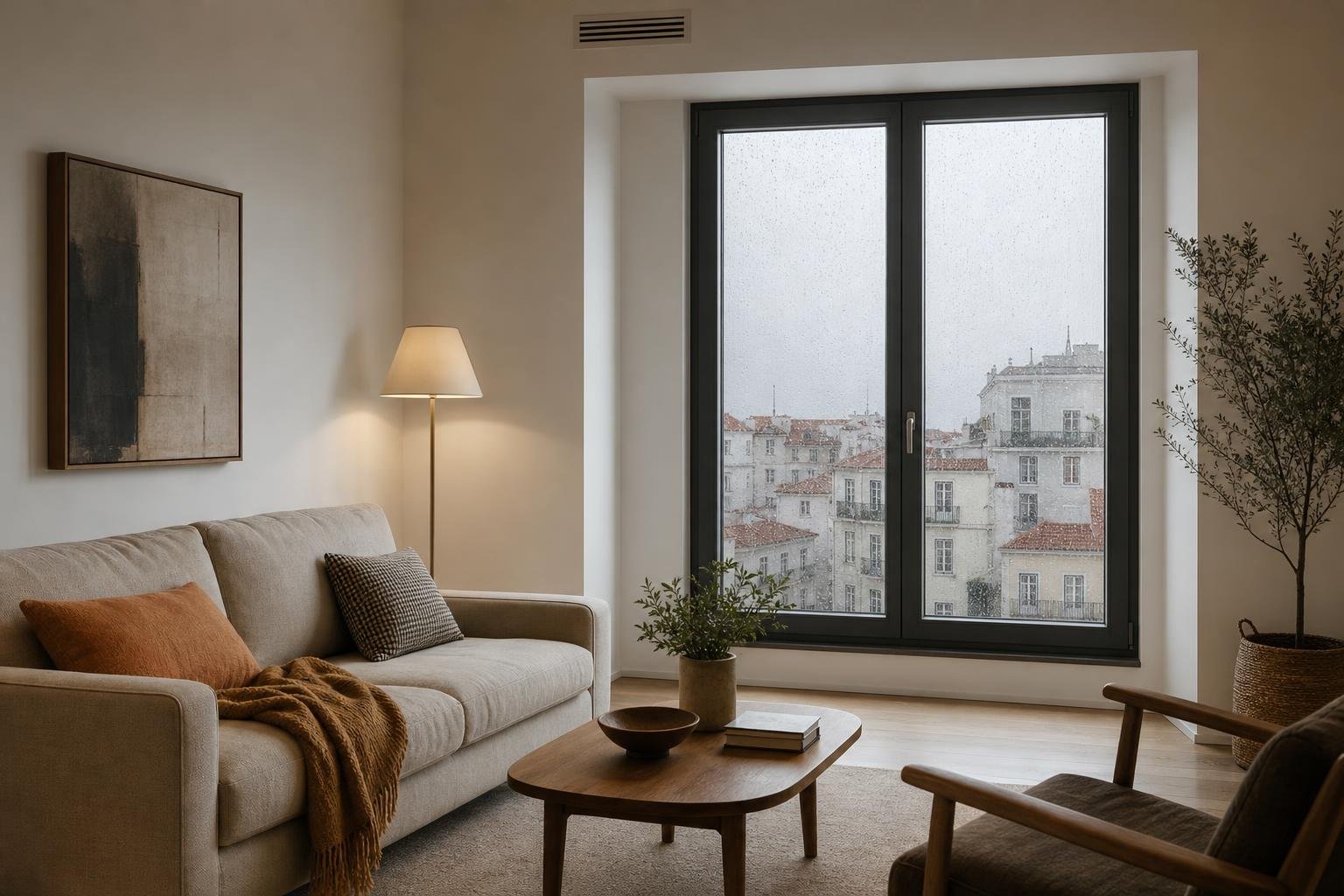

A tile that sounds hollow, moves, or has a crack at its edge should be treated as a possible falling hazard, especially on a façade or balcony above a route used by people. Do not try to glue it from street level or push it to “test” it. Keep people away from the area below, record the condition in photographs, and arrange a technical assessment where tiles are high up, cracks, rust, recurring damp or several affected areas are present. In Lisbon, the issue may concern the individual flat, the shared façade and, in protected buildings, a specific approval route.
Contents
- Which signs suggest that a tile may come loose?
- What to do in the first few hours without making the hazard worse
- Why do façade tiles come loose?
- What a durable repair diagnosis should cover
- What belongs with the condominium decision?
- When to call a professional before the next meeting
Which signs suggest that a tile may come loose?
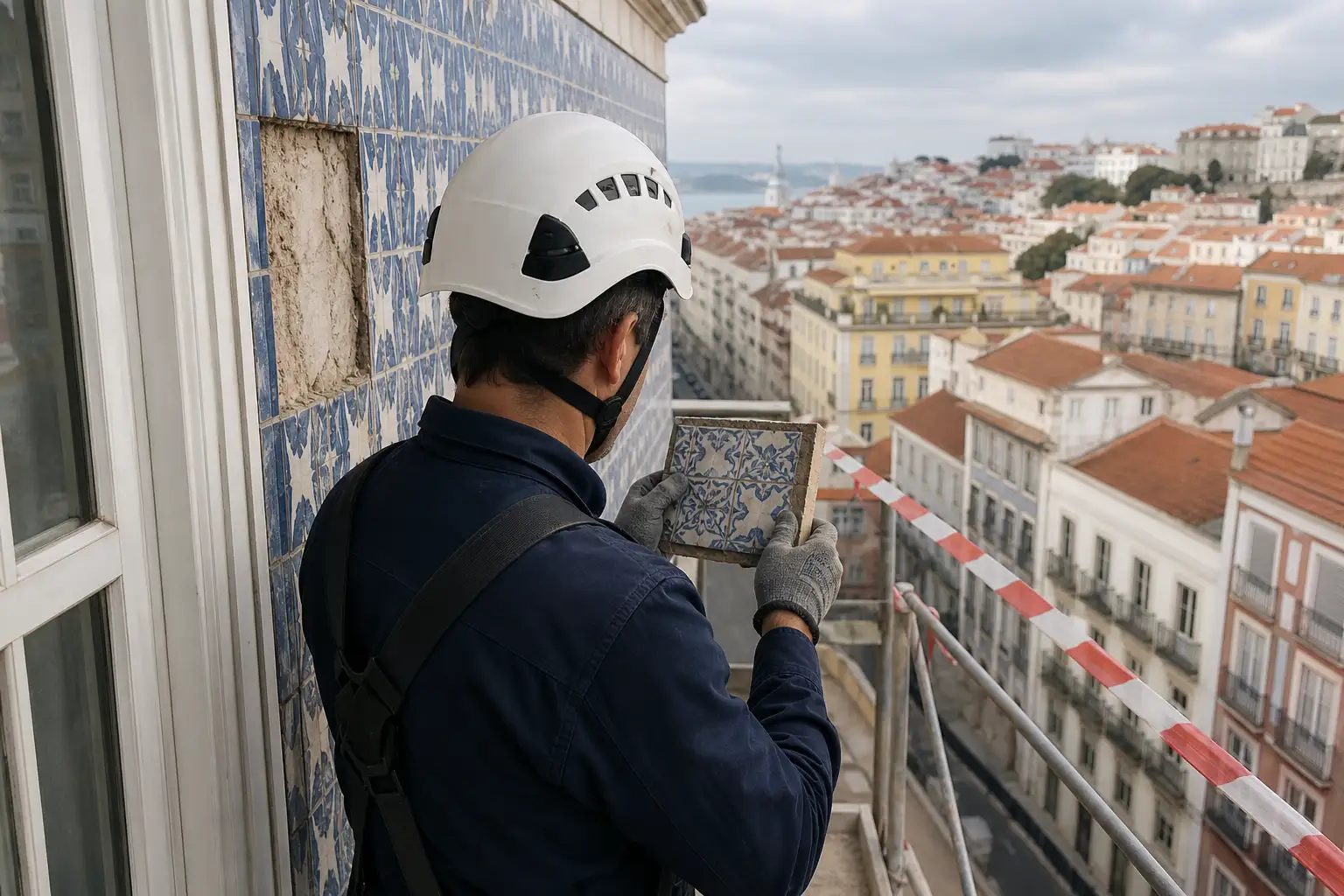
A dark grout joint does not automatically mean that a tile is about to fall. Risk rises when several signs appear together: a hollow sound from a light tap, a misaligned tile, a lifted corner, a crack running through the tile, open joints, damp marks, or small fragments found on the ground. On balconies, also inspect the junctions at the guard, threshold and drain, where water can reach the back of the finish.
Carry out a visual check from a safe position. Do not climb a ladder on a balcony or lean out to inspect a façade. Photograph the area with a scale reference and note whether the defect appeared or worsened after rain and wind. IPMA weather-warning criteria for rain and wind can help you decide whether to postpone exterior checks or work at height.
- Local sign: one cracked or loose tile may need controlled removal and a compatible replacement.
- Repeated pattern: many hollow tiles, open joints or damp marks suggest an underlying cause.
- Immediate risk: moving tiles, fragments on the pavement or protruding pieces call for restricted access and prompt help.
What to do in the first few hours without making the hazard worse
The first aim is to stop anyone walking or standing below a potentially unstable area. Within the property, move chairs, pots and storage away from the vertical line of the defect. If the affected area is above public space, do not improvise tape, scaffolding or pavement occupation: protection may need coordination between the condominium, repair contractor and municipality.
- Do not hit tiles, drill joints or use silicone or expanding foam to “hold” them in place.
- Close balcony access if loose tiles are on the floor, around the guard or on the outer face of a parapet.
- Notify the building manager in writing when the façade, gable or guard is a common element.
- Keep dated photographs and record rain, water ingress or fallen fragments.
- Where there is a danger in a street or access route, use Lisbon City Council’s safety intervention request service, which includes degraded buildings and walls.
A fallen tile does not automatically solve the problem: it may have left a route for water into the substrate, while nearby tiles may also have lost adhesion. Start with the cause, rather than choosing an adhesive.
Why do façade tiles come loose?
Water is a frequent cause, though it rarely acts alone. Ageing sealant, cracks in render, leaking rainwater pipes, poor threshold details and open joints can wet the substrate behind the tiles. Through wetting and drying cycles, thermal movement and salts carried by moisture, adhesion can deteriorate. A previous repair made with an overly rigid or incompatible mortar can also concentrate stress.
In older Lisbon buildings, look above the damaged area: a gutter, cornice or higher crack may explain the water that keeps returning. See our article on cornices on historic Lisbon buildings to understand why upper details matter for protecting a wall.
Do not assume that the issue is simply “not enough glue” without checking the substrate. If render is powdery, detached or damp, bonding a new tile over it creates a repair that may look sound briefly while concealing the defect that needs attention.
| What you can see | Issue to confirm | Prudent response |
|---|---|---|
| One isolated cracked tile | Local impact or a one-off movement | Prevent touching and have the fixing and substrate assessed |
| Open joints and marks after rain | Water entry through a detail, crack or roof area | Trace and repair the water route before replacing tiles |
| Several hollow or misaligned tiles | More extensive loss of adhesion | Plan a zone-by-zone technical survey; do not randomly chip away |
| Fragments on the ground or protruding tiles | Falling risk over a route | Restrict access and report the issue urgently |
What a durable repair diagnosis should cover
A useful assessment starts by mapping the extent of the issue and identifying the finish, substrate and water-entry routes. It may require close observation, adhesion checks by someone able to interpret them, and controlled opening of a small area. The answer is not always to replace an entire façade: it can be possible to retain much of the finish and intervene only where adhesion and the backing have failed.
Ask for the proposal to distinguish clearly between protection of people and property, access at height, removal of unstable tiles, substrate repair, waterproofing or correction of details where needed, replacement tiles, jointing and final cleaning. For historic tiles or a protected property, confirm the planning route first. Lisbon City Council’s page on conservation-work licensing explains that listed buildings, buildings under listing consideration and protected settings have specific control.
Do not accept a vague scope such as “repair loose tiles”. It does not state how damp will be addressed, what will be used to repair the substrate, how public space will be protected or how neighbouring tiles will be checked for stability.
What belongs with the condominium decision?
On an apartment building façade, the external finish will usually be a common-part matter, even if the stain is only visible from one flat. Prompt communication prevents a small defect becoming a dispute about origin, access and responsibility. Send the manager photographs, the exact location and a clear note of any risk to people or property.
The duty to maintain a building does not disappear because the defect lies outside one flat’s window. The conservation framework published in the Diário da República connects maintenance with safety, health conditions and proper use, and names façades, roofs, plumbing and stairs among the elements to be repaired.
If the work affects a façade, balcony, roof or needs scaffolding, deal early with the resolution, access to flats and protection of shared areas. To organise a decision without leaving urgent work undefined, see our guide to planning maintenance for an old building.
When to call a professional before the next meeting
Call for professional help urgently where tiles are detaching, fragments are on the ground, tiles are bulging, there are broad cracks in the substrate, visible rust, active water ingress behind the finish, or a hazard above an entrance, pavement, parking space or used balcony. It is also sensible to stop any work that is vibrating, drilling into or loading a wall where the finish already shows signs of instability.
Do not use ladders, ropes or window access to repair a façade. Height, falling materials and the likelihood of damaging adjacent tiles turn a seemingly small repair into work requiring a method, protection and appropriate access equipment. Once repaired, add regular visual checks of details, joints and rain-exposed areas; correcting an early water entry is far easier than recovering a whole section of finish.
Key takeaways
- Keep people clear and avoid touching tiles that move, sound hollow or have already shed fragments.
- Find the water route and assess the substrate before deciding how tiles will be replaced.
- Notify the condominium early when the issue affects a façade, guard or other common element.
- Where the risk is above a pavement or entrance, prioritise protection and reporting over an improvised repair.
If you are preparing a façade repair or a renovation involving balconies and exterior details, ask Obra Lisboa to include the substrate, drainage and access checks in the scope before the work is defined.
Sources and further reading
- safety intervention request service
- conservation-work licensing
- IPMA weather-warning criteria for rain and wind
- Diário da República
Editorial image; it does not depict an Obra Lisboa project.

Obra Lisboa