

A freshly painted façade or an apparently new roof does not, by itself, reduce the buying risk: before making an offer, request the meeting minutes, accounts, contract and handover documents for the common-area works. These records show whether the intervention was merely cosmetic, whether a phase remains unfinished and whether payments, defects or disputes are still open. In a Lisbon building, this matters particularly where the works involved façades, roofs, risers, balconies or a lift.
The legal starting point is straightforward: costs needed for the upkeep and enjoyment of common parts are generally borne, in proportion to unit value, by the owners at the time the resolution was passed. Read the applicable wording in the horizontal property rules published in the Diário da República. That does not remove the need to state responsibilities clearly in the promissory contract and deed.
Contents
- Why recent work can still create a buying risk
- Which meeting minutes should you request — and how should you read them?
- Which accounts and evidence reveal the real liability?
- Warranties, defects and who can make a claim
- Are there permits, notices or designs to check?
- How to turn the information into a careful offer
Why recent work can still create a buying risk
Recent common-area work can be good news: it may have addressed leaks, protected deteriorated elements or upgraded a shared installation. It can also be an incomplete decision. A façade may have been painted without resolving cracks or window junctions; roof waterproofing may have been approved without dealing with every access point, drain or reinstatement; work on service risers may have left some flats unconnected.
Do not judge the work by its age or appearance. Ask what defect was identified, which solution was approved, which areas were excluded from the contract and who confirmed handover. If the listing says “building recently refurbished”, ask for an objective description of the work and the date of the handover record, final invoice or closing minutes.
Where work affects a façade, balcony, roof or other common part, Lisbon’s urban-planning documentation itself calls for the condominium’s authorising minutes. See the municipal list of documents for works affecting common areas. Minutes alone do not prove that the work was properly carried out; they show that there was a decision to examine.
Which meeting minutes should you request — and how should you read them?
Request at least the minutes approving the work, later minutes approving changes or additional payments, and the most recent annual meeting minutes. Where possible, request the meeting notice and the attachments circulated to owners. Brief minutes often refer to quotations, reports or payment schedules containing the decisive information.
- Identify the scope: “façade repairs” is too broad; look for areas, materials, defects and limits.
- Check the financial resolution: approved value, allocation method, instalments and any reserve fund used.
- Look for variations: establish who authorised them and whether the final figure was recorded.
- Read outstanding matters: continuing leaks, inaccessible areas, units not included or defect complaints require technical clarification.
Compare dates. Work approved two years ago, started much later and still not handed over may affect the building’s use and your budget flexibility. For a practical view of useful resolutions, read how to prepare condominium minutes for approving works.
Which accounts and evidence reveal the real liability?
Ask the seller for a statement from the administrator covering unpaid condominium charges, approved extraordinary instalments and amounts still to be collected. Also request the accepted quotation, measurement or certification records where they exist, invoices, proof of payment and the schedule showing the amount allocated to the unit. You do not need to turn the purchase into an audit; you need to know whether the asking price includes a paid-for improvement or an obligation that will still fall due.
Use two columns in your purchase file: approved but unpaid liabilities and foreseeable costs only. The first group should be dealt with in the promissory contract, with an amount, liable party and proof of settlement. The second may include a second phase mentioned in minutes, a report recommending future intervention or work whose warranty claim is still being discussed.
Do not mistake the common reserve fund balance for an available works budget. It may be earmarked, insufficient for the next repair or simply not approved for that purpose. The guide to an older Lisbon building maintenance plan helps separate urgent repairs, meeting decisions and municipal checks.
| Document | What to confirm | Warning sign |
|---|---|---|
| Approval minutes | Scope, value, ownership share and payment method | Generic scope or uncapped cost |
| Quotation and changes | Contracted solution and exclusions | Extra work without a clear resolution |
| Invoices and payments | Final value and instalments still due | Unexplained difference between approval and total |
| Recent minutes | Defects, complaints and next works | Repeated issue or a new phase announced |
Warranties, defects and who can make a claim
Request the building contract, handover record, snagging list and correspondence about remedial work. The purpose is not to assume that a warranty automatically transfers to every buyer: it is to establish who contracted the work, what was agreed, the handover date and whether the condominium notified defects within the applicable time limits.
For private works, a written building contract must identify the parties, contractor qualification, scope, value, completion period and payment terms when it exceeds the legal threshold indicated by IMPIC. See the IMPIC explanation of private building-contract requirements. Request the identity of the company that carried out the work and check whether the records identify subcontractors, materials or systems with their own warranties.
If there is water ingress after recent roof work, cracking beside a refurbished façade or an unresolved complaint, do not accept “it is under warranty” as a verbal answer. Request the notice sent, response received and meeting decision. If the issue affects the flat you plan to buy, make your offer conditional on documentary clarification and, where needed, independent technical advice.
Are there permits, notices or designs to check?
Not all maintenance work follows the same planning route. The nature of the work still matters: alterations, extensions and certain interventions may require prior communication, designs and technical responsibilities. Lisbon City Council explains that works covered by prior communication may start after a correctly submitted process and payment of the relevant fees, with the filing receipt forming part of the relevant record. See the municipal page on building works subject to prior communication.
Request the file number, applicable receipt and project documents when the work changed elements that may affect legality, safety or use: enclosed balconies, roof changes, new openings, substantial façade work or conversion of spaces. If the records do not match what you see in the building, pause the assumption that the work automatically “adds value” until the mismatch is resolved.
How to turn the information into a careful offer
Before signing, create a one-page decision sheet with four fields: work completed, documents received, outstanding costs and questions that remain as conditions. You do not need to forecast every future building issue; you do need to stop known information from being omitted from the price and contract.
- State in the promissory contract who pays each extraordinary instalment already approved.
- Attach or identify the no-debt statement and the works documents.
- If defects are being corrected, define evidence of completion before the deed, or an agreed retention with legal advice.
- Keep a margin for future work already anticipated in the minutes; do not treat it as a zero-cost item.
If the documents arrive incomplete, do not replace facts with an arbitrary price reduction. First define what is missing and who can provide it: administrator, seller, contractor or council. For your own refurbishment scope, also review construction costs before appointing a contractor, without mixing the flat’s budget with liability already assumed by the condominium.
Key takeaways
- Request minutes, quotations, payments and handover records; a renewed façade is not a substitute for them.
- Separate approved instalments from future risks, and put known liabilities in writing in the promissory contract.
- A warranty only helps when you can identify the contract, handover date, notified defect and responsible party.
- If the documents do not explain the work, make that gap a purchase condition rather than a minor detail.
Buying and renovating a Lisbon flat? First organise the building documents and the scope inside the unit; then ask Obra Lisboa for a renovation proposal based on verifiable decisions, without confusing condominium works with work inside your home.
Sources and further reading
- horizontal property rules published in the Diário da República
- building works subject to prior communication
- municipal list of documents for works affecting common areas
- IMPIC explanation of private building-contract requirements
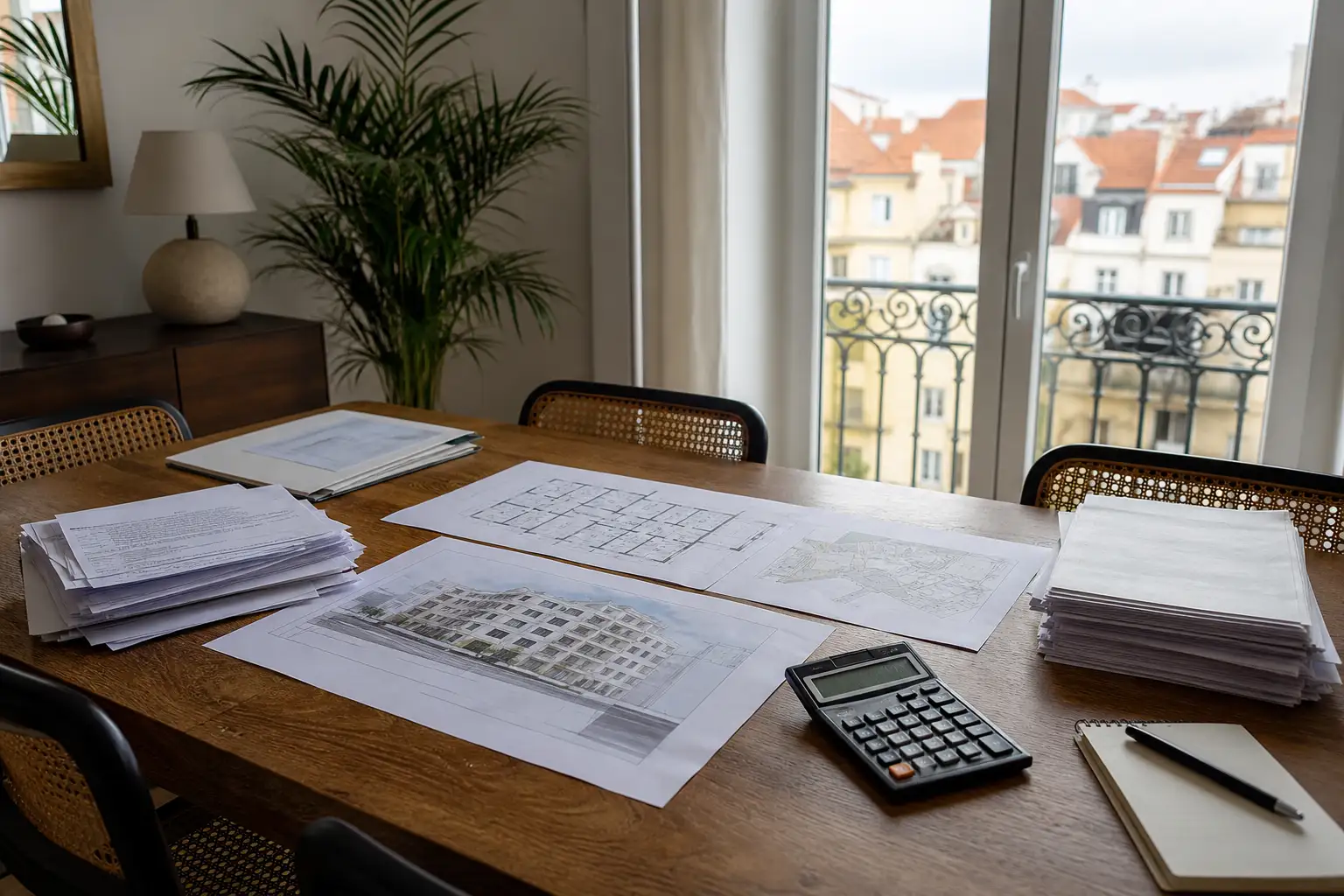
Editorial image; it does not depict an Obra Lisboa project.

Obra Lisboa