A temporary cable should never cross a shared stair, landing or corridor as though it were harmless. During an apartment renovation, temporary power must keep routes clear, avoid improvised connections and leave doors, meters and emergency equipment accessible. Before the first delivery or demolition task, decide where power will come from, where the cable will run, who checks it each day and when it will be removed.
Contents
- Why a cable on a landing quickly becomes a safety issue
- Decide where temporary power will come from first
- Which routes are acceptable in corridors and stairways
- Fire doors, technical cupboards and exits are not storage points
- A daily routine: four checks before locking up
- When to stop work and call a professional
Why a cable on a landing quickly becomes a safety issue
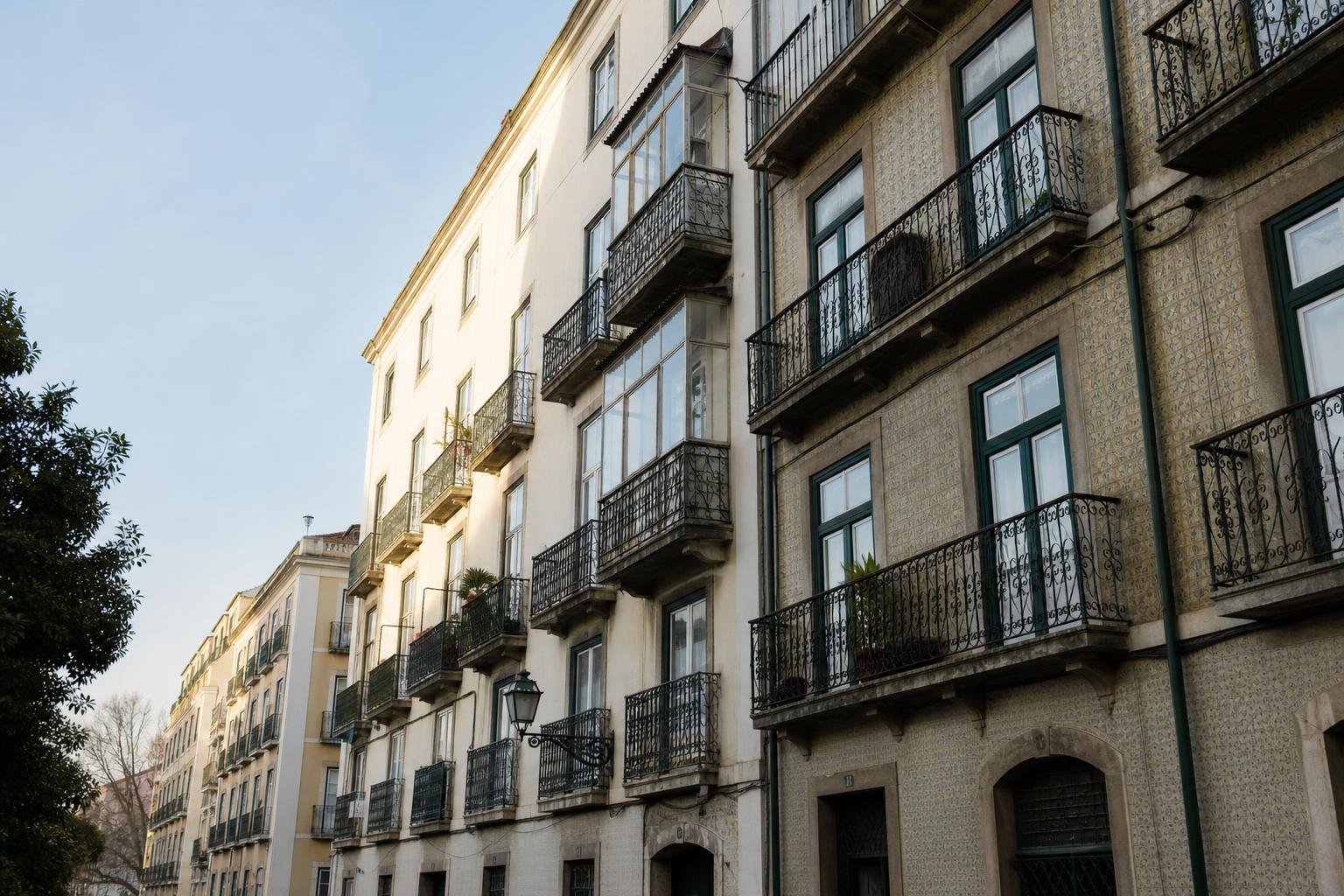
An extension lead left on the floor may look temporary until someone trips, a materials trolley crushes it or a door can no longer close. In older Lisbon apartment buildings, landings are often narrow, serve several homes and concentrate letterboxes, meter cupboards and changes of direction. That makes any obstruction more serious than it would be on a self-contained site.
There is an electrical risk as well. Loose plugs, multiple adaptors and cables damaged by wheels, sharp edges or moisture are not an acceptable way to run site tools. Portugal’s health authority advises care to avoid overloading an electrical panel when using heating equipment; the same principle applies to high-demand tools connected to a domestic installation whose capacity has not been confirmed. See the DGS guidance on using electrical equipment safely.
The aim is not to hide the cable. It is to remove the hazard from the route: an escape route must remain obvious, unobstructed and usable even when work has stopped.
Decide where temporary power will come from first
The safest decision is made before the first trade arrives. Establish whether electricity will come from the flat’s meter, from a temporary distribution board inside the flat, or from a shared supply expressly authorised by the condominium. Do not assume that an outlet in the entrance hall, garage or storage area can be used for the works.
- Obtain confirmation of the power point and who is responsible for the installation.
- List equipment likely to run at the same time: lighting, an industrial vacuum, drill, mixer, saw or chargers.
- Set out suitable protection at the board and a simple method for isolating power at the end of the shift.
- Avoid adaptor chains and extension leads joined together simply to reach the flat.
Rules for electrical installations in publicly accessible spaces and escape routes state that moveable wiring must not obstruct circulation and should be kept as short as possible. Read the relevant framework in the Portuguese safety regulation for private electrical installations, particularly where power must pass beyond the flat entrance.
If there is any doubt about capacity, protection or the condition of the board, bring in a qualified electrician before connecting higher-power tools.
Which routes are acceptable in corridors and stairways
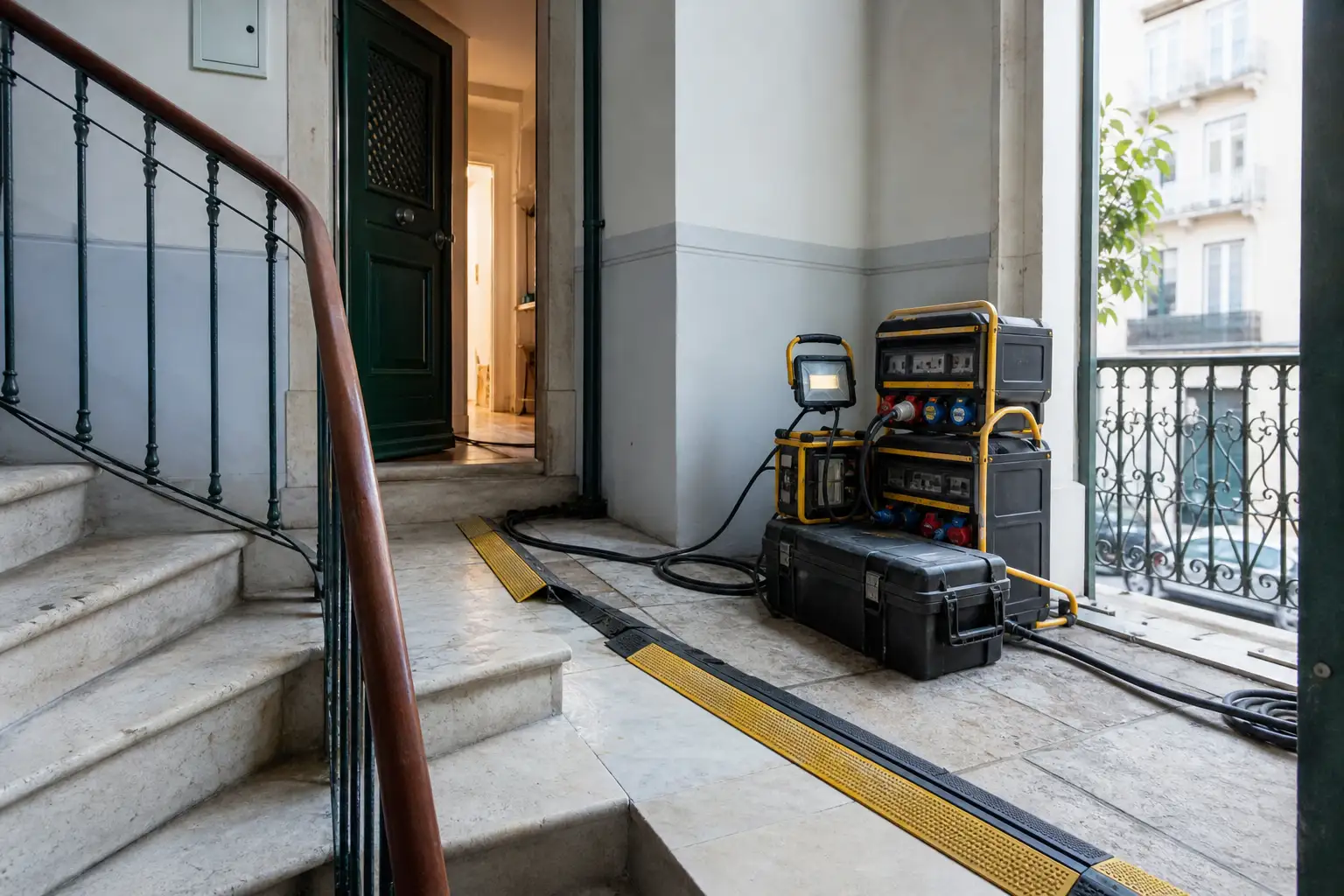
The best route is no route at all: put the temporary board and distribution inside the flat as soon as possible. When an external run is unavoidable for a short task, keep it close to a wall and away from door openings, steps, changes of level and the natural line of travel.
A cable should not be hung from handles, handrails, pipes, grilles or fire doors. It should not be trapped beneath a door either; repeated pressure damages the sheath and may prevent the door from closing fully. On stairs, the practical rule is simple: no cable on the tread, riser or handrail.
Use suitable mechanical protection where a cable must briefly pass through an area used by people, remove it when the task ends and visually inspect it before normal circulation resumes. Do not improvise with ordinary tape, cardboard or timber offcuts: they come loose, collect dust and create another uneven surface.
If the route affects an escape path, treat it as an exception to eliminate, rather than a site arrangement that can remain in place for weeks.
Fire doors, technical cupboards and exits are not storage points
A renovation must not turn safety features into supports for tools, cable reels or extension leads. Keep fire doors, technical cupboards, electrical boards and existing extinguishers clear and accessible. In an incident, losing time moving materials or finding a key is an organisational failure, not a minor inconvenience.
The technical fire-safety regulation includes specific conditions for electrical boards located on escape routes and requires equipment to be operable and identifiable. See the applicable text in the Portuguese Technical Fire Safety Regulation for Buildings. For residents, the practical consequence is straightforward: do not cover, improvisedly lock or narrow access to these items.
Before work begins, photograph the landing, stair door, meter cupboard and entrance area. Use the image to set a materials boundary and to confirm each day that the route has been returned to a clear condition.
Also read our guide to where to keep a home fire extinguisher and when to leave: an extinguisher does not make up for a blocked route or poorly organised electrical work.
A daily routine: four checks before locking up
Temporary-cable safety depends more on routine than on an initially tidy installation. The person responsible for the works should check the route at the start of the day, after every delivery and before leaving the building.
- Condition: no cuts, crushing, bare insulation, hot plugs or exposed joins.
- Clear passage: doors close, stairs and landings are free, and handrails can be used without obstruction.
- Access: boards, meters, extinguishers and exit doors remain reachable.
- End of shift: tools are switched off, extension leads are removed when no longer required, and the area is clear of dust, water and packaging.
Avoid leaving chargers, temporary lights or tools energised overnight without a clear need. If a specific item needs a continuous supply, that should be a considered technical arrangement with a suitable installation and defined supervision, not an extension lead forgotten in the corridor.
Where neighbours need to be involved, include this rule in the works notice. Our article on condominium documents to request before renovating can help prepare that discussion with useful information about the building and its shared areas.
When to stop work and call a professional
Isolate the power and do not attempt a repair if there is a burning smell, unusual heat at a plug or cable, sparking, a breaker that repeatedly trips, water near the installation or visible damage to the insulation. Do not wrap a warming area in tape, and do not fit a higher-rated fuse or breaker simply to make a tool keep running.
You should also stop if the only way to maintain power is to cross a stair, obstruct a fire door or connect repeated extension leads. At that point, this is no longer a housekeeping issue: the temporary-power arrangement needs redesigning.
For basic home checks, learn how to test a home RCD using its test button, but do not confuse that test with an inspection of a site installation. An RCD that trips gives useful information; it does not identify the cause of a fault or make a damaged extension lead safe.
The next step is to draw the temporary route into the site plan, name the person who checks it and remove it as soon as internal power is operational.
Key takeaways
- Do not run a cable across stairs, landings or door openings, even for a few days.
- Set the source, protection and responsible person for temporary power before tools are connected.
- Keep fire doors, boards, meters and extinguishers accessible at all times.
- Burning smells, heat, water or repeated tripping mean isolate the supply and seek technical assessment.
If you are renovating in a Lisbon apartment building, ask Obra Lisboa to include the temporary-power route, shared-area protection and access checks in the site set-up before the first work stage begins.
Sources and further reading
- Portuguese Technical Fire Safety Regulation for Buildings
- Portuguese safety regulation for private electrical installations
- DGS guidance on using electrical equipment safely
Editorial image; it does not depict an Obra Lisboa project.

Obra Lisboa