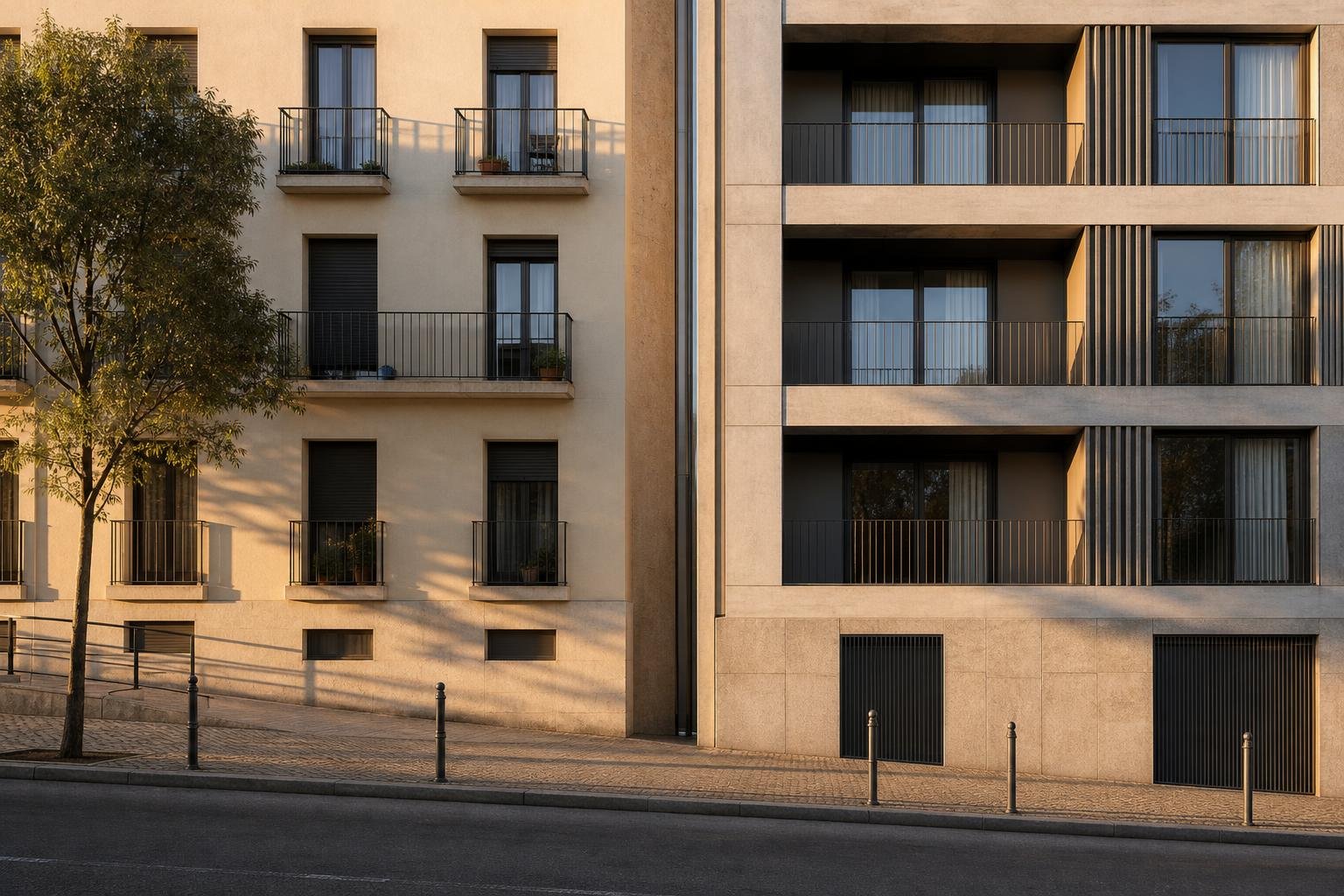
With an exposed brick façade, first establish whether the issue is on the surface, in the joints or behind the wall; cleaning without that diagnosis can trap moisture or speed up deterioration. In Lisbon, wind-driven rain, urban deposits, temperature changes and unsuitable past repairs leave very different marks. A dark patch may only be surface grime; an eroded joint may let water in; a continuous crack may need closer assessment. The right decision avoids replacing sound brickwork and stops a cosmetic repair from concealing a leak.
Contents
- What should you inspect before washing or applying any product?
- When is careful cleaning enough?
- How can joints be repaired without harming the brick?
- Why do salts, stains and flaking bricks appear?
- What condominium and planning checks apply in Lisbon?
- When should you stop and request a technical diagnosis?
What should you inspect before washing or applying any product?
Make the first inspection when the wall is dry and in side light, ideally after several rain-free days. Compare high and low areas, then look closely around window sills, roof details, downpipes and balconies. Photograph each issue with a scale reference and check whether it returns after rain.
- Surface dirt: fairly even darkening, with no loss of material.
- Failing joints: mortar that is powdery, recessed, loose or missing in places.
- Moisture: localised marks, white salt deposits, peeling internal paint or mould on the opposite side.
- Movement: cracks crossing joints and bricks, misalignment, bulging or loose units.
Do not confuse visual ageing with a construction defect. Brick naturally varies in colour and texture; what matters is a recent, concentrated or progressing change. Before work on older walls, it helps to understand how mortar compatibility affects moisture management in mortars for old Lisbon walls.
When is careful cleaning enough?
Cleaning is suitable when the brickwork is firm, the joints remain sound and there is no evidence of water entry. The aim is to remove deposits without wearing away the fired face of the brick or opening the existing mortar further.
Start with the least aggressive method: soft dry brushing in an inconspicuous area and, if required, gentle controlled washing. Avoid soaking a cold wall, working in rain, or aiming strong jets at joints and junctions. Acidic, abrasive or stripping products can change the colour, attack mortar and mobilise salts within the wall.
Local cleaning is also a useful test of what lies beneath. If removing dust and deposits reveals flaking, erosion or broken brick edges, the work is no longer simple maintenance. Stop before applying the same method across the whole façade.
| Observed sign | First decision | What to avoid |
|---|---|---|
| Even darkening with no material loss | Test gentle cleaning in a small area | Direct high-pressure washing |
| Hollow, recessed or powdery joints | Assess whether joints need repointing | Covering them with rigid filler without removing loose material |
| White salts or persistent damp | Find the water source before repair | Painting or waterproofing without diagnosis |
| Continuous cracks, loose units or bulging | Request a technical assessment | Cleaning, chipping or removing loose elements |
How can joints be repaired without harming the brick?
Repointing means removing only mortar that has lost cohesion and replacing it with a mortar appropriate to the masonry. It does not mean covering every joint from the surface. New mortar must bond to the sides of the joint, match the intended finish and behave compatibly with the wall.
- Mark the deteriorated areas and check whether water is entering through roof details, windows or drainage.
- Carefully remove loose mortar; do not widen sound joints merely to create a uniform appearance.
- Clear dust and manage the background moisture before placing new mortar.
- Apply mortar in layers where depth requires it, then finish the joint without smearing the brick face.
- Protect the early curing period from strong sun, rain and excessively rapid drying.
In older buildings, mortar that is too hard can transfer stress to more fragile bricks. It can also make it harder for a wall already receiving moisture to dry. The choice between lime, formulated mixes and cement-based solutions should follow the existing material, façade exposure and brick condition, rather than the colour of a sample alone.

Why do salts, stains and flaking bricks appear?
Salts appear when water carries minerals through a wall and they crystallise as the water evaporates. They may come from the ground, leaks, unsuitable mortars or repeated wetting and drying cycles. Brushing away the deposit can improve appearance, but it does not necessarily remove the water source.
Flaking on the brick face is more serious than an ordinary stain. It may result from prolonged moisture, salts, freezing in colder areas or aggressive past intervention. Where material is being lost, isolated replacements should respect the size, tone and absorption of existing units. Introducing very dense bricks into an older wall can create drying differences and leave the repair visibly distinct for years.
Always inspect the places designed to throw water clear: drips, sills, copings, window seals, gutters and downpipes. The wall itself is rarely the only source of the problem.
What condominium and planning checks apply in Lisbon?
A façade is usually a common part of an apartment building. Even when the issue is visible from one flat only, the intervention should be coordinated with the condominium. For work affecting common parts, the municipal supporting-document list for conservation works states that condominium approval minutes should be submitted where applicable; see the Lisbon City Council supporting-document list.
For listed buildings, buildings being considered for listing, or properties within protected groups and sites, conservation works require a licence. The Council sets out the framework and procedure in Conservation works — licence. Certain local planning rules also set architectural integration requirements, including limitations on exposed cement solutions and imitation materials, in regulations published in the Diário da República.
Before ordering cleaning, scaffolding or materials, check whether the building has heritage constraints, whether the works alter the façade’s appearance and which approval must be recorded. For the wider decision, see what to approve before work affecting façades and common parts.
When should you stop and request a technical diagnosis?
Do not proceed with deep cleaning or local repointing if you find bricks at risk of falling, extensive hollow brickwork, cracks continuing across several storeys, wall bulging, rust linked to metal elements, recurring water ingress or damage that returns shortly after repair.
A useful diagnosis does more than state that the façade needs repair. It should locate the water entry point, distinguish a joint defect from a failed detail, assess the stability of the units and set an order of work: correct the causes first, stabilise the substrate, repair joints and bricks, then clean or apply a compatible protection treatment.
Ask for the proposal to separate cleaning, joint repair, brick replacement, junction repairs, access at height and public-space protection. This makes it possible to compare scope, method and exclusions rather than choosing solely on a final price.
Key takeaways
- Always test cleaning in an inconspicuous area before using it across the façade.
- Repair the water path before repointing, treating salts or applying a surface treatment.
- Older brickwork and joints need compatible materials; overly rigid mortar can worsen damage.
- Continuous cracking, bulging, rust or loose bricks require a technical diagnosis before cleaning.
If your building façade needs a phased intervention, Obra Lisboa can help define the scope, materials and condominium coordination required. A sensible next step is to gather photographs, the relevant meeting minutes and a list of places where water appears before requesting a proposal.
Sources and further reading
Editorial image; it does not depict an Obra Lisboa project.

Obra Lisboa