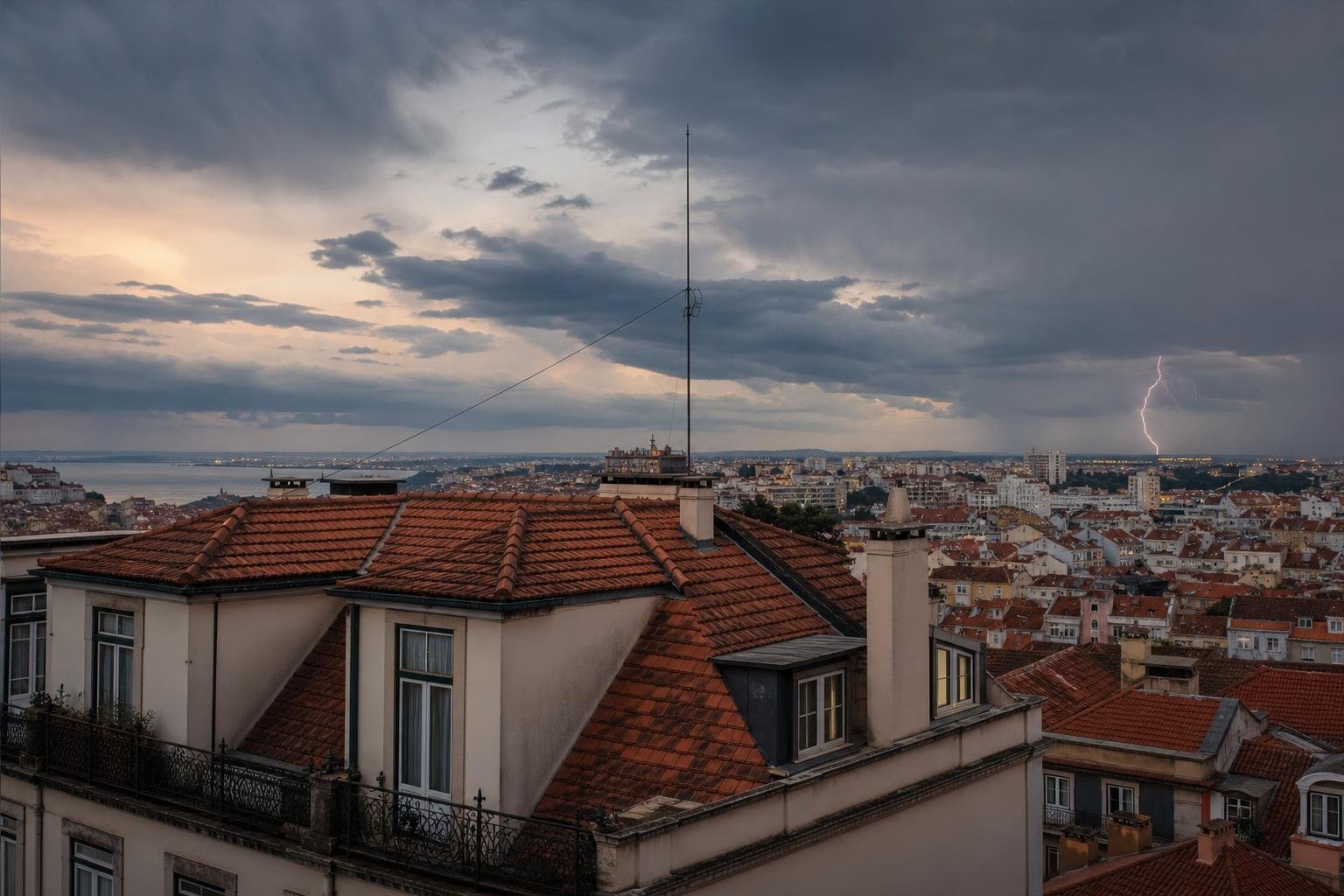
A lightning protection system provides a controlled route for an atmospheric discharge to reach the ground; it does not make a building immune to storms or automatically protect appliances plugged into sockets. That distinction prevents two common mistakes: fitting a rod on a roof without checking the full route to ground, and assuming that the rod will protect computers, appliances and gate controls. In a Lisbon building, the solution must work as a whole: air terminals, conductors, earthing, bonding and suitable electrical protection.
Contents
- What happens when lightning strikes, or passes close to, a building?
- What parts make up a lightning protection system?
- When is lightning protection required or advisable?
- Why does a lightning rod not automatically save TVs and appliances?
- Which signs call for a technical inspection?
- A checklist before changing the roof, façade or electrical panel
What happens when lightning strikes, or passes close to, a building?
Lightning carries a very large amount of energy and can have thermal, mechanical and electromagnetic effects. The Portuguese weather service explains lightning types and their effects, including the risk of damage to equipment when a discharge hits an electricity line near a home.
There are two separate problems. The first is a direct strike to the structure: the aim is to give it a predictable path rather than allowing it to travel through combustible elements, pipes, exposed reinforcement or improvised services. The second is a surge: a direct or nearby strike, or one transmitted through the network, can create a brief voltage rise in cables and damage equipment even where the building has lightning protection.
This means the useful question is not simply “does the building have a lightning rod?”. It is: is there a continuous, maintained system coordinated with the electrical installation? A visible roof rod does not prove that the conductors are intact, connections are correct or the earth arrangement is effective.
What parts make up a lightning protection system?
The principle is straightforward: intercept the strike, conduct it and disperse it in the ground. In practice, every stage depends on the previous one.
- Air termination: rods, conductors or mesh placed at exposed points on the roof.
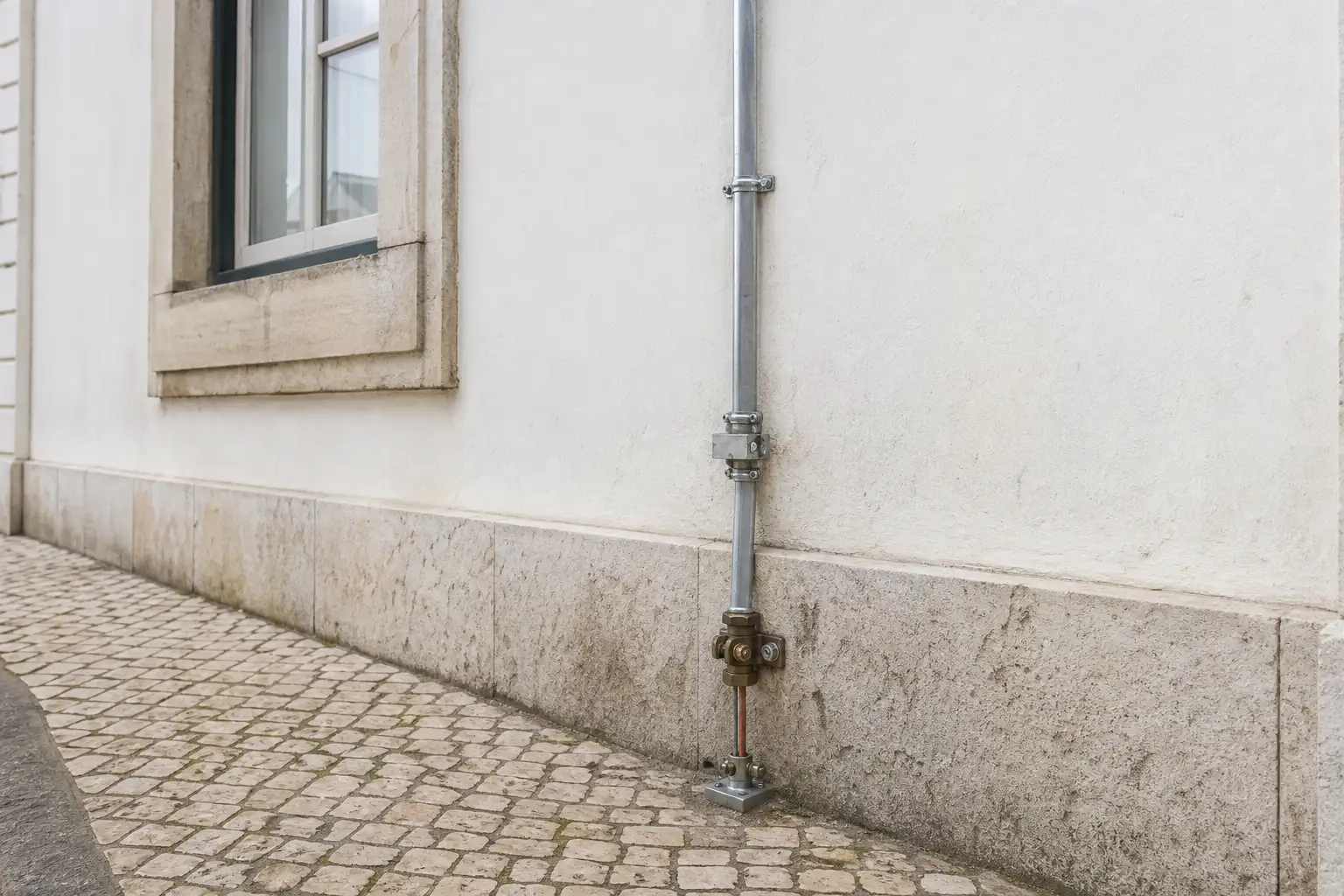
- Down conductors: conductors carrying current along defined routes to ground level.
- Earthing: buried electrodes and conductors that disperse energy into the ground.
- Bonding: connections that limit dangerous voltage differences between metalwork and services.
- Internal protection: surge protection devices at the electrical panel and, where appropriate, close to sensitive equipment.
Continuity is the crucial detail. Roof alterations, façade painting, solar-panel installation, air-conditioning equipment or waterproofing work can all affect fixings and connections. Before closing up work, establish where conductors run and who will reinstate every connection. That coordination belongs with the rest of the electrical planning, including when you plan sockets and switches before walls are closed.
When is lightning protection required or advisable?
Portugal’s Technical Fire Safety Regulation states that buildings in which atmospheric discharges represent a significant fire risk must have a lightning protection installation in line with the relevant technical criteria. Read the regulation published in the Diário da República before turning that general requirement into a project decision.
For ordinary housing, there is no universal answer based solely on the number of storeys. An assessment should consider the building’s height and form, site exposure, prominent elements, roof materials, technical equipment, nearby trees and how the property is used. An isolated house on an elevated site does not face the same exposure as a flat in a block surrounded by taller buildings.
National statistics should not be used as a shortcut for design either. The IPMA’s 2025 atmospheric-discharge bulletin recorded activity in every mainland district, including Lisbon. That shows thunderstorms are a real condition to consider; it does not replace a technical assessment of a particular building.
Why does a lightning rod not automatically save TVs and appliances?
Because external lightning protection and circuit protection address different risks. The lightning protection system aims to stop the main strike current from travelling through random parts of the building. A surge, however, can enter through electricity supply, telecommunications, aerials, data cables or external circuits.
During renovation, discuss surge protection at the electrical panel with the responsible technician and make sure it is coordinated with the existing earth arrangement. Also consider dedicated circuits for significant equipment such as a heat pump, gate motor, electric-vehicle charger, security system or air conditioning. Do not treat low-cost extension leads and power strips as structural protection: they may have limited uses, but they do not replace correctly selected and installed protective devices.
In multi-home buildings, the decision may involve common elements: the main panel, shared earthing, roof and service routes. Checking that disciplines, materials and execution remain compatible is part of construction supervision, particularly when a seemingly small alteration affects a safety system.
Which signs call for a technical inspection?
Arrange an assessment before roof or façade work if you find loose conductors, corroded clips, cut cables, improvised joints, badly sealed penetrations or components hidden by recent finishes. A down conductor that has been painted over or partly concealed is difficult to inspect; a hole drilled for an awning or external unit can break continuity without leaving an obvious sign at ground level.
After a severe thunderstorm, do not touch suspicious metalwork or try to tighten connections yourself. If there is a burning smell, arc marks, repeated trips at the panel, simultaneous equipment failures or roof damage, isolate what can safely be isolated and contact a qualified professional. Where there is an immediate fire or electric-shock risk, keep people away from the area and use the appropriate emergency services.
This is not a DIY task. Protection against atmospheric discharges depends on sizing, material compatibility and checks that cannot be carried out by sight alone.
A checklist before changing the roof, façade or electrical panel
Use this list to connect architectural choices with technical safety:
- Identify the existing air terminals, down conductors and earth connections on drawings or on site.
- Record photographs before removing tiles, flashings, finishes or guards.
- Do not cut, divert or conceal conductors simply to improve a façade’s appearance without a defined technical solution.
- Coordinate solar panels, aerials, rooflights and air-conditioning equipment with the existing protection system.
- Confirm the surge-protection strategy and circuit arrangement at the electrical panel.
- Request documentation for the completed solution and clear identification of points that must remain accessible for maintenance.
In older Lisbon buildings, roofs often gather elements added over decades. Before adding another item, carry out a simple survey and treat lightning protection as building infrastructure rather than a decorative accessory.
Key takeaways
- Lightning protection only works as a complete system: air termination, down conductors, earthing and continuous connections.
- Structural protection against a direct strike does not replace surge protection at the electrical panel.
- Roof, façade and technical-service work must preserve and document existing protection routes.
- Loose cables, corrosion, cuts or storm damage require assessment by a qualified professional.
If your renovation includes the roof, façade, electrical panel or technical equipment, first collect the information available about existing installations. Then contact Obra Lisboa to place those decisions within the planning of the work.
Sources and further reading
- regulation published in the Diário da República
- Portuguese weather service explains lightning types and their effects
- IPMA’s 2025 atmospheric-discharge bulletin
AI-generated editorial image; it does not depict an Obra Lisboa project.

Obra Lisboa