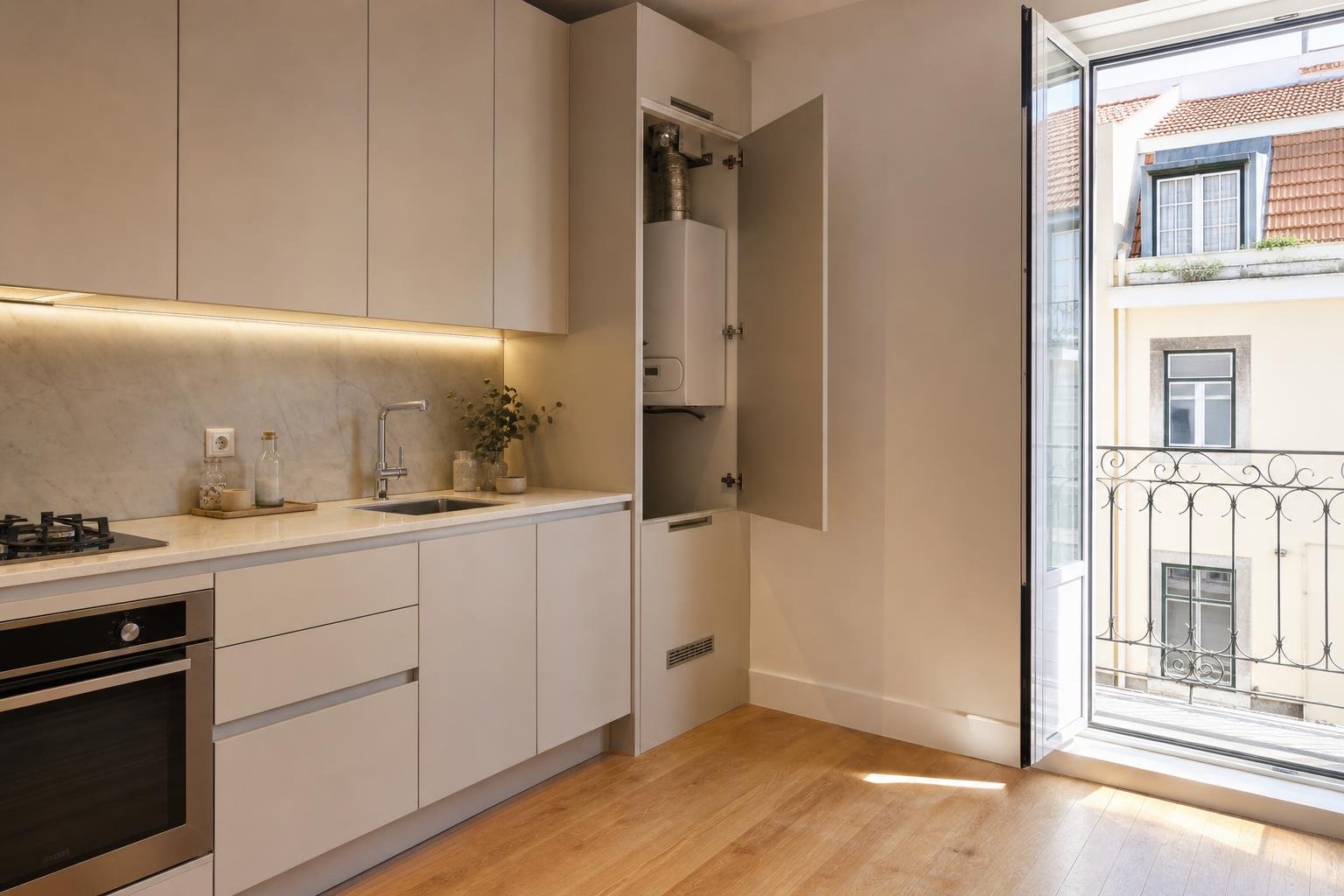
A home with gas heating can be a sensible purchase when you assess the installation before making an offer, rather than treating it as a minor detail during the viewing. The equipment may run on the day, yet lack records, proper ventilation or enough electrical capacity for a later alternative. Ask for evidence, inspect what is accessible and reflect the findings in the price you are prepared to offer.
Contents
- Which gas appliances are in the property, and why does that matter?
- Which documents should you request before proceeding?
- What can you observe during a viewing without taking anything apart?
- When should you obtain a technical check before making an offer?
- How do you price the risk without making return promises?
- Which offer condition is reasonable?
Which gas appliances are in the property, and why does that matter?
Start by identifying what the gas system actually does. A boiler may provide space heating and domestic hot water; an instantaneous water heater only supplies hot water; a gas hob uses fuel without solving the home’s thermal comfort. The distinction changes the property’s dependency on gas, the scope of future works and the consequence of a breakdown.
Photograph the appliance data plate and note the make, model, stated output and installation year where visible. Ask whether heating is delivered through radiators, underfloor heating or another system, and whether all important rooms have emitters. A listing that says “central heating” may refer to a working boiler while radiators are disconnected, valves are seized or pipework has unresolved repairs.
ADENE notes that heating-system maintenance and replacement should be considered before a failure leaves the owner with no time to compare options or installation conditions. Read ADENE’s guidance on maintenance and heating-system efficiency as a starting point, rather than as a diagnosis of the home you are considering.
In Lisbon, separate three questions: does the appliance heat effectively, does the home retain that heat, and can the system remain in service safely? A recent boiler does not, by itself, offset draughty windows, cold walls or a living room that is difficult to heat.
Which documents should you request before proceeding?
Request documents before signing an offer that leaves no room to review technical issues. For properties built, or subject to certain works, after 30 March 2004, the Housing Technical File describes technical and functional features at completion. IMPIC explains when the Housing Technical File is required. Where available, check how it describes the heating and hot-water systems.
Also request:
- a valid energy certificate and its recommendations;
- invoices, reports or maintenance records for the boiler or water heater;
- declarations relating to recent work on the installation or appliances;
- information about faults, leaks, supply interruptions or work to the service connection;
- a clear list of what remains with the sale: boiler, thermostat, radiators and kitchen appliances.
The Portuguese framework for gas installations and appliances requires a declaration of conformity following installation, alteration, repair or maintenance, while inspections cover matters including ventilation, appliance operation and shut-off devices. Read the relevant provisions in the regulation published in Diário da República. Do not assume that an invoice with little detail is an adequate substitute for these records.
What can you observe during a viewing without taking anything apart?
A viewing cannot replace a technical inspection, but it can reveal signs that justify a condition in the offer or a specialist quotation. Ask to see the appliance running normally where this is possible and safe. Notice hot-water response time, unusual noise, smells, error messages and staining below the unit.
Look at the surrounding area as well:
- ventilation grilles blocked by furniture, tape, paint or stored items;
- corroded pipework, improvised connections or cables close to hot surfaces;
- condensate or water around the boiler, utility cupboard or radiators;
- a flue, duct or exhaust outlet that appears to have been altered;
- no reasonable access for servicing.
The answer “it has always worked” is not enough. Portugal’s health authority, DGS, advises proper ventilation in rooms with gas equipment to prevent harmful gas accumulation and warns about carbon-monoxide risk. Read the DGS guidance on ventilation and combustion equipment. If you notice a gas smell, signs of poor combustion or doubts about flue discharge, do not test or alter the appliance; arrange an assessment by a qualified technician.

When should you obtain a technical check before making an offer?
Arrange one whenever the system matters to your budget, winter comfort or planned renovation. It is particularly important if the property has been empty, the appliance is older, records are unavailable, the boiler sits in an enclosed balcony or you intend to move the kitchen, enclose a balcony or change technical walls.
Set the scope in writing: appliance identification, visible condition of the installation, ventilation, flue discharge, shut-off devices, heating-circuit pressure where applicable and service access. Ask for a note that separates urgent defects, foreseeable maintenance and optional upgrades. This keeps a vague observation from becoming a confused negotiation.
It is unwise to negotiate solely on the basis of appliance age. A newer system may have been poorly installed; an older one may be documented, maintained and suitable for temporary use. What matters is the whole picture: safety, documentation, performance, compatibility with the home and the cost of moving away from the system.
| What you find | Prudent response | Effect to consider |
|---|---|---|
| Consistent documentation and maintenance | Proceed with the usual home checks | Less technical uncertainty, without removing the need for review |
| The appliance works but records are missing | Request a technical inspection before fixing the offer | Possible accumulated maintenance or hidden corrections |
| Ventilation, flue discharge or shut-off raises concerns | Treat it as a safety issue and request specialist assessment | Work may be needed before occupation |
| You plan to electrify heating or hot water | Check space, electrical capacity, drainage and pipe routes | Future cost depends on the existing preparation |
How do you price the risk without making return promises?
Rather than subtracting an arbitrary amount because the home “has gas”, build three scenarios. In the first, the installation remains and only receives routine maintenance. In the second, it needs safety, ventilation or component corrections. In the third, the system is replaced during renovation.
Get separate quotes for each scenario and keep decorative improvements you would make anyway outside the calculation. Add works that often accompany a change: electrical alterations, opening and closing walls, condensate drainage, cabinet changes, painting and reinstatement of finishes. This comparison helps you decide whether the home still fits your total budget without assuming that any work will automatically increase its value.
The energy certificate can help rank priorities, but it does not independently establish the condition of the installation. For a wider renovation plan, see our guide on turning an energy certificate into a home renovation plan. If the purchase involves recently completed work, also review the documents and risks to check when buying a renovated Lisbon apartment.
Which offer condition is reasonable?
An offer can allow time for documents to be supplied and for a technical assessment, especially where the gas installation materially affects your decision. The wording should be reviewed for the specific transaction by those assisting with the purchase, but the purpose is straightforward: establish what exists, its condition and who addresses a significant defect found before completion.
Avoid impossible requests, such as an open-ended guarantee for every future component failure. Prefer verifiable points: provision of available records, confirmation of included equipment, access for inspection and an agreed response or price adjustment if a relevant pre-defined non-compliance is found.
If you move on to renovation, treat hot water, ventilation, electricity and finishes as one sequence. Choosing a boiler or heat pump before deciding location, access and services often creates rework. Our article on essential clauses for a Lisbon renovation contract explains why scope and responsibilities should be clear before work begins.
Key takeaways
- Request documentation and maintenance records before treating gas as a negotiable detail.
- Check ventilation, flue discharge and access; they are safety matters, not finishes.
- Cost three scenarios: keep, correct or replace the system.
- If the installation is material to the purchase, make the offer conditional on adequate information and technical assessment.
If the home will need renovation, gather the documents, photographs and technical priorities first. Obra Lisboa can help frame the work, scope and sequence before execution decisions are made.
Sources and further reading
- regulation published in Diário da República
- IMPIC explains when the Housing Technical File is required
- ADENE’s guidance on maintenance and heating-system efficiency
- DGS guidance on ventilation and combustion equipment
AI-generated editorial image; it does not depict an Obra Lisboa project.

Obra Lisboa