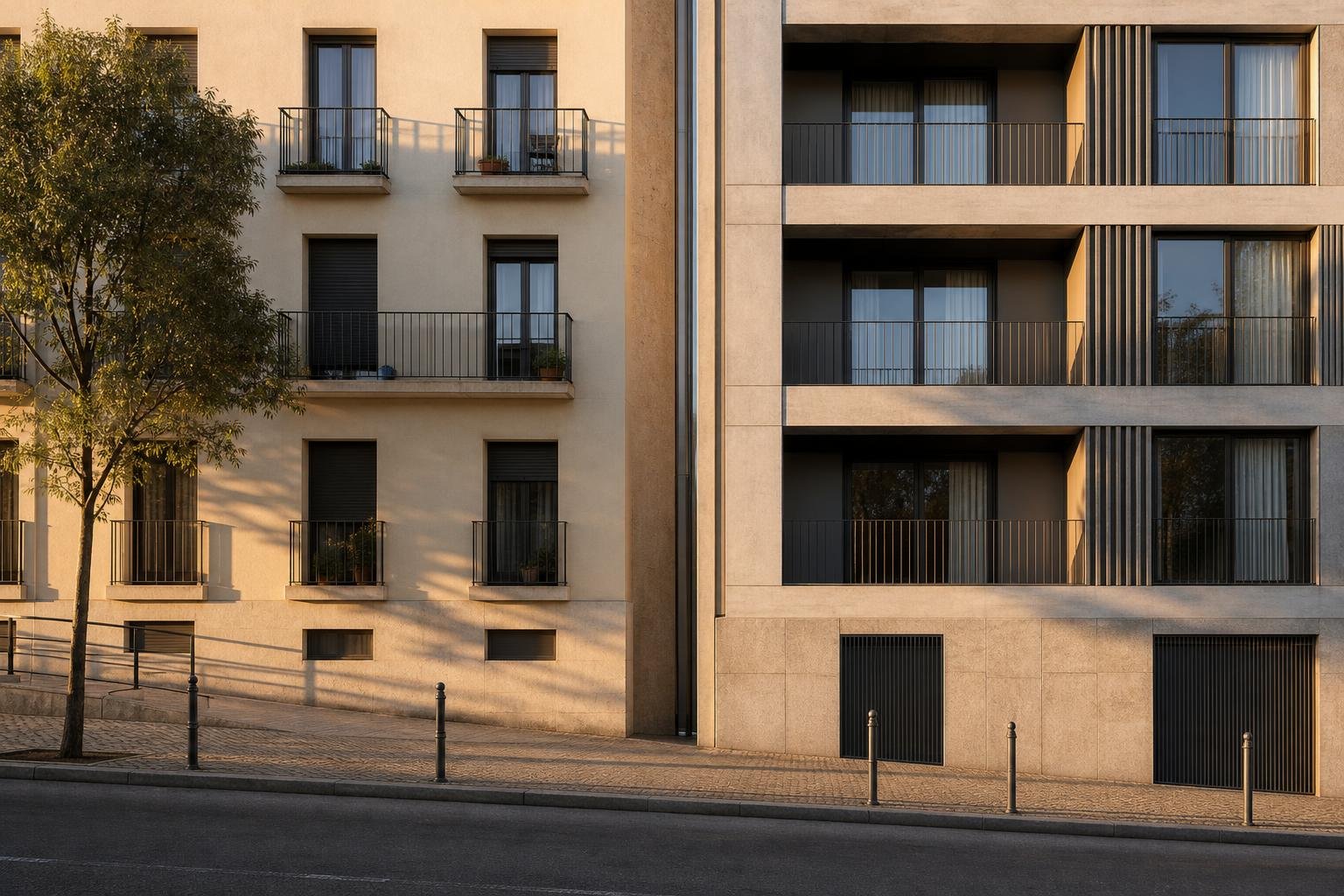
The iron stars, plates and rosettes visible on some older Lisbon façades may be tie-rod anchors that help keep walls, floors and façades connected. They are not decorative details to remove during repainting or renovation. Before touching one of these pieces, a thick wall or an old floor structure, establish whether it belongs to the building’s structural system and arrange an appropriate technical assessment.
Contents
- What are tie rods, and why are they visible on a façade?
- Which structural problem can tie rods help solve?
- Pombaline cage structures, gaioleiro buildings and tie rods: are they the same thing?
- Which signs mean you should stop before opening a wall?
- Why a “magic beam” may not solve the real issue
- What to request before repairing, painting or concealing an anchor plate
What are tie rods, and why are they visible on a façade?
A tie rod is, simply put, a metal bar designed to work in tension: it resists two parts of a building pulling apart. It may pass through walls, connect opposite façades or strengthen the junction between perpendicular walls. At its ends, there may be plates, stars, crosses or rosettes. These pieces spread the load over the masonry and stop the bar from punching through the wall locally.
In Lisbon, these signs can be found on masonry buildings, particularly where repairs or strengthening have taken place during the building’s life. Appearance alone is not enough, however, to establish whether a rosette is connected to an active tie rod, whether it is original, or whether it still performs its intended role. There may be decorative pieces, interrupted bars, concealed corrosion or later alterations. A safe reading starts at the façade, then continues inside and through the elements that the tie rod may connect.
The structural principle matters because older walls are strong at carrying vertical weight, while often being more vulnerable to forces that pull, bend or push them sideways.
Which structural problem can tie rods help solve?
In an older building, exterior walls, internal walls, floors and the roof need to work together. When their connections are weak, a façade may move relative to floors or cross walls. During an earthquake, that movement raises the risk of a wall falling outwards, away from its own plane.
The Lisbon municipal guide on wall repair and strengthening explains that connections between walls, and between walls and floors, are critical to overall behaviour. It also identifies metal tie rods as a widely used way of connecting structural elements and, in some cases, tying façades together.
This clarifies a common renovation issue: an apparently secondary wall can help restrain another one; an apparently modest rosette can indicate a connection that should not be cut, loosened or covered by a new finish without prior assessment.
Pombaline cage structures, gaioleiro buildings and tie rods: are they the same thing?
No. The Pombaline cage is an internal timber structure with diagonal elements, associated with part of Lisbon’s Pombaline building stock. Its role is to provide bracing and a more organised response to horizontal actions. Tie rods are metal elements and may be found in buildings from different periods and construction systems.
They do share one principle: resistance depends on connections. The City of Lisbon guidance on earthquake-resistant construction warns of the damaging effect of cutting timber diagonals in trussed structures, for example to run plumbing. The same care applies to work that weakens connections between walls, floors and façades.
In a Pombaline or gaioleiro building, do not treat the structure as a row of independent parts. The wall beside a living room, the timber beneath a floor and the façade may contribute to the same structural response, even when concealed by render, plaster or suspended ceilings.

Which signs mean you should stop before opening a wall?
A rosette alone does not prove a defect. A combination of signs does call for caution:
- diagonal cracks starting at opening corners or following wall junctions;
- a visible separation between wall and ceiling, skirting board or floor;
- a sloping, bouncy or locally sagging floor;
- rust, water marks or loose render around metal anchors;
- a thick wall aligned through several floors that is due to be removed to enlarge a room;
- earlier works where beams were inserted with no record of what they replaced.
Do not cover cracks, cut a bar, or tighten anything by trial and error. Active tie rods may be tensioned; changing their force or anchorage without calculations can redistribute stresses unpredictably. Where there is recent movement, falling material or immediate uncertainty about safety, restrict access to the area and seek technical help promptly.
Why a “magic beam” may not solve the real issue
Removing a wall and inserting a beam may deal with a local vertical load, but it does not automatically recreate the bracing that the wall and its connections provided. That is why opening a kitchen to a living room or widening a corridor requires more than measuring the opening.
The municipal guidance on wall removal notes that even non-loadbearing walls can help brace the building and redistribute forces. In Pombaline buildings, some frontal walls with Saint Andrew’s crosses are structural; in other older buildings, thickness and position may offer clues, but they do not replace an inspection.
Before ordering steelwork, cabinetry or demolition, use this sequence:
- collect drawings, old photographs and records of earlier works;
- mark rosettes, cracks, thick walls and level differences on a plan;
- arrange an assessment by a qualified professional when work affects walls, floors or façades;
- define the structural solution and service routes before ceilings and finishes are closed;
- record what has been concealed and where future access remains possible.
What to request before repairing, painting or concealing an anchor plate
A well-prepared external repair starts by separating maintenance from structural alteration. Ask for the condition of the plate or rosette to be checked, along with the tightness and continuity of the tie rod where accessible, signs of corrosion, cracks in the render, water ingress and the compatibility of new mortars with the existing wall. Painting rusty iron without dealing with the moisture source only postpones the problem.
If the work includes demolition, floor replacement, deep chases for services or changes to the façade, confirm whether a design project and planning procedures are required. The municipal earthquake-strengthening FAQs make an important point: strengthening methods are not recipes, and this kind of work should be supervised by specialised professionals.
For an early framework, read also what to check before removing apartment walls in Lisbon and how to recognise a Pombaline cage structure before renovation. These are decisions to make before, rather than after, demolition starts.
Key takeaways
- A façade rosette may be the visible end of a structural tie rod, but this needs confirmation inside the building.
- Do not remove, cut or tighten tie rods independently; the change can redistribute structural forces.
- Before opening up old buildings, assess walls, floors and their connections as one system.
- Treat corrosion and water ingress at their source before repainting or covering metal anchors.
If your renovation involves old walls, timber floors or structural signs on the façade, ask Obra Lisboa to frame the construction work and coordinate the necessary steps before demolition or finishing work begins.
Sources and further reading
- Lisbon municipal guide on wall repair and strengthening
- City of Lisbon guidance on earthquake-resistant construction
- wall removal
- municipal earthquake-strengthening FAQs
AI-generated editorial image; it does not depict an Obra Lisboa project.

Obra Lisboa