An exterior service door can look like a straightforward replacement: remove the old unit, fit a new one and finish the edges. Yet these secondary openings — leading to a utility room, garage, kitchen, storage area or garden — are where water ingress, draughts, corrosion, sticking hardware and damaged paving around the threshold often begin.
For a house in Lisbon, the choice should reflect actual use, orientation, exposure to wind and rain, the difference in level between indoors and outdoors, and the façade build-up. The IPMA climate normals for Lisbon / Instituto Geofísico show a setting with rainfall concentrated in wetter months and high summer temperatures. In other words, the door needs to manage water, sun and material movement, rather than simply provide access.
A dependable outcome starts before the order is placed. Measuring the opening is not enough: you need to decide where water will go, how the threshold will work, which opening direction is practical and how the connections to wall and paving will be built.
Start by diagnosing the existing opening
Before choosing aluminium, PVC, timber or steel, inspect the current door on a dry day and, if possible, after rain. Look for marks on the internal wall face, cracked sealant, bubbling paint, darkened timber, rusty hardware, loose paving and water tracks near the frame. These signs may be caused by a distorted leaf, but they may also point to a threshold with no fall, a cracked façade or a gutter discharging too close to the entrance.
Measure the opening width and height at several points, check whether the reveals are square, and record the levels of the internal floor, threshold and external paving. Also consider the opening direction. An outward-opening leaf can be useful in a small utility space, but it needs clear space, must not hit a step and is more exposed to wind. An inward-opening door needs manoeuvring room and can carry water indoors if opened during heavy rain.
Write down the priorities: weather resistance, ventilation, daylight, impact resistance, privacy, insulation, easy cleaning or access for equipment. This prevents you from paying for a visually attractive solution that is unsuitable for a technical area.
Choose the material for the location and realistic maintenance
Aluminium is widely used for exterior doors because it is dimensionally stable and relatively low maintenance, particularly when the finish suits the environment and the hardware is well specified. In coastal or highly exposed locations, surface protection, screws and hinges deserve as much attention as the profile itself. PVC can provide good thermal performance with limited maintenance, but it needs suitable reinforcement and a configuration that matches the leaf size, colour and solar exposure.
Timber can give an entrance a warmer character and work especially well in older houses, provided the species, coating, ventilation to the lower edge and periodic upkeep are genuinely feasible. Steel may increase mechanical strength, although it needs careful detailing to reduce condensation and corrosion. With every material, ask about the leaf, frame, perimeter seals, threshold and hardware as one system, rather than as unrelated components.
Where the door separates a habitable area from outdoors, thermal performance matters too. As a public-support benchmark, the Diário da República notice set a maximum thermal transmittance of 2.2 W/(m²·K) for eligible entrance doors, supported by an accredited laboratory report. It is not a universal rule for every service door, but it is a sound reason to compare technical data rather than judge performance by apparent thickness alone.
The threshold and drainage determine whether the doorway stays dry
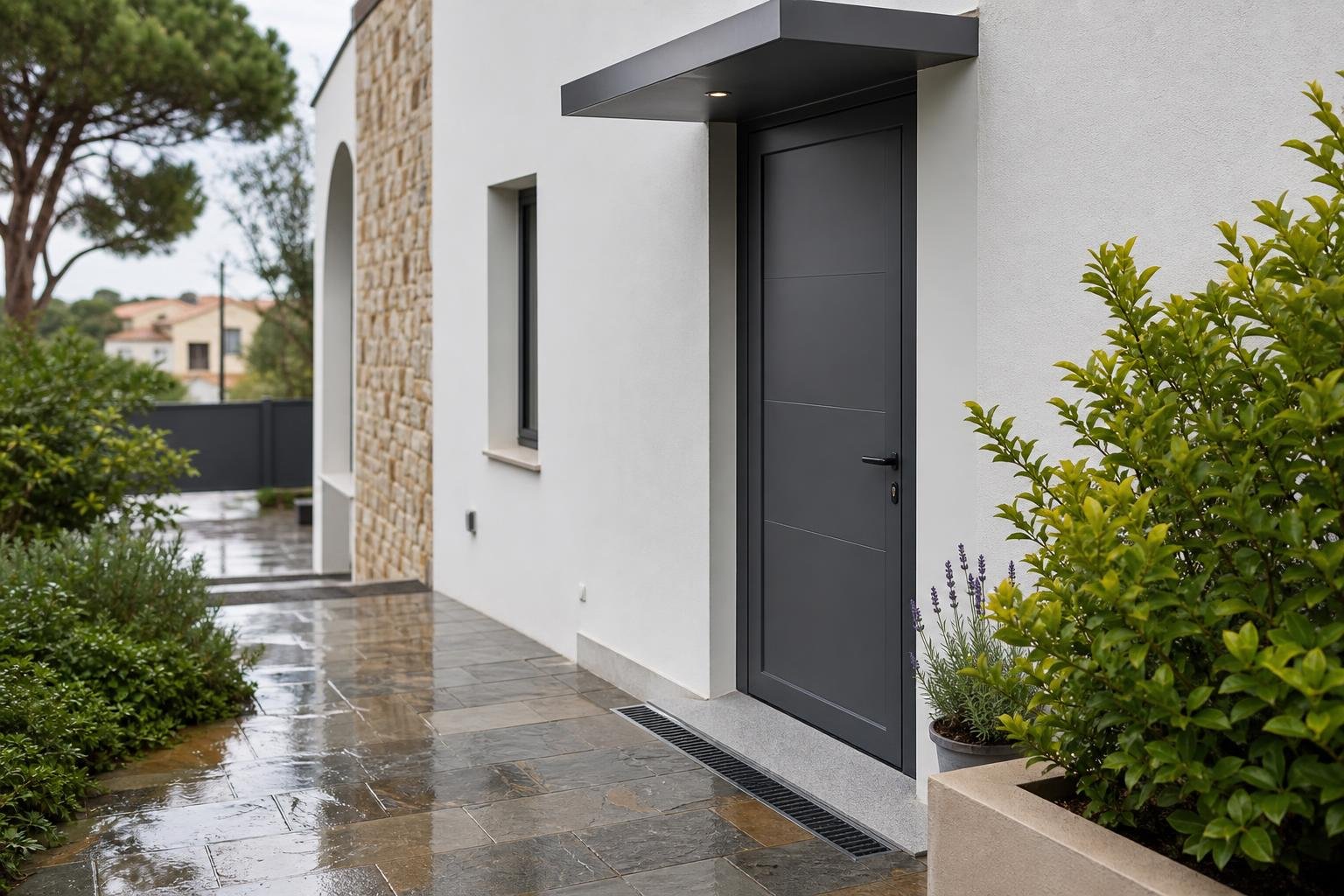
Water seldom enters only through the gap between leaf and frame. Many leaks begin at the junction of external paving, threshold and wall. The paving should direct water away from the door; reverse falls, cracked rigid junctions or blocked channels can defeat an otherwise excellent new door.
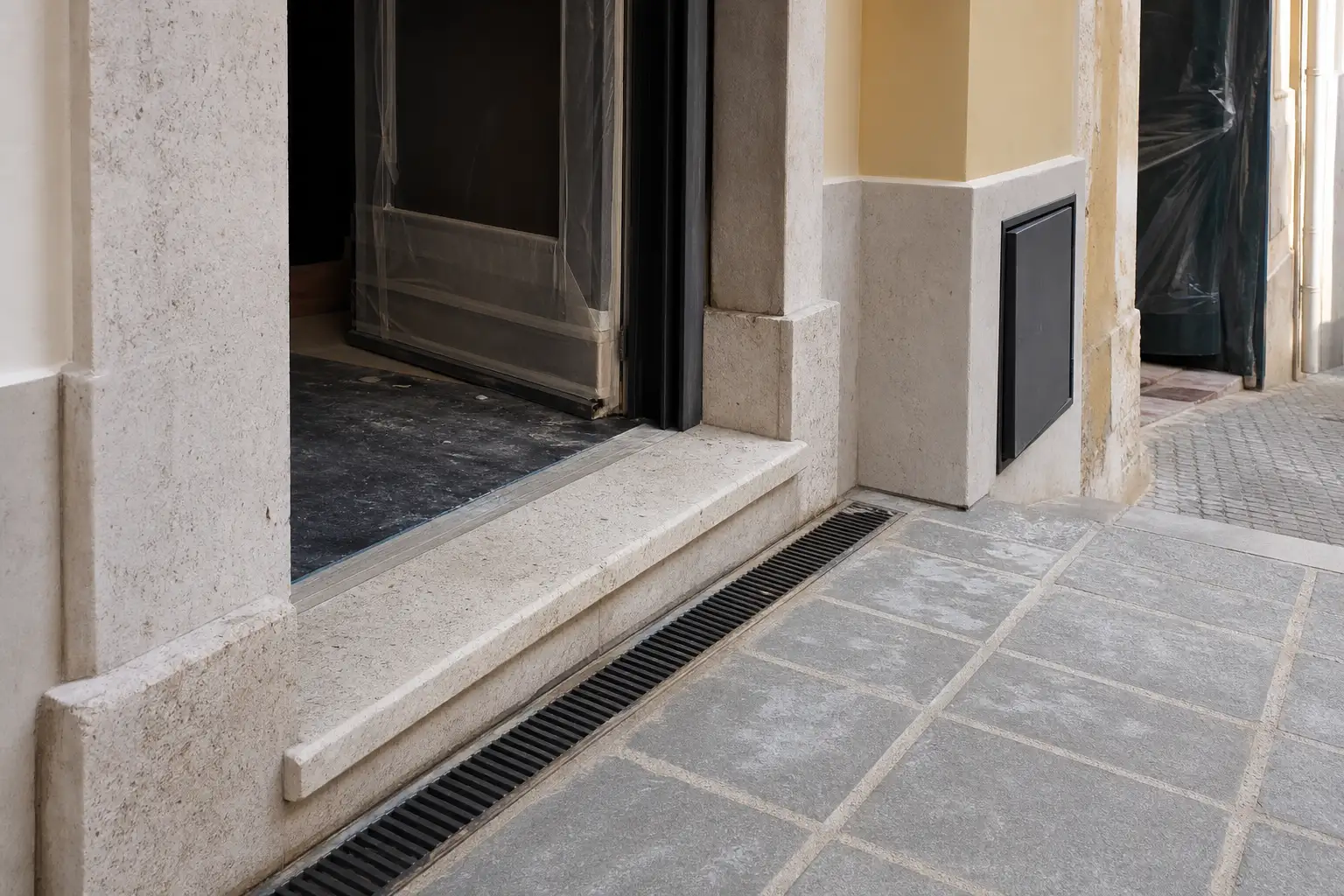
Avoid simply raising the external paving until it covers part of the threshold. That reduces the effective protective upstand, restricts drainage and can create a route for water to reach the lower frame. Where water may collect, a linear drain or gully positioned before the entrance can be appropriate, but it needs a working connection to drainage and access for cleaning. An attractive grille is of little use if it quickly fills with soil, leaves or sand.
Junctions should allow for movement between different materials. Stone, ceramic, concrete, door frames and façade finishes all expand differently. Sealant matters, but it cannot replace correct geometry: a drip edge, outward fall, capillary break and stable support. For related exterior maintenance priorities, see Obra Lisboa’s guide to gutters and downpipes before Lisbon’s rainy season.
Build in security without overlooking daily use
A service door must close reliably every day, including when people are carrying shopping, bicycles, garden waste or equipment. A multipoint lock can improve closure and resistance to intrusion, but it only works as intended if the frame is correctly fixed and aligned. A heavy leaf on weak hinges will eventually drop; a high-quality lock in a poorly secured wall will not solve the underlying problem either.
Consider who uses the door and in what circumstances. If it opens to a garage or garden, it may be worth allowing for a viewer, sensor-operated exterior lighting, a protected cylinder, durable pull handle and emergency escape from inside. If glass is included, assess the need for safety glass and the handle’s position in relation to glazed areas. Avoid arrangements that allow the mechanism to be reached easily through broken glass.
Accessibility is also a practical issue. Overly high thresholds become obstacles and collect dirt, while a lower transition requires even more rigorous drainage detailing. For a wider approach to safer, easier access, read our article on preparing a home for ageing well.
Check façade, permission and property rules before ordering
Replacing a door like-for-like in the same opening is not the same as changing its dimensions, creating a new access, changing the façade composition or working on a protected property. In Lisbon, internal works that do not alter the form of façades may fall within works exempt from prior control, as described by the municipal service on exempt works and public-space occupation. An external intervention, however, should always be checked according to its specific circumstances.
Listed properties, properties being considered for listing and buildings within protection zones have their own constraints. Lisbon City Council states that conservation, alteration or extension works on such properties, as well as external alterations in protection zones, are subject to licensing; see its service page on building works licences. If the door is visible from the street, confirm acceptable materials, colour, design, bars and any development-specific rules as well.
In an apartment building, the façade may be a common element even where the door serves one dwelling. Keep photographs, specifications and any required approvals before appointing the contractor.
Plan an installation you can inspect and verify
A good door can fail because of poor installation. The quotation should clearly state removal, protection of finishes, repair to the opening, mechanical fixings, insulation of the gap between frame and wall, tapes or membranes where specified, external sealing, threshold work, drainage and internal finishes. “Installation included” is far too vague for a junction exposed to rain.
Before signing off the work, test that the door opens and closes without force, check that gaps are even, make sure the leaf does not rub on the threshold and inspect the continuity of all seals. Ask for product documentation, maintenance instructions and warranty details. After the first substantial rain, inspect the inside of the frame and the adjacent floor; finding a finishing defect early is far easier than repairing damaged wall linings and flooring later.
If the replacement is part of a larger renovation, coordinate the door with waterproofing, paving and façade work before those trades are completed. That sequence is what turns an exterior door into a durable, secure and comfortable part of the house.
Planning to replace an exterior door or resolve leaks around an entrance? Obra Lisboa can help assess the opening, define the junction details and coordinate a solution suited to the house and its exposure.
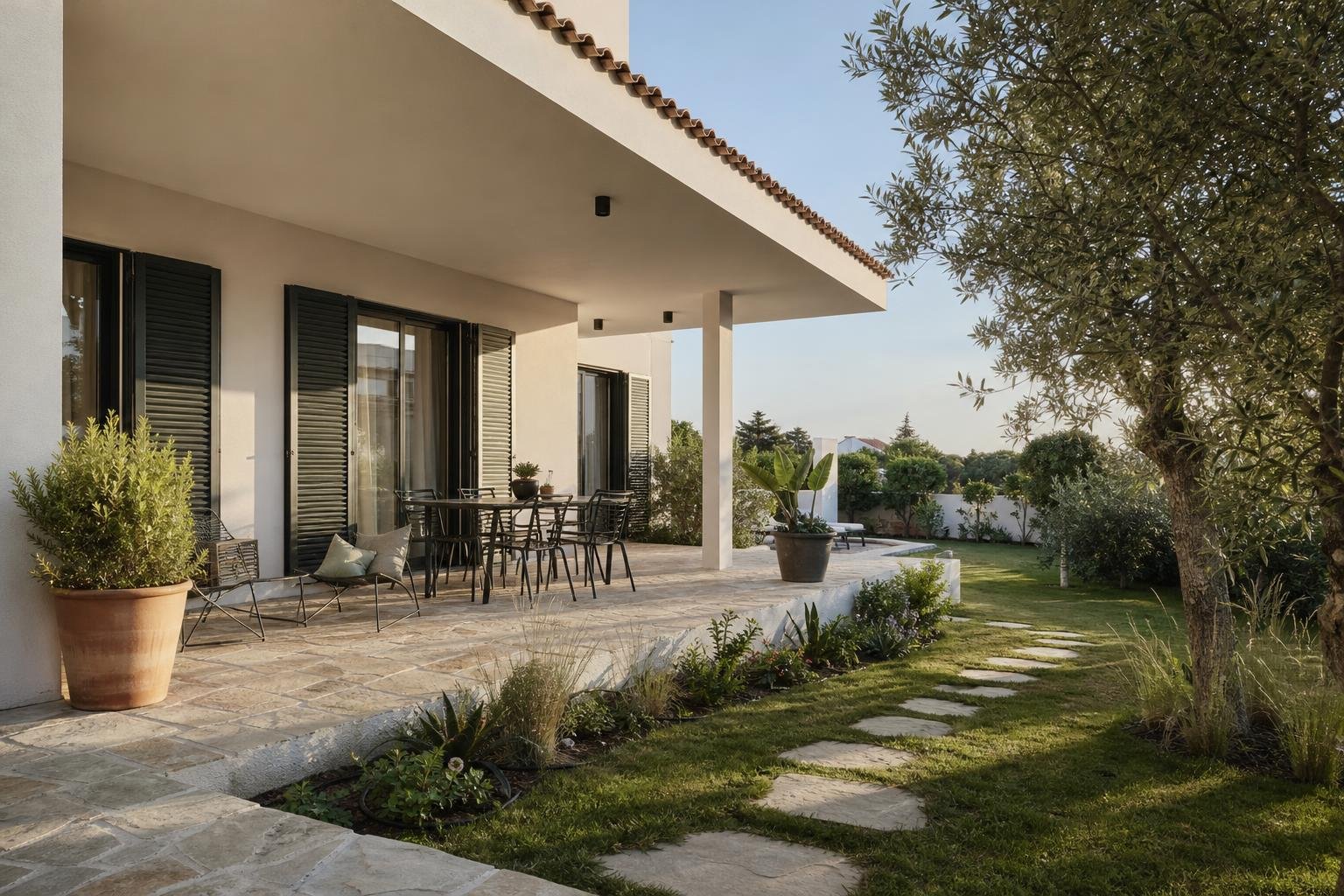
Editorial image; it does not depict an Obra Lisboa project.

Obra Lisboa