
Gutters rarely attract attention until they stop doing their job. By the time water is overflowing down a façade, a ceiling stain appears or water can be heard inside a service void, the issue may already have reached materials that cannot be seen. In Lisbon, it is worth planning ahead: the Lisbon/Tapada climate normal records about 294.2 mm of rainfall from October to December, roughly 44% of the annual total. Use the IPMA Lisbon/Tapada climate data as a planning reference, rather than a daily forecast.
Cleaning gutters and downpipes is only straightforward when access is safe, the layout is understood and there is no hidden damage. The aim is not simply to wash the roof. It is to confirm that water reaches its intended outlet without overflowing, entering the building fabric or discharging where it can create another problem. This guide helps homeowners and condominium managers prepare a sensible inspection before the wetter months.
Map the route water takes through the building
Before arranging cleaning, identify the complete route: roof or terrace, gutter or roof channel, outlet, downpipe, bends, brackets and final discharge point. A blockage may sit at roof level, but it can also be inside a concealed bend, a ground-level gully or an external drain. Photographs taken safely from windows, balconies or ground level can help identify components, changes of material and areas exposed to falling leaves.
In older buildings, do not assume that all roof water follows one system. Previous work may have created diversions, temporary outlets or difficult-to-reach connections. Rainwater drainage is part of how a building performs, so during renovation it should be considered alongside waterproofing, junction details and maintenance access. For a broader maintenance framework, see Obra Lisboa's guide to building maintenance.
- Record where water enters the system and where it leaves it.
- Note areas affected by trees, birds, moss or wind-blown debris.
- Check whether inspection points can be reached without unsafe work at height.
Warning signs to check before the rain arrives
Accumulated leaves are the most obvious warning sign, but they are not the only one. Look for dark marks below gutters, peeling paint around pipes, drips that continue after rainfall, open joints, rust, distortion, loose brackets and internal staining near façades or ceilings. A gutter can look clean while still having inadequate fall or a partially blocked outlet.
Lisbon City Council's roof guidance identifies damaged or blocked roof channels, gutters and downpipes as possible causes of water and moisture ingress. In timber roof elements, this can contribute to decay, deformation and loss of mechanical capacity. Review the council's guidance on roof defects and anomalies before treating a damp mark as a painting problem only.
If water is close to electrical wiring, distribution boards, bulging suspended ceilings or loose façade components, do not carry out improvised hose tests or attempt to dismantle high-level parts. Make the area safe where necessary and arrange a technical assessment.
Cleaning means more than removing leaves
Effective maintenance removes leaves, seeds, silt and debris, but it should always end with a drainage check. On a single-storey house, a suitably equipped professional can clear the gutter and test the route with controlled water, watching for backup, overflow or slow discharge. In apartment buildings, the same task requires access planning, protection of common areas and prior communication, particularly where ladders, access platforms or roof work are involved.
Avoid rigid rods, metal cables or tools that can puncture waterproof membranes, open joints or push a blockage into an inaccessible location. Leaf guards and meshes can reduce build-up, but they do not eliminate inspection: they also trap fine particles and need cleaning. Do not pour corrosive products into pipes, as they may damage materials, seals and nearby surfaces.
After cleaning, confirm three things: the gutter has not been distorted, water reaches the downpipe without running behind the component, and the final discharge does not form puddles at the base of the façade. In courtyards, drainage must be assessed as a system. This guide to courtyard and patio drainage in Lisbon explains how downpipes relate to gullies, falls and ground-level water ingress.

Inspect brackets, joints and junction details
Debris causes blockages, but many failures start with loose components. Check that the gutter keeps a continuous fall towards its outlet, that brackets hold the downpipe without crushing it, and that there are no cracks, holes, displaced joints or corroded areas. In metal gutters, small rusty spots can develop quickly when they remain damp. In PVC systems, expansion and sunlight exposure can affect connections and supports.
Pay particular attention to junctions between roof, wall and gutter. Water passing behind a gutter may wet eaves and façades without appearing indoors for months. It is also important to check that tiles, flashings or membranes discharge into the gutter rather than behind it. Repairing only the visible part without identifying where the water originates is a common route to repeated work.
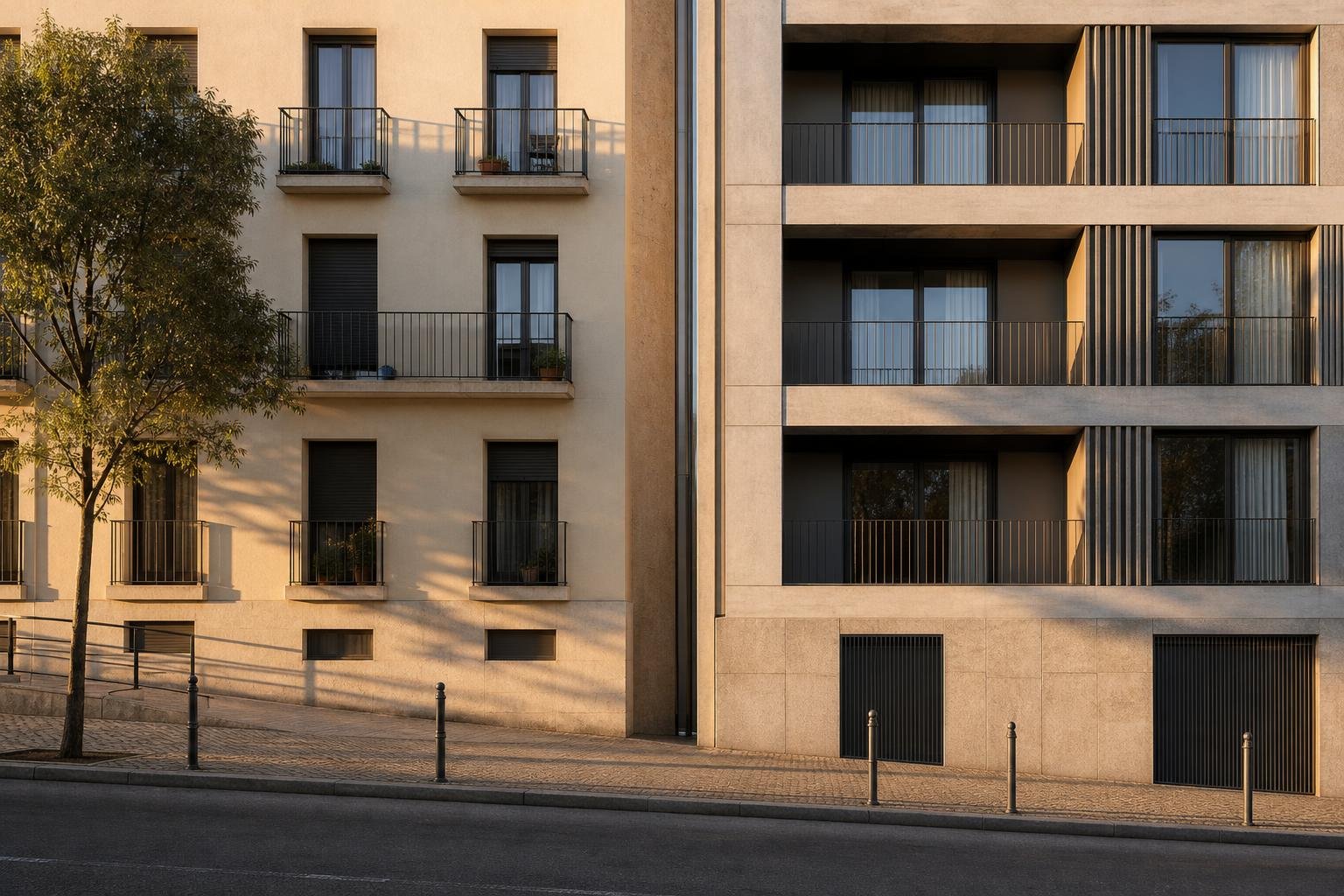
On façades facing public streets, changing downpipes and gutters should not be decided solely for convenience. Lisbon's municipal regulation includes restrictions on pipes, gutters and openings on street-facing façades and requires roof channels and downpipes to be integrated with the building as a whole. Check the Lisbon Municipal Urbanisation and Building Regulation and any applicable constraints before changing an external route.
Plan maintenance without compromising safety
The biggest mistake is turning a maintenance task into a dangerous situation. Wet roofs, fragile coverings, rooflights, balconies without suitable protection and ladders placed on uneven ground all require caution. Do not walk on roof tiles without knowing whether they will take a person's weight; do not lean out of a window to reach a gutter; and do not work alone at height. The saving from a quick clean does not justify a fall or further roof damage.
For a condominium, establish who authorises access, who informs residents, how entrances and vehicles are protected, and where debris will be removed. Ask for a report or quotation that describes the areas inspected, points cleared, defects found, photographs taken and recommended repairs. This documentation supports future decisions and prevents routine cleaning from being confused with structural or waterproofing repair.
A sensible approach is to arrange one inspection at the end of summer, another after heavy leaf fall and an additional check after intense rain if warning signs appear. The right frequency depends on exposure, nearby trees, roof type and the building's own history.
Knowing when to clean, repair or investigate
Cleaning may be enough when the system is sound and the obstruction is superficial. A local repair can be appropriate for a broken bracket, aged joint, small crack or damaged outlet. Recurrent damp, darkened timber, deformation, returning stains, water entering behind the façade or suspected leaks in concealed pipes all justify a fuller diagnosis.
Request a proposal that clearly separates cleaning, component replacement, waterproofing repair and any access work. That makes it easier to compare options and decide whether to address a single damaged point or correct a wider defect. If the work also involves windows, exterior junctions or surfaces exposed to water, see how to coordinate protection for windows and façades during external works.
Keeping gutters and downpipes working is an unobtrusive but important measure: it keeps water on its intended route and creates time to correct small defects before they become water-ingress problems that are difficult to trace.
If you have noticed overflowing water, damp marks or loose roof components and need to assess the work safely, Obra Lisboa can help organise the diagnosis, access and repair work suited to your building.
Editorial image; it does not depict an Obra Lisboa project.

Obra Lisboa