
A poorly lit staircase may feel like a minor detail until someone climbs it at night with their hands full, misses a step or has to search for a switch on the landing. During a renovation, stair lighting should be treated as a daily-use and safety decision, rather than a decorative afterthought. The light needs to make steps, changes of direction, landings and the handrail easy to read, without producing harsh shadows or uncomfortable glare.
The best outcome rarely comes from one powerful fitting. It comes from distributing light properly, controlling glare, choosing a colour temperature that suits the home and placing controls where people actually need them. This matters particularly in narrow stairs, windowless interiors, homes with children or older residents, and apartments where night-time circulation is common.
As a technical reference, the stair circulation table published in the Portuguese Official Gazette sets out 100 lux for stairs. It is not an automatic prescription for every home, but it supports a useful principle: a staircase needs adequate light on the steps themselves, not simply decorative brightness from above.
Start with the route, not the light fitting
Before choosing downlights, wall lights or LED strips, walk the staircase as it will be used every day. Where does the first step begin? Does a door open onto the landing? Does the flight turn? Is there a low ceiling, an uneven wall or a point where a hand naturally reaches for the rail? These details establish where light is needed and where excessive contrast should be avoided.
A useful approach combines soft general light with guidance light. General light makes the whole stair visible and helps people recognise objects or other users; guidance light marks the route along a wall, on the risers or beneath the handrail. With only one central ceiling light, the steps may cast deep shadows. With only low-level light, the space can look attractive yet remain inadequate for cleaning, carrying items or moving quickly.
When the stair is part of a wider intervention, coordinate the lighting with the layout, finishes and building services. Good planning prevents walls being opened after painting, or discovering too late that a switch box clashes with a structural element. You may also find useful our guide to interior stairs in a renovation: safety, space and decisions that prevent mistakes.
Make every step easy to read
Visual safety depends on clearly seeing the edge of each tread. Very dark, glossy or visually uniform finishes can make this harder, especially at night. Light should reach the walking surface fairly evenly, without sharp alternation between bright and dark steps.
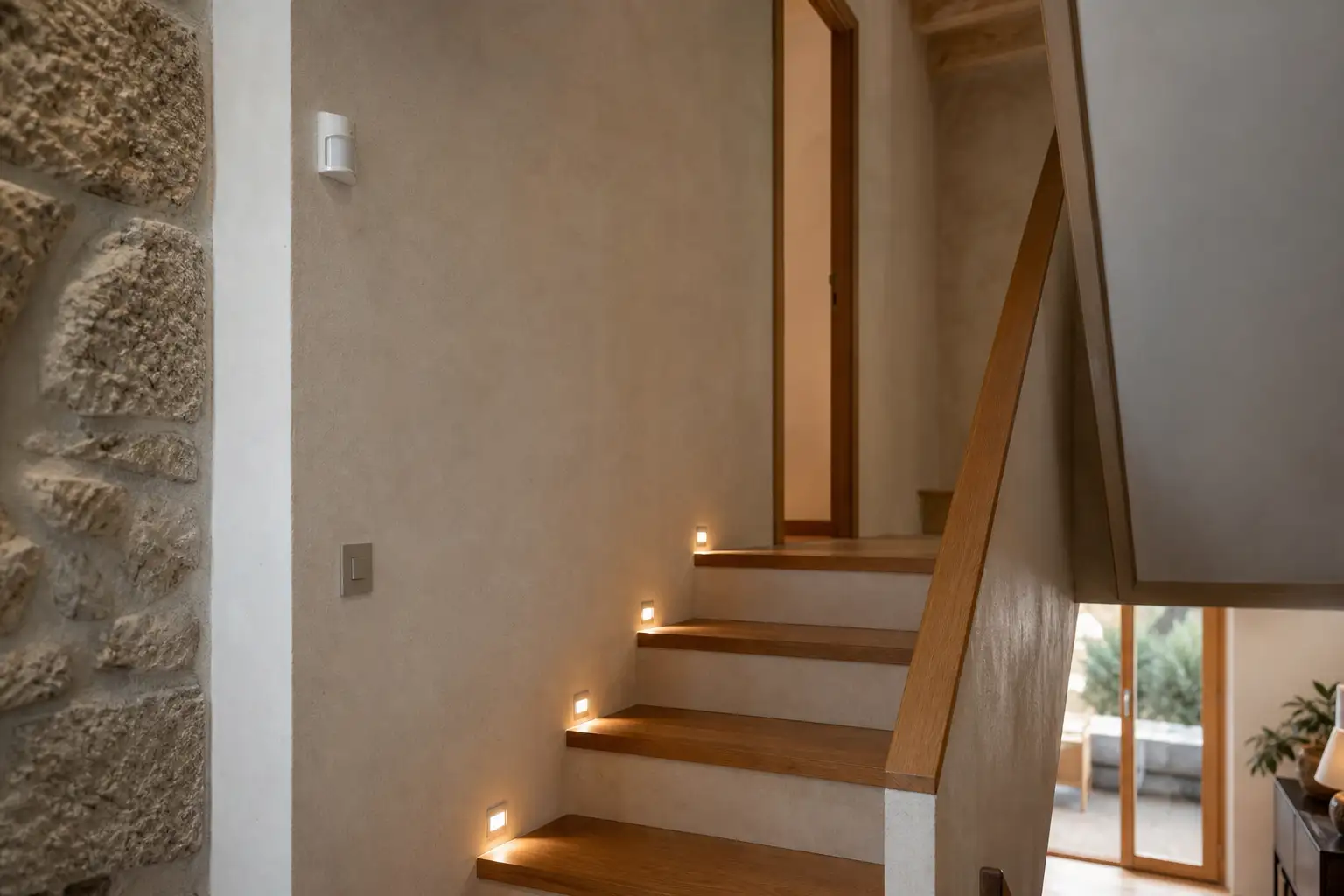
Shielded wall lights, linear profiles concealed beneath the handrail and small downward-facing fittings are common options. On stairs with a continuous side wall, low-level guide lights can create an effective orientation line. Recessed ceiling fittings work best when positioned to light steps and landings rather than shining directly into the eyes of someone climbing.
Avoid placing an intense source at the bottom of the stair or directly in the sightline. Glare makes it harder to distinguish the shape of each tread, even when the space appears very bright. Diffusers, suitable optics and recessed fittings make light more comfortable and more useful.
Choose colour temperature and colour rendering sensibly
In a home, warm or neutral white light usually integrates better than excessively cool light. In many interior stairs, 2700 K to 3000 K creates a welcoming appearance that works well with living and sleeping areas; 3000 K to 4000 K may suit a very dark or heavily used access route where sharper definition is wanted. More important than following a trend is maintaining consistency between visible fittings along the same route.
Ask about colour rendering too. Good colour rendering helps occupants see the true colour of materials, marks on the floor and objects left on steps. This is relevant in homes with timber, stone, ceramic finishes or softly painted walls, where poor lighting can substantially alter the perception of the space.
Choosing LED remains a sensible way to reduce energy use and maintenance. ADENE includes more efficient LED lighting among its domestic-lighting recommendations in its CasA+ simulator. Efficiency, however, does not mean adding too much light: the right output is the one that meets the task with the least unnecessary consumption.
Plan switches, two-way controls and sensors early
A stair should be lit before somebody enters it and switched off without requiring them to return to the starting point. For that reason, controls are commonly provided at both ends: downstairs and upstairs. Where there are intermediate landings, an additional two-way control or a simple automation solution can prevent journeys in darkness.
Motion or presence sensors can be particularly useful for night-time access, storage areas connected to stairs and shared areas in residential buildings. They need careful adjustment: a delay that is too short can turn the light off while someone is still on the route; excessive sensitivity can trigger it unnecessarily. One effective approach is to pair a sensor with low-level guidance lighting, while retaining manual control for cleaning, visitors or extended use.
During renovation, decide these locations before walls are closed. The position of back boxes, conduits and circuits should be recorded, just as with other electrical decisions. For further guidance, read sockets and switches in a renovation: plan them before the walls are closed.
Use guidance light without turning the stair into a display
LED strips beneath a handrail, profiles at skirting level or discreet lighting in risers can work very well when installed with suitable profiles and components. An exposed strip often reveals individual LED dots, gathers dust and loses visual quality; a profile with a diffuser protects the strip, softens its output and makes maintenance easier.
There is no need to light every individual tread. In many homes, it is enough to mark the beginning and end of the flight, reinforce landings and create a continuous line beside the handrail. The aim is to guide movement, not compete with the living-room lighting. A dimmer or timed setting can reduce output further during the early hours.
If work affects shared parts of an apartment building, check whether it involves elements subject to condominium rules, fire-safety requirements or planning procedures. Lisbon City Council explains that certain alteration works may require an urban-planning procedure and qualified professionals; check the relevant framework through Building works — licence before proceeding.
Build a durable, maintainable solution
Good stair lighting must continue to work well long after the renovation is complete. Choose fittings that can be reached for cleaning or replacement, drivers placed in ventilated and accessible locations, and finishes that withstand contact and impact. Near external doors, basements or stairs exposed to damp, make sure the protection rating suits the environment.
It is also wise to avoid mixing too many fitting types, colour temperatures and control systems. Simplicity makes the home more intuitive and reduces future faults. Keep references for lamps, drivers, sensors and circuits in the project file; that record saves time whenever maintenance is needed.
Finally, test the stair late in the day, once daylight has dropped. Walk up and down, look at the steps from the front and side, try every control and check that the handrail remains visible. It is during real use, rather than in a finished photograph, that you discover whether the lighting truly does its job.
Planning to renovate a staircase or improve circulation in your Lisbon home? Obra Lisboa can help bring lighting, services and finishes together in a coherent, practical and durable renovation plan.
Editorial image; it does not depict an Obra Lisboa project.

Obra Lisboa