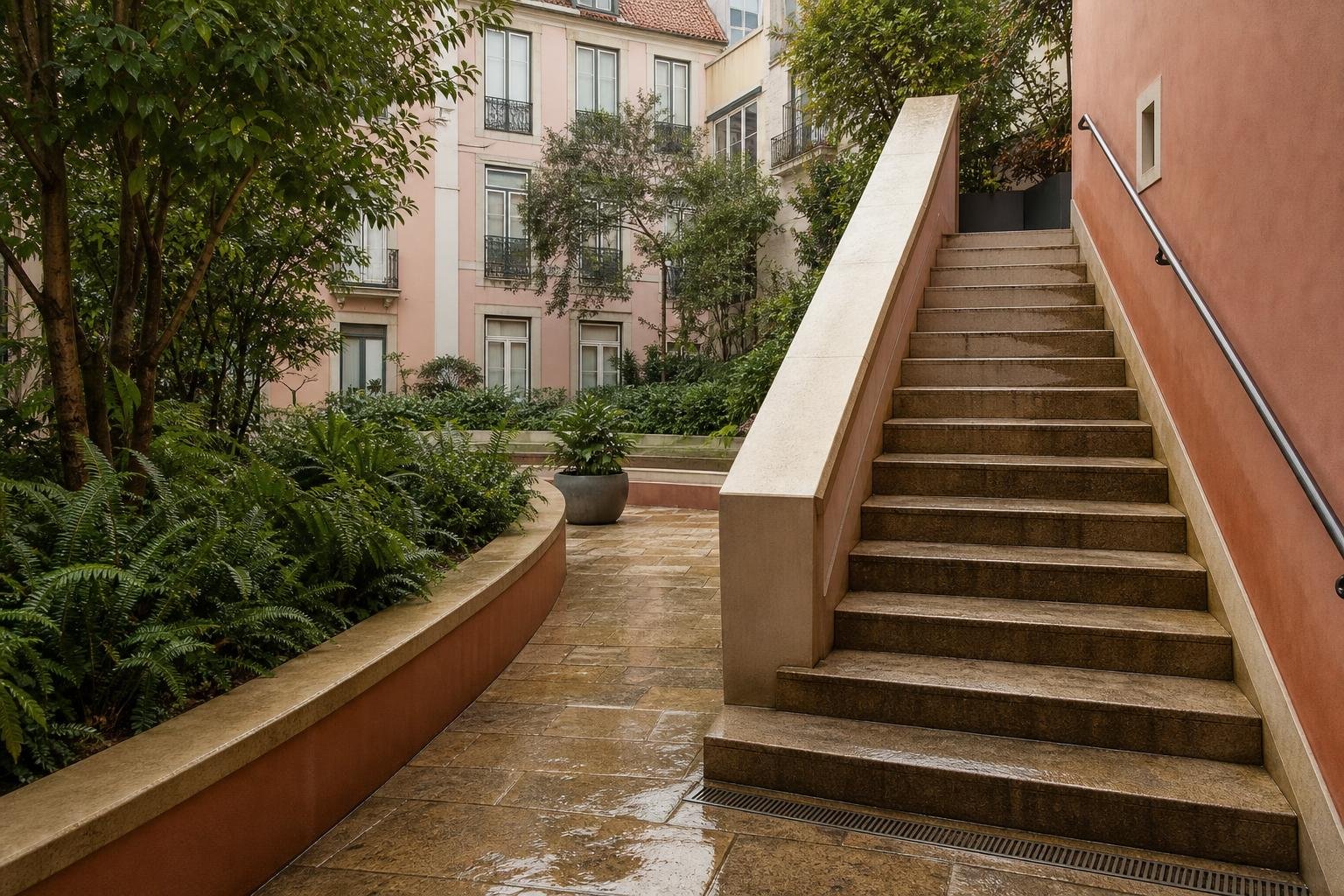
An outdoor staircase can look straightforward until the first wet day, a layer of fallen leaves or a quick repair that hides rather than resolves the cause. At houses, courtyards, apartment entrances and shared condominium areas, safety depends on the combined performance of geometry, surface finish, drainage, guarding, lighting and maintenance. Treating only the visible finish can leave a poor slope, undersized drain or badly positioned handrail untouched.
A sound intervention starts by watching how the route is actually used: where people approach from, where they place their feet, where rainwater travels and who may find the climb difficult. This guide sets out practical priorities before choosing stone, tile or concrete, bringing together everyday safety, durability and the realities of renovation work in Lisbon.
Start by diagnosing the whole route
Before ordering materials, inspect the stairs in both dry and wet conditions. Look for worn treads, cracks, loose pieces, polished patches, algae, persistent staining beside walls and standing water on landings. Check for unexpected differences in riser height, treads that are too short, and abrupt level changes at the top or bottom of the flight. Small irregularities repeated along a staircase become much more hazardous in poor light or when someone is in a hurry.
The assessment should cover the complete route rather than the steps alone: the approach path, threshold, landings, connection to the door, walls, guards and water outlets. If the stairs serve several homes, speak to daily users and note any slips, water entering the building or difficulty carrying pushchairs and shopping. This first review helps distinguish cleaning and local repair from a renovation that needs levels and drainage to be redesigned.
Where work affects common elements or significantly changes the exterior, check the planning route early. Lisbon City Council’s information on building-work licensing explains that construction, reconstruction, extension, alteration, conservation and demolition works may require prior control depending on the circumstances.
Consistent steps matter more than an expensive finish
The aim is not a grand staircase; it is a predictable walking rhythm. Within one flight, tread depth and riser height should remain consistent because the body quickly learns the climbing pattern. One step that is higher, lower or partly sunken is a common trip hazard. Landings should provide genuine room to turn, open a door or pause without standing on the first step.
Avoid patches that create thin lips, vulnerable edges or treads sloping forwards. Any fall needed for drainage must be designed across the whole assembly and must never turn the walking surface into an unstable slope. For escape routes covered by fire-safety rules, there are specific requirements for continuous handrails, slip-resistant finishes and guards; consult the regulation published in Diário da República before assuming that a decorative solution is enough.
If risers need correcting or the base has to be rebuilt, treat the staircase as a small construction element rather than a simple finish replacement. It is worth revisiting the principles of workmanship, inspection and longevity in how to ensure the quality and durability of a building.
Choose grip for wet days, not the showroom
An exterior finish should be assessed when damp, dirty and worn, not only from a dry sample. Highly polished stone, smooth tile or paint without an appropriate system can become slippery. Texture, useful relief, wear resistance and ease of cleaning matter more than an initial shine. On existing stairs, the answer may be repairing pieces, fitting suitable strips or profiles and renewing joints; in other cases, replacing the finish and correcting the waterproofing beneath it will be the wiser option.
Do not mistake excessive roughness for safety. An overly aggressive surface traps dirt, is harder to wash and can wear unevenly. Choose a finish designed for outdoor use and compatible with the substrate, sun exposure and planned cleaning products. Step edges deserve particular attention: they should be visually readable, impact resistant and free from a projection that catches footwear.
For help comparing materials, grip and substrate preparation, see Obra Lisboa’s guide to non-slip outdoor flooring for balconies, patios and home entrances. The right selection always depends on water, use and installation detailing together.
Give water a clear route that can be maintained
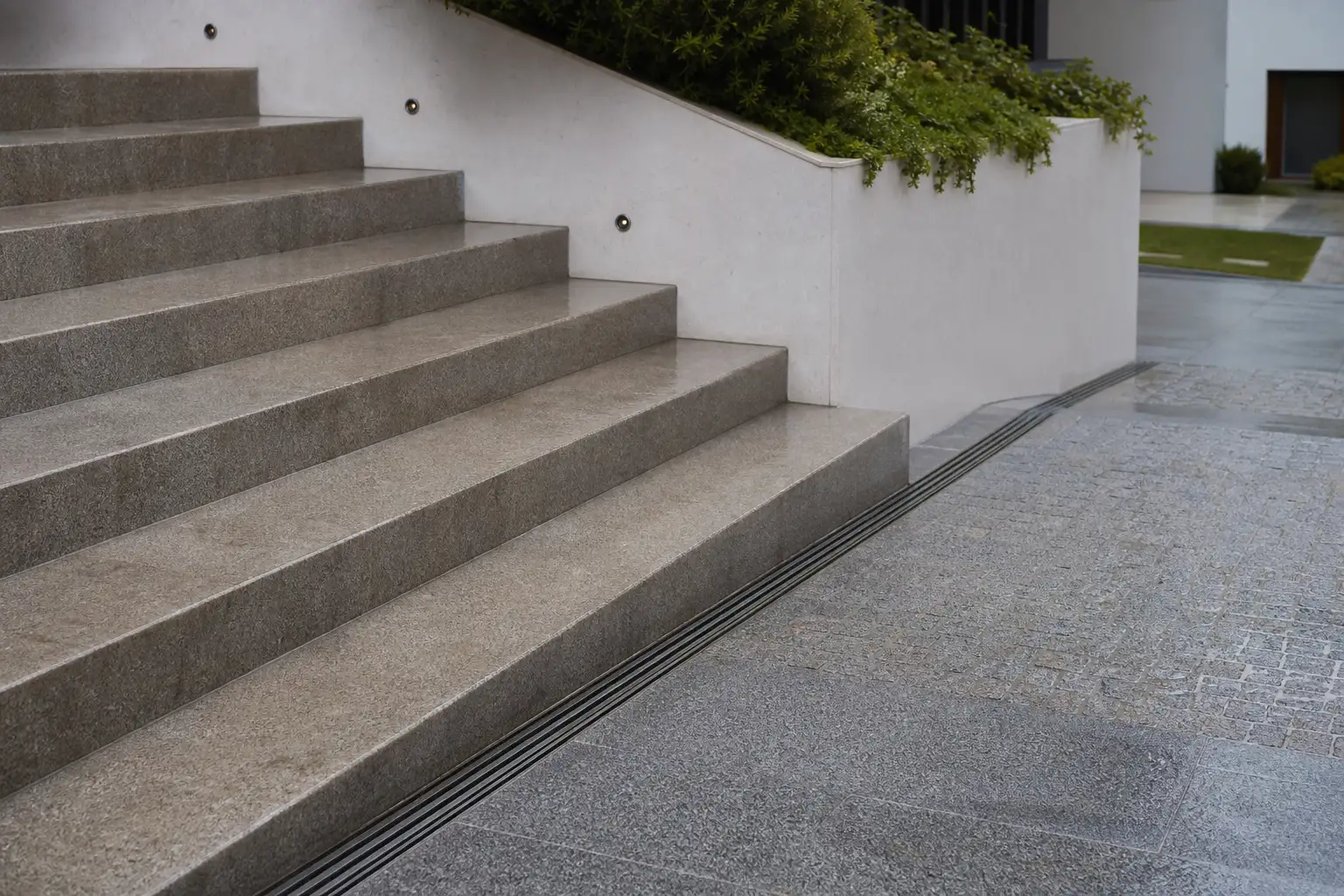
Water should not remain on treads or be directed towards a wall, door or finish joint. Each flight and landing needs a subtle but continuous fall towards a collection point sized for the expected flow. Gullies, linear channels and grilles work only when they sit at the correct level, are not undersized and can be cleaned. An attractive grille that fills with leaves stops functioning as drainage precisely when it is most needed.
Check where water goes after it disappears from view. Improvised outlets can stain façades, saturate planting beds, wash out joints or discharge into neighbouring areas. In larger interventions, the rainwater system should be integrated into the specialist design. Lisbon City Council expressly includes wastewater and rainwater networks and drainage design among technical specialist projects; review its guidance on specialist projects before closing the finished surface.
Protecting walls and junctions is inseparable from this decision. Stairs with no puddles can still create leaks if they throw water against the façade or leave joints open. Learn what to check in protecting windows and façades during external works.
Handrails, guards and lighting must work as one
A firm, continuous handrail provides real support, especially on the way down and when the finish is wet. It should be comfortable to grip, follow the flight logically and have no loose brackets, sharp edges or interruptions where a hand needs support. Wherever there is a drop, guards should prevent falls without creating climbable points or unsuitable gaps. Do not select these elements solely because they match the gate or façade.
Accessibility should be considered even in a house occupied by people with no current mobility limitations. The accessibility framework published in Diário da República demonstrates the importance of landings, gradients and usable routes; the application to a particular project depends on the building and scope of work. When stairs become a barrier, a ramp, lifting platform or reorganised entrance may be safer than adding more steps.
Lighting should reveal the first and last tread and every change of direction without glare. Use directed, weather-protected lighting with exterior-suitable circuits and controls. Sensors can be helpful, but should not leave someone descending in darkness because of a delay or failed detection.
Plan the works and maintenance so the improvement lasts
Set the work out in stages: measured survey and levels, diagnosis of the substrate and water path, guard solution, material selection, sample or trial area, installation and a final check with the stairs wet. Ask for quotations to identify demolition, waterproofing, levelling, drainage, finishes, metalwork, electrical work and reinstatement separately. This prevents comparisons between one proposal that corrects the hidden problem and another that merely covers it.
In a condominium, arrange alternative access, notices, protected walkways and daily cleaning. If the stairs are the only route, the work sequence must retain safe passage or provide a viable alternative. After handover, establish a simple routine: remove leaves, clear grilles, tighten fixings where needed, inspect joints and deal promptly with algae or darkened areas. Preventive maintenance costs less than repair work triggered by a leak or an accident.
For a structure for periodic inspections, see building maintenance: what property owners need to know. Dated before-and-after photographs, material records and supplier contacts will also make it easier to keep the staircase safe in the years ahead.
Assessing outdoor stairs at a house or condominium in Lisbon? Obra Lisboa can help turn a site assessment into a clear intervention plan focused on safety, drainage and durable execution.
Editorial image; it does not depict an Obra Lisboa project.

Obra Lisboa