INE’s median-price figures can frame a purchase in Lisbon, Cascais or Oeiras, but they cannot tell you what to offer for a particular flat or what its renovation should cost. In the second quarter of 2026, Lisbon recorded €5,299/m², Cascais €5,200/m² and Oeiras €4,704/m²; these are completed-sale references, useful for opening the analysis rather than closing an offer.
Anyone buying to renovate should combine the municipality data with the street, the actual condition of the unit, likely works to the building and financing costs. That approach prevents a high local average from becoming an excuse to accept expensive defects or to assume a future uplift that has not been earned.
Contents
- What changed in the Greater Lisbon market in 2026?
- Why a median price is not an offer price
- How to separate location value from renovation value
- Which numbers should be in your offer calculation?
- Does the new-versus-existing gap change the renovation decision?
- How to proceed without treating a market trend as a guarantee
What changed in the Greater Lisbon market in 2026?
The INE release on second-quarter 2026 local housing prices describes a market that remains under pressure: Portugal’s median sale price was €2,445/m², up 18.4% on the same quarter of 2025, while the number of transactions fell by 9.0%.
Across Greater Lisbon, the pace was uneven. Lisbon rose 8.9% year on year and Oeiras 13.0%, both below the national rate; Odivelas matched it. That does not make Lisbon inexpensive. It only means its rate of increase slowed relative to other markets.
For a buyer, the practical consequence is straightforward: do not use “prices are rising” as a decision rule. Compare properties within the same municipality that have similar size, type, lift access, orientation, building condition and renovation needs.
| Municipality | Median housing price | Year-on-year change |
|---|---|---|
| Lisbon | €5,299/m² | 8.9% |
| Cascais | €5,200/m² | Not stated in this summary |
| Oeiras | €4,704/m² | 13.0% |
| Portugal | €2,445/m² | 18.4% |
Why a median price is not an offer price
The indicator measures registered sales and uses the median, meaning the central value of the observed transactions. It is not a bank valuation, it does not include the renovation you are planning, and it does not automatically adjust for differences between a quiet street and a noisy avenue.
Timing matters too. INE local statistics use a 12-month reference period to reduce short-term swings and changes in the mix of homes sold. They are useful for identifying a trend, but they move more slowly than the listings you may see in one week.
Use the price per square metre in three ways: to see whether the asking price is far from the municipal market; to prepare questions for the seller; and to decide whether technical due diligence is worthwhile. Do not treat it as an automatic ceiling. A dark ground floor, an unmaintained roof, or a unit with inconsistent documentation may still require a discount in an expensive municipality.
Before discussing finishes, confirm that storage, parking or a terrace are actually included in the legal documents. See our guide to verifying storage or parking before buying.
How to separate location value from renovation value
In a high-price market, buyers often credit renovation with value that mainly comes from the location. A new kitchen can make a home more practical and easier to sell; it cannot cure a cramped layout, a deteriorating façade, ongoing noise or poorly understood condominium costs.
Make two separate lists. The first covers what renovation cannot change: orientation, floor level, lift access, transport connections, views, noise, common-part condition and building rules. The second covers what works can genuinely improve: electrical installation, internal plumbing, kitchen, bathroom, lighting, storage, windows where permitted and thermal comfort.
Then request a quote by scope, rather than a vague price “per square metre”. Compare demolition, protection of common areas, specialist work, materials, exclusions, ordering lead times and reinstatement. A defined renovation scope protects the purchase decision; a short list of finishes merely postpones the difficult questions.
If the flat contains older interior alterations, check whether they align with the documentation available before assuming you can redistribute the layout. Opening new openings or removing walls without structural confirmation is not a value calculation.

Which numbers should be in your offer calculation?
Start with a total cost of entry rather than the purchase price alone. Add the price, acquisition taxes and charges, financing, works, essential equipment, condominium costs, potential building repairs and a reserve for technically justified unknowns. That reserve is not there to cover a poorly specified quote; it is there for concealed conditions found after finishes or services are opened up.
Financing deserves its own line. In September 2026, the implicit interest rate on housing loans rose to 3.194%, and interest again accounted for more than half of the average instalment, according to the INE monthly housing-credit release. A modest change in the monthly payment can reduce the budget available for necessary works.
- Set a total limit you can carry without relying on an optimistic future sale.
- Separate urgent works from improvements that can wait one or two years.
- Ask the condominium for recent minutes, budget, insurance and details of approved or discussed works.
- Make the offer conditional on document and technical checks appropriate to the property’s value and condition.
Does the new-versus-existing gap change the renovation decision?
It does, particularly when you are comparing a flat needing work with a newly built, ready-to-live-in alternative. In data covering July 2025 to June 2026, Lisbon had the largest gap between median new and existing-home prices among the most populous municipalities: €6,434/m² for new homes and €5,030/m² for existing homes.
That difference is not a renovation allowance for turning every older property into the equivalent of a new one. A recent building may include a lift, parking, insulation, new services and fewer immediate maintenance needs. An older building may offer location, ceiling height, materials and character that are difficult to reproduce, while also requiring collective decisions on the roof, service stacks, façade or lift.
Read the comparison as a project question: does the existing home have qualities that justify the works and the risks? If so, set a realistic brief. If not, a lower entry price may simply move cost and uncertainty into the following years.
How to proceed without treating a market trend as a guarantee
The October 2026 data describes past sales; it does not guarantee the next valuation, loan approval or renovation outcome. It is also worth tracking the construction context. The INE portal reported a 7.5% increase in new-housing construction costs in August 2026. A renovation does not follow that index directly, but labour, materials and availability still influence quotations and lead times.
Turn market research into a verifiable decision: save comparable sales with known dates and condition; visit when noise is highest; read condominium documentation; obtain a work scope; then decide the highest sensible price. If you proceed, tie payments to confirmed work and to hold points before walls, floors or ceilings are closed.
A well-prepared purchase does not try to predict the market. It limits what you will pay for issues you can solve and refuses to pay for those you cannot control.
Key takeaways
- Use INE median values as municipal context, not as an automatic offer price.
- Separate permanent location factors from improvements a renovation can actually deliver.
- Include condominium exposure, finance and common-part works in the total decision cost.
- Request documents and a technical scope before assuming the property will gain value after works.
If you are considering buying and renovating a Lisbon apartment, speak with Obra Lisboa before finalising the work brief. A clear scope can turn the property assessment into an executable plan with defined priorities and decisions.
Sources and further reading
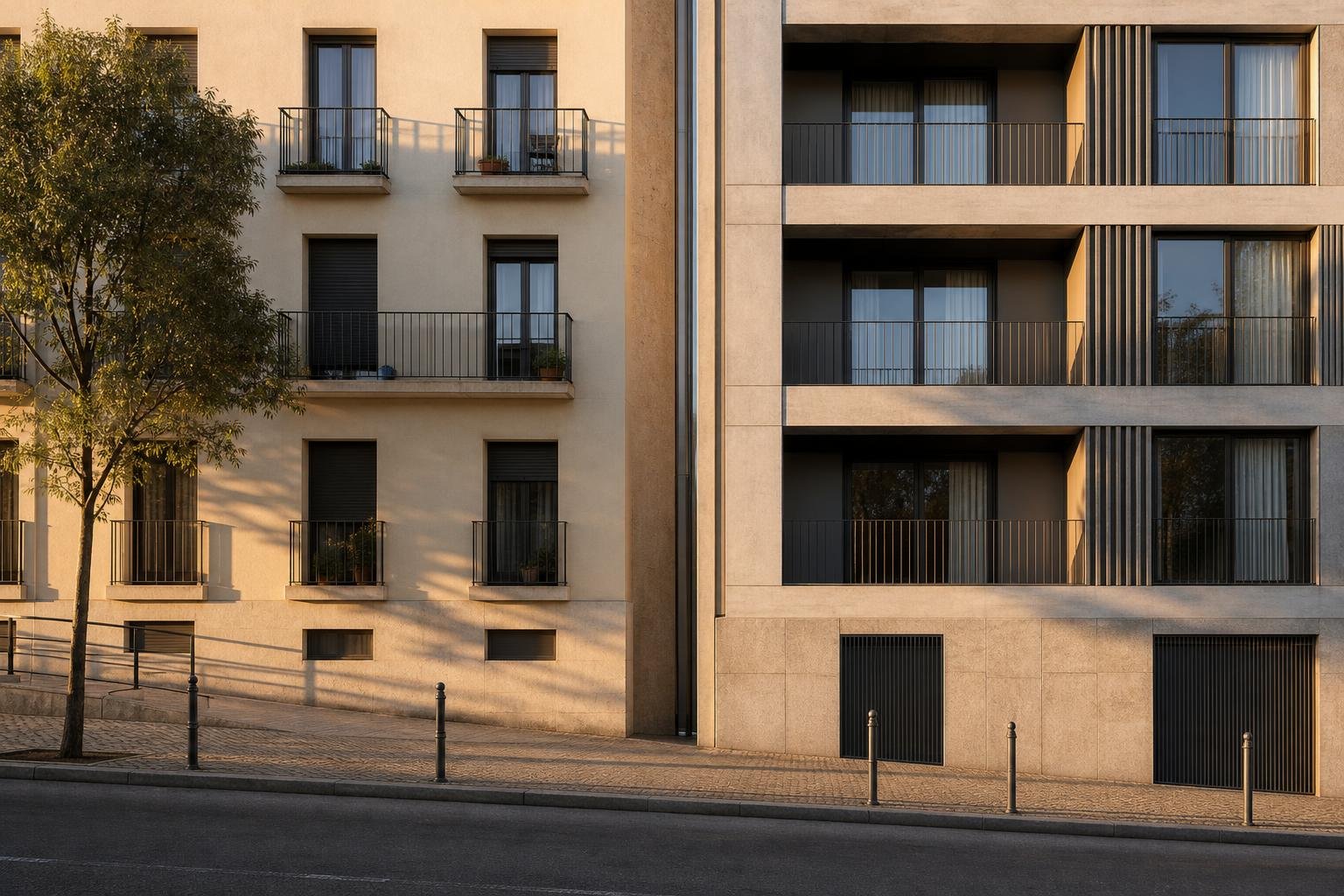
Editorial image; it does not depict an Obra Lisboa project.

Obra Lisboa