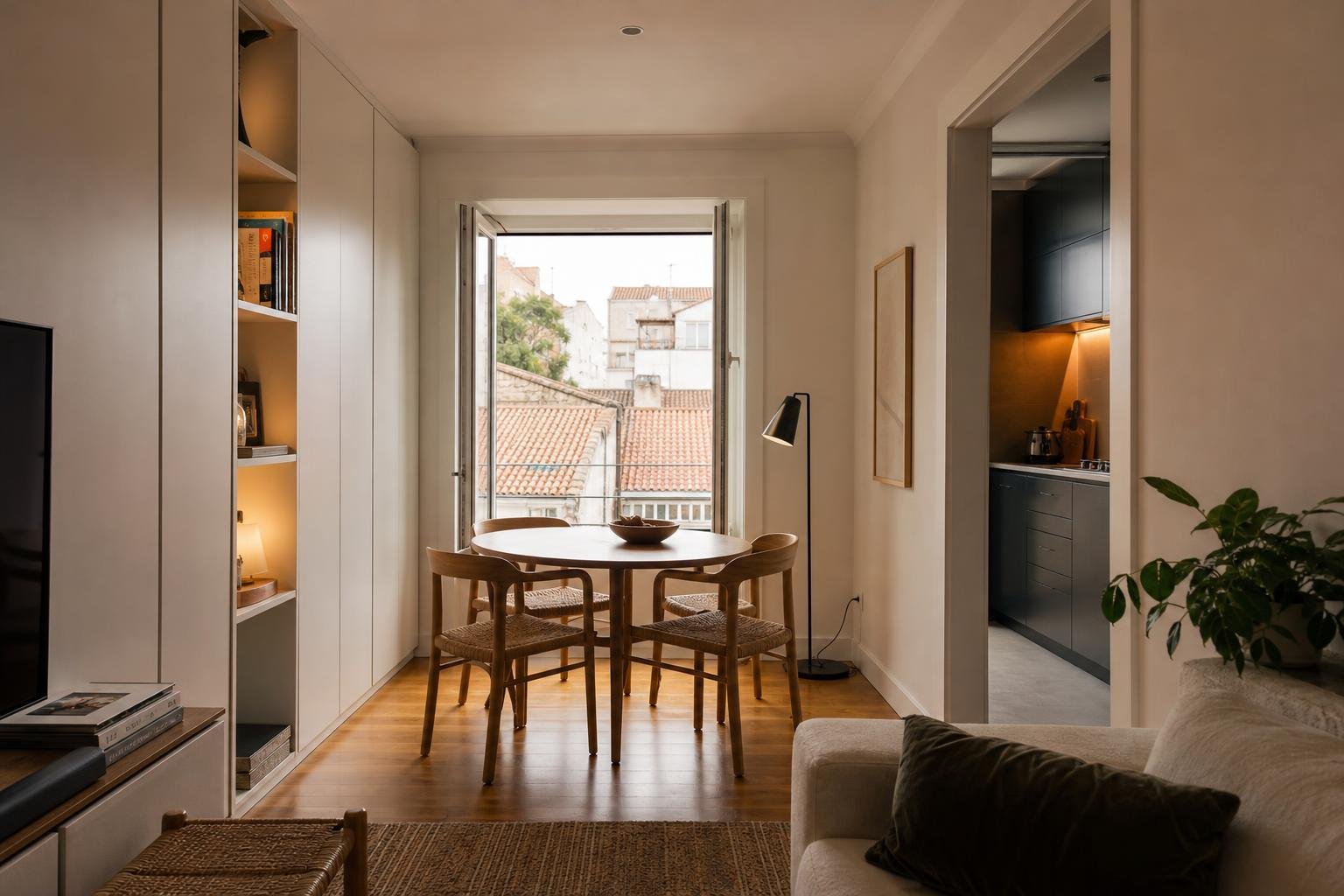
In a small room, curtains should start as high as possible, extend beyond the window and finish without tangling with furniture or pooling carelessly on the floor. That arrangement makes the wall read as taller, brings in more daylight when the fabric is open and keeps the window usable. In Lisbon, where late-afternoon sun can make a living room uncomfortable, the choice also needs to balance transparency, blackout and solar control.
Contents
- Why do high curtains change the way a room feels?
- How wide should the track be for the window to remain usable?
- Is one layer enough, or should fabrics be combined?
- How should a south- or west-facing room be handled?
- Which mistakes shorten the life of the installation?
- Checklist before ordering made-to-measure curtains
Why do high curtains change the way a room feels?
A track or pole placed immediately below the ceiling creates one vertical line from ceiling to wall and floor. The window stops looking like a small feature placed halfway up the wall and becomes part of a full-height composition. It works best when the curtain has enough width to stack away without covering the glass.
Do not force this solution where the track would interrupt a cornice, cover a shutter box that needs access or obstruct a balcony door. Before ordering fabric, check operating mechanisms, handles and the opening direction of every window leaf. A fluted-glass interior door can carry daylight into a darker hall without fully exposing the room, but it does not remove the need to keep windows and their shading practical.
When deciding whether window improvements or solar control should form part of the works, see the ADENE tools for home comfort and energy efficiency. Curtains are a useful layer, but they do not by themselves correct poor window performance, draughts or an awkwardly arranged room.
How wide should the track be for the window to remain usable?
Measure the wall, rather than the window opening alone. The track should extend on each side far enough for the gathered fabric to sit mostly on solid wall. That lets in more light and allows the opening leaf to move without rubbing against the curtain. In a narrow room, reserve this extra width only on the side that will not interfere with shelving, a sideboard or the route to the balcony.
Set the projection as well: curtains, poles and blinds all occupy space in front of the wall. Where a sofa, desk or dining table sits close to the window, leave enough room for the fabric to fall freely and for someone to open the window without dragging furniture. A poorly positioned table can waste more usable floor area than a properly sized curtain; compare the layout choices in round or rectangular table in a small living room.
- Measure from the fixing point to the finished floor, not to a floor still under construction.
- Mark the window-opening arc on the floor with masking tape before fixing the track.
- If there is a radiator, grille or air-conditioning unit, do not hide it behind heavy fabric.
| Option | Best use | Main caution |
|---|---|---|
| Sheer or translucent curtain | Daytime privacy and softer daylight | Does not solve strong glare or provide night blackout |
| Opaque side curtain | West-facing room, projection or occasional rest | Needs stacking space beyond the glazed area |
| Roller blind close to the glass | Window with furniture close by | Can look more technical and gives less flexible light control |
Is one layer enough, or should fabrics be combined?
In a living room used for relaxing, working and hosting, two layers often deal with separate needs: a sheer filters the view and softens daylight; a denser layer closes in the evening, reduces screen reflections and gives the room a more sheltered feel. An opaque curtain does not replace effective external protection against direct sun, although it helps manage glare and privacy.
Start with the function the room lacks. If the problem is exposure to the street, a sheer layer may be enough. If the room is used for television, video calls or late-afternoon direct sun, add a second layer that stacks on the less-used side. In a shallow room with limited daylight, avoid making a dark, thick curtain the first visible layer: in daytime, it can visually occupy the whole wall.
Choose a light fabric with texture visible at close range beside the glass, then let the blackout or solar-control layer stack to one side. Check each sample in daylight and with the lights on: a colour that appears restrained in daytime may make the room feel heavy after dark.

How should a south- or west-facing room be handled?
In south-facing rooms, the regular issue is prolonged brightness; in west-facing rooms, it is accumulated late-afternoon heat. Start by noting the hours when direct sun enters, where it falls on the sofa and whether it reaches a screen. Then place the table and seating accordingly instead of expecting curtains to correct an awkward layout.
ADENE identifies shading to limit solar gains and natural ventilation when outside air is cooler as useful summer-comfort measures. See ADENE’s explanation of shading and night ventilation. In practical terms, close the more protective layer before the sun reaches the glass; doing so after the room has heated up has less effect.
If the room has air conditioning, keep a clear air path around the indoor unit and do not fasten fabric in front of the discharge. Curtains manage light, but they do not provide fresh-air ventilation; that distinction matters in a tightly closed home. See also why air conditioning does not ventilate your home.
Which mistakes shorten the life of the installation?
The most common mistake is ordering first and measuring later. Another is choosing fabric too heavy for the track or fixing a pole only to a superficial finish. In old plaster walls, suspended ceilings or service boxes, confirm the substrate before drilling. A sagging curtain or a pulled-out fixing quickly ruins the effect you were trying to create.
- Request a sample and view it in morning light, afternoon light and artificial light.
- Test the fabric against the glass: some pale colours reveal more of the room at night than they seem to in a shop.
- Check that the curtain can be removed and washed without dismantling the entire track.
- Do not allow hems to gather dust on the floor, especially beside balcony doors.
For home work areas, DGS advises having a window for daylight and airing the room, together with task lighting where required. That supports keeping the window accessible and providing a dedicated work light rather than permanently closing the room with curtains. Read the DGS guidance for working from home.
Checklist before ordering made-to-measure curtains
Photograph the wall straight on and from the side, record the final floor height and mark outlets, radiators, handles and shutter boxes. Decide whether the priority is daytime privacy, glare control, occasional blackout or thermal comfort. Only then choose the track, fabric and stacking position.
During a renovation, treat curtains as a coordinated decision with the ceiling, paint, lighting and furniture. Track position affects the ceiling detail; the table position affects opening clearance; fabric colour changes how much light is reflected into the room. It is a small detail that prevents purchases ending up pushed against a wall or kept closed all day.
Before placing the final order, open the window with the chair or table in position, check the distance to the skirting board and test whether the stacking side remains clear. This simple check prevents a good source of daylight from becoming an awkward part of the room.
Key takeaways
- Fit the track high and leave enough wall beside the opening for the curtain to stack away from the glass.
- Measure opening clearance, furniture and projection before ordering fabric.
- Combine a sheer layer with a control layer when the room has several uses.
- Use curtains for light and privacy; address overheating with suitable shading and ventilation.
If you are renovating a living room, include window positions, lighting and furniture in the initial survey before ceilings are closed or made-to-measure items are ordered. Obra Lisboa can help coordinate those interior decisions as part of a planned renovation.
Sources and further reading
- shading and night ventilation
- DGS guidance for working from home
- ADENE tools for home comfort and energy efficiency
Editorial image; it does not depict an Obra Lisboa project.

Obra Lisboa