More qualified construction companies in the market does not guarantee that your renovation can start on the date you want. In 2025, the number of valid construction licences rose to 40,293, yet every company has value-class limits, particular trades, direct crews, subcontractors and ongoing jobs. For anyone renovating a Lisbon flat, the useful decision is to stop looking only for someone who can start now and compare real capacity, scope and work sequence.
There is also pressure on programmes and execution costs. In September 2026, the new-housing construction cost index increased by 7.4% year on year; materials rose by 7.2% and labour by 7.7%. Those figures do not set the price of a refurbishment, but they help explain why booking trades and confirming supplies early is sensible. See the current release on the Statistics Portugal website.
Contents
- What has changed in construction-company numbers?
- Licence, certificate and availability are different things
- Why programmes remain tight even when quotations are available
- How to request quotations that make real dates comparable
- What makes a programme credible rather than merely attractive?
- What to do now if you want work to begin in the coming months
What has changed in construction-company numbers?
IMPIC’s annual indicators record 40,293 valid construction licences in 2025, up from 37,606 in 2024. The same table shows valid certificates falling from 31,481 to 27,065. The figures point to a formally broad market, but they are not a list of crews available for a small or medium-sized refurbishment.
A licence or certificate confirms administrative eligibility. It does not show how many people are free, whether the company directly carries out plumbing, electrical work and joinery, or whether it has room to coordinate deliveries in an occupied building. Treat the IMPIC annual indicators on licences and certificates as a market snapshot, not as a promise of a start date.
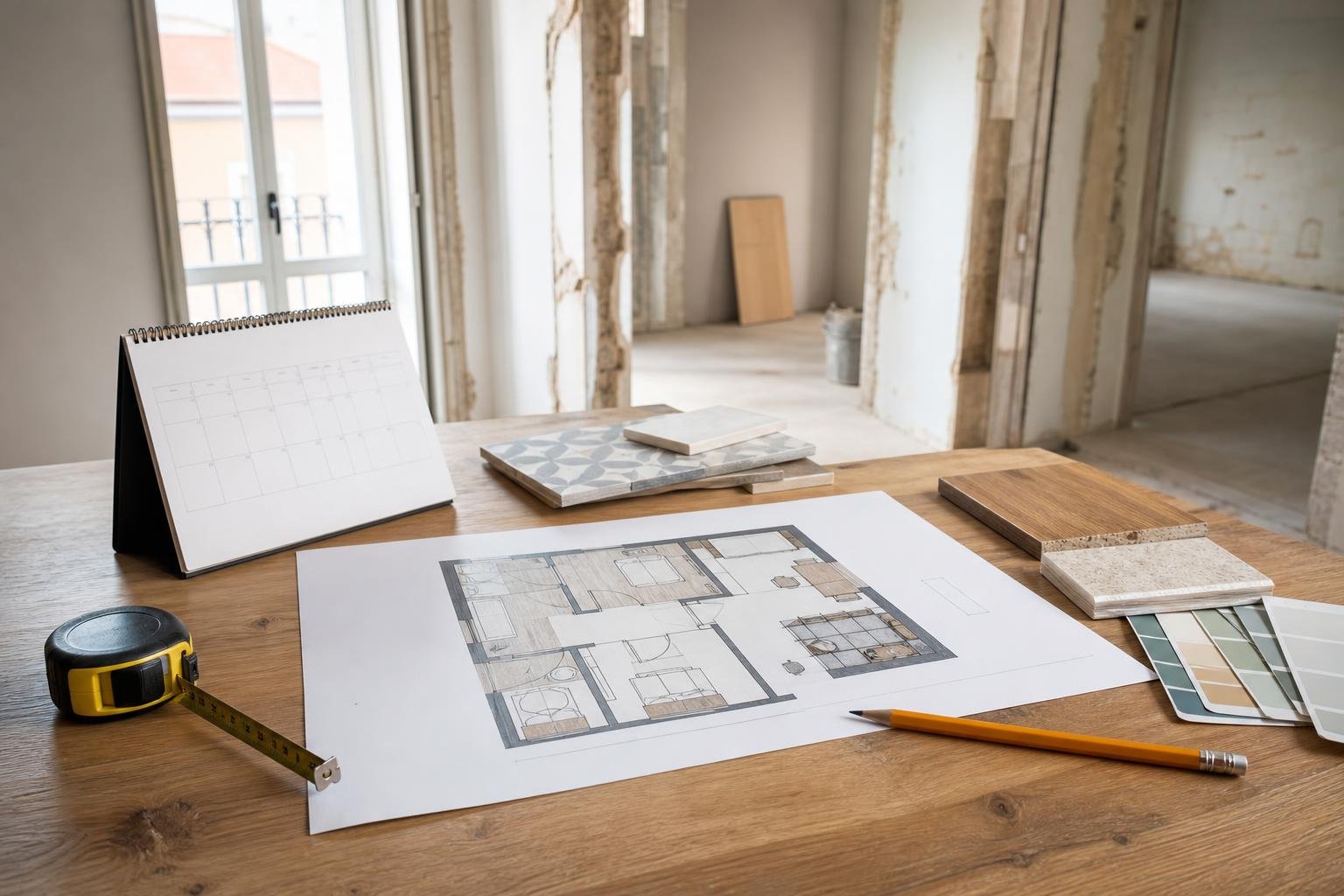
For a kitchen and bathroom refurbished at the same time, the programme only works when demolition, plumbing, electrics, waterproofing, finishes, cabinets and worktops can all follow compatible work fronts. The first company to reply may not be the company that can maintain that sequence.
Licence, certificate and availability are different things
Law 41/2015 sets the framework for construction activity and defines licences, certificates and value classes. Check eligibility before appointing a contractor, but do not stop there: eligibility answers “can this company legally undertake the work?”; planning answers “can it deliver this scope, in this home, during this period?”. Read the legal framework for construction activity before treating those as one question.
- Eligibility: a valid title appropriate to the contracted work.
- Capacity: an available site lead, crews and subcontractors at the critical dates.
- Coordination: someone to confirm decisions, measurements, orders and changes.
- Logistics: building hours, lift use, protection of common areas, deliveries and waste removal.
Ask for these four points to be stated plainly in the quotation or start-up plan. A vague answer about labour often returns later as an unexplained gap between trades.
| Check | Useful question | What to request |
|---|---|---|
| IMPIC title | Is the company qualified? | Identification and an up-to-date check |
| Programme | When does each trade attend? | Dates, dependencies and estimated duration |
| Team | Who coordinates on site? | Named person and contact details |
| Scope | What is excluded from the price? | Schedule of works, materials and exclusions |
Why programmes remain tight even when quotations are available
A renovation does not use one crew from its first day to its last. A contractor may be able to start demolition next week but have no window fitter, stone installer or cabinet fitter free when the project reaches that stage. This is why a start date without a procurement plan has limited value.
The increase in labour costs matters particularly for work with many on-site hours: controlled demolition, subfloor corrections, building services, repairs in older buildings and finishes. It does not mean every quotation must rise by the same percentage. It does mean diary space and duration estimates deserve careful written treatment.
Do not let programme pressure become a reason to accept vague scope. If materials change, approve the change in writing. Our guide to material substitutions without losing control helps connect approval, cost and timing before the change reaches site.

How to request quotations that make real dates comparable
Send the same information pack to every candidate. Loose photographs and an oral wish list create quotations that cannot be compared and dates that are too optimistic.
- Define the rooms included and what remains in place.
- State whether you will live in the home during the work.
- Include plans, known dimensions and photographs of service areas.
- List equipment already purchased and delivery deadlines.
- Request price, exclusions, estimated duration and client decision points.
- Confirm whether common-area approval or public-space occupation may be needed.
In flats, a technical visit before a final quotation is especially important where there are old walls, narrow access, a small lift or service risers with no clear access. It is also worth identifying where materials and waste can be kept: an arrangement that works in a house can obstruct an apartment building.
If you have not chosen finishes or the kitchen yet, mark those decisions as pending. The contractor can then give an honest start window instead of assuming lead times that nobody has checked.
What makes a programme credible rather than merely attractive?
A credible programme shows allowances and visible dependencies. It should make clear, for example, that a final worktop template follows wall finishes, and that cabinet installation depends on dry walls, protected flooring and confirmed water and electrical points.
Be cautious with quotations that give a total duration without stating who completes each stage, or that treat items you are buying as though they were already available. A contractor who can start immediately but cannot name a site lead, trade sequence or procedure for additional work also deserves scrutiny.
Before signing, hold a short start-up meeting covering access, keys, water isolation, building protection, condominium contact, material storage and change approvals. If common parts or the façade are affected, also review construction boards and condominium notices for a Lisbon renovation.
What to do now if you want work to begin in the coming months
Start with scope and with decisions that block ordering: layout, openings, windows, kitchen, finishes, sanitaryware and lighting. Then seek quotations with a start window and an execution sequence, rather than demanding a fixed date before there is enough information to support it.
Allow time to compare two or three like-for-like quotations. The fastest contractor may suit the project if scope is settled and materials are secured; it is not automatically the better choice if it relies on rushed selections or crews yet to be confirmed.
A predictable renovation starts with a clear appointment: a qualified company, a price tied to scope, an identified lead and a programme that accepts the flat’s real dependencies. If one of those elements is missing, ask for clarification before paying a deposit or ordering materials that are hard to change.
Key takeaways
- Check IMPIC eligibility, then assess the actual team, site lead and programme.
- Give every contractor the same scope so price, exclusions and dates can be compared.
- Do not accept a start date without a sequence of trades and critical orders.
- Record every material, price and programme change in writing.
If you are preparing a renovation in Lisbon, speak with Obra Lisboa about the scope, the decisions that shape the programme and a phased quotation before appointing a contractor.
Sources and further reading
- IMPIC annual indicators on licences and certificates
- legal framework for construction activity
- Statistics Portugal website
Editorial image; it does not depict an Obra Lisboa project.

Obra Lisboa