A flat near a railway line can be a sensible purchase when the price, intended use and comfort observed on site work together. Being close to a station can simplify daily travel, yet it does not remove the risk of noise, vibration, dust or limited use of a balcony. Before making an offer, visit the property at different times, read the building records and treat any acoustic work as a possible cost rather than a guaranteed improvement.
Contents
- Being near the line is not enough information
- How to visit when the property is actually being tested
- Noise, vibration and insulation are separate checks
- Which records and questions reduce surprises
- How to include possible works in your offer
- When to proceed, renegotiate or stop
Being near the line is not enough information
“Near the train” can describe very different conditions. One flat may be 150 metres from a station but screened by other buildings; another may be on the second floor, with its living room facing a curve, level crossing or braking area. Straight-line distance says little without considering orientation, floor level, obstructions and façade type.
Start by locating the bedroom and living-room windows, rather than simply finding the building on a map. Look for tracks, overhead line equipment, walls, embankments, platforms, metal bridges or railway equipment opposite the property. Then consider the street itself: road traffic, motorcycles, deliveries and waste collection can combine with rail noise.
In Lisbon, Lisbon Interactive provides noise maps. Use them to compare areas and prepare questions, but do not treat them as an indoor measurement. A map describes modelled environmental exposure; it cannot show the condition of that flat’s windows, shutter boxes, seals or air inlets.
How to visit when the property is actually being tested
One short viewing in mid-morning can hide the issue. Arrange at least two: one during a busy period and another in the evening or at night. If you intend to let the property, consider the routine a future tenant will have, especially in the bedrooms.
- Stay silent for five minutes with the windows closed, then open them.
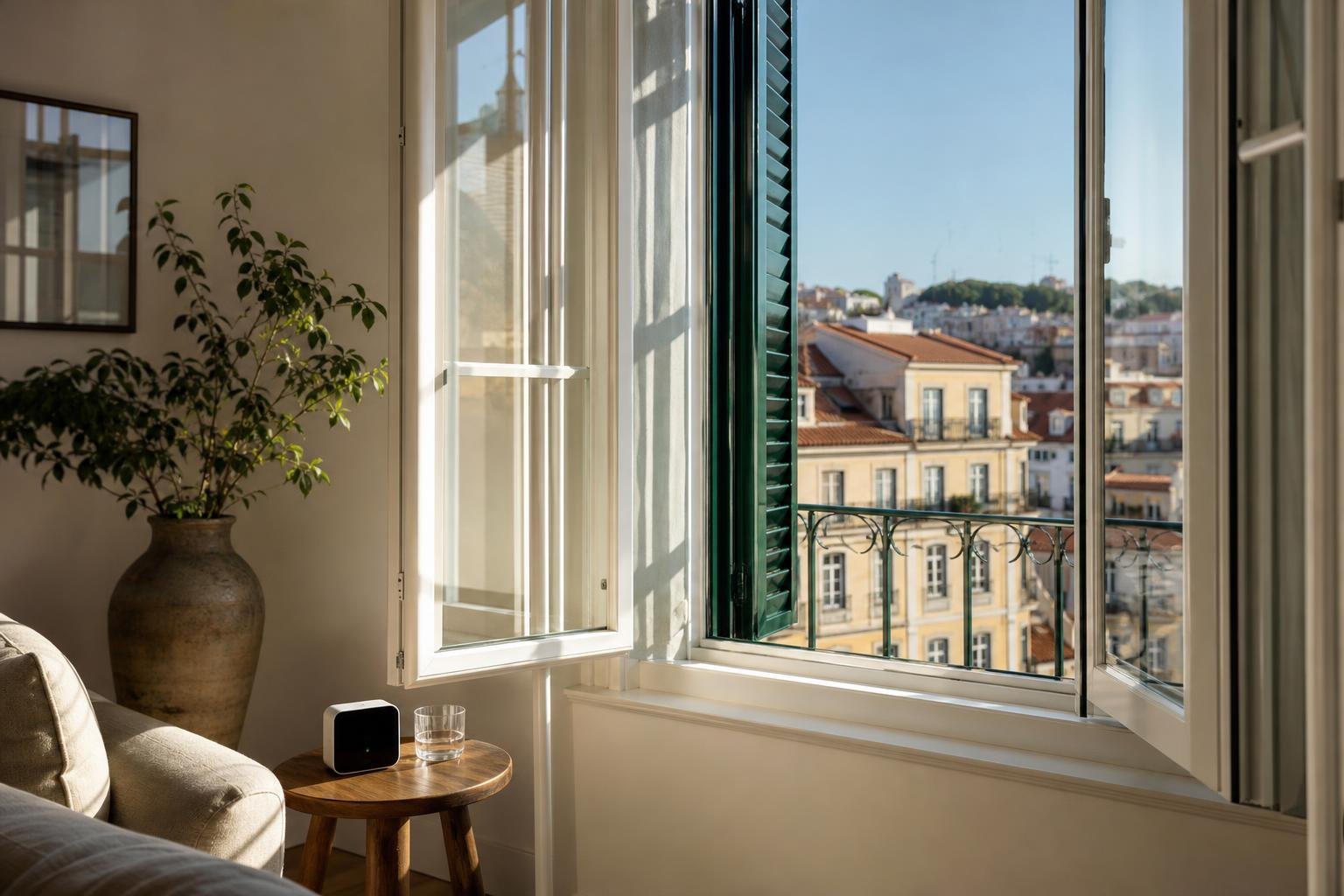
- Open and close every window; note gaps, resistance, glass movement and noise from shutter boxes.
- Ask for televisions, extractor fans and air conditioning to be switched off during the test.
- Stand by the façade and in the middle of the room when a train passes.
- Test the balcony, if there is one: it may be pleasant between services but difficult to use at busier times.
Listen for more than loudness. Low-frequency noise, squeal on curves, warnings and vibration noticed in doors, fittings or furniture can be more disruptive than steady sound. Record the time, room, window and what you felt. That note is more useful in a negotiation than the general impression that “there was some noise”.
Rail remains heavily used: Portugal recorded 62.9 million rail passengers in the second quarter of 2026, 6.2% more than in the same period a year earlier, according to Statistics Portugal. This does not predict noise on one street, but it is a practical reason not to assume services will be insignificant.
Noise, vibration and insulation are separate checks
Outside noise mainly enters through windows, air inlets, shutter boxes and gaps. Vibration may be felt through the structure, fixed elements and objects inside the home. Acoustic insulation is the ability of the envelope and internal partitions to reduce sound transmission. Improving a window may reduce airborne sound while doing little for perceived vibration.
The Portuguese Building Acoustic Requirements Regulation sets acoustic-quality requirements for construction, reconstruction, extension and alteration work. Its existence does not automatically certify the performance of an older flat, and it does not replace an assessment of the property you are considering.
For refurbished existing residential buildings, Ordinance 305/2019 sets specific technical rules and, in certain cases, allows requirements reduced by 3 dB. The buyer’s practical conclusion is straightforward: a recent refurbishment deserves detailed questions about façade work, but it should not be assumed to provide a complete answer to a railway setting.
| Observation | Cautious reading | Next step |
|---|---|---|
| Noise falls sharply when the window closes | The façade may be the main entry route | Check frames, glazing, seals and shutter boxes |
| Vibration in doors or objects with windows closed | Structural transmission or local resonance may be involved | Record the timing and seek technical advice before counting on a simple fix |
| Rear bedrooms are quiet but the living room is exposed | The home’s use may be reorganised | Check whether the layout can keep bedrooms on the more protected side |
| A balcony is highly exposed | Its outdoor value may be limited | Do not value it as a comfortable extension of the living room without testing it |

Which records and questions reduce surprises
Request the property-tax record, land-registry certificate, use licence where applicable, energy certificate and available plans. Check that the advertised configuration matches both the records and the built property. A changed layout may have moved bedrooms to the noisier façade or created an enclosed balcony that worsens ventilation and overheating.
Read condominium meeting minutes for at least the last two years. Look for references to window replacement, cracks, leaks, façade work, vibration complaints, roof works and approved costs. If the building has a rail-facing façade, ask whether there are recurring cleaning or maintenance difficulties.
Ask the seller or agent, in writing where possible: have formal noise complaints been made? What work was done to the windows, and when? Are there announced rail or urban works nearby? The answer may be incomplete, but the question creates a record and helps you decide what to verify independently.
Before proceeding, also compare the area that is genuinely usable with the advertised figure. Our guide to advertised, registered and usable area can help you avoid overvaluing enclosed balconies, storage or circulation space.
How to include possible works in your offer
Do not add window replacement to the purchase price as though it solves every effect of the line. First make a base-case assessment: is the home acceptable to you without intervention? Then create separate scenarios for adjustment and sealing, replacement windows, shutter-box treatment and a possible acoustic assessment. Some work requires coordination with the façade and condominium.
Avoid vague assurances such as “double glazing will fix it”. Glass specification, window airtightness, installation, air inlets and the wall connection all affect the result. A very airtight window also requires ventilation to be considered; blocking every air path to reduce noise can worsen condensation and mould. Read how to use window weatherstripping without blocking ventilation.
If your offer depends on work, obtain a technical description and estimate before giving up negotiation margin. In an apartment building, also check whether exterior changes, window appearance or access for works need condominium approval. For a rental purchase, allow for works, maintenance and potentially lower demand for exposed bedrooms; do not offset those uncertainties with an untested rent assumption.
When to proceed, renegotiate or stop
Proceed when the flat works at the most demanding time of day, the bedrooms have a realistic solution, the records reveal no added risk and the offer retains a margin for proportionate corrections. Renegotiate when discomfort is clear but localised and technically manageable, provided that you have enough information to obtain a costed approach.
Stop or pause the decision if there is strong, persistent vibration without an explanation, cracks needing assessment, documentary discrepancies, major unexplained works, or if the purchase only seems acceptable after costly and uncertain interventions. Being near transport is a characteristic of the property; it should not become a promise of future value growth.
The building’s wider exposure matters too. Before signing, review condominium financial risk before buying, especially where any façade intervention may overlap with common works already needed.
Key takeaways
- Visit at least twice and test every room with windows open and closed.
- Use noise maps to understand the area, never as a substitute for viewing the flat.
- Keep airborne noise, vibration and insulation separate: they can require different technical responses.
- Allow a margin for corrective work and condominium decisions before making an offer.
If the flat passes your purchase checks and needs work, contact Obra Lisboa to frame the renovation scope, façade interfaces and decisions to settle before appointing a contractor.
Sources and further reading
- Lisbon Interactive provides noise maps
- Portuguese Building Acoustic Requirements Regulation
- Ordinance 305/2019
- Statistics Portugal
Editorial image; it does not depict an Obra Lisboa project.

Obra Lisboa