A home fire extinguisher should be kept near an exit, in plain sight and within reach, and used only on a small fire that does not block your escape route. The key decision is not buying the cylinder: it is recognising that a smoke-filled kitchen, flames reaching the extractor hood or a fire that forces you too close are no longer situations to tackle alone. Plan prevention, keep the way out clear and treat the extinguisher as support for evacuation, never as a reason to stay.
Contents
- Is a fire extinguisher compulsory inside a flat?
- Which domestic risks should you reduce before buying equipment?
- Where should it go so that it is genuinely available?
- When is it safe to tackle an incipient fire?
- When should you leave instead of trying to fight the fire?
- How should this be built into a renovation?
Is a fire extinguisher compulsory inside a flat?
For the inside of a dwelling, Portugal’s fire-safety framework has specific exceptions from the general requirements that apply to other parts of a building. That does not make a portable extinguisher automatically compulsory in every flat, and it does not remove the need to look after installations, equipment and exits. The legal framework also distinguishes the owner’s responsibilities inside the home from the condominium’s responsibilities in common areas. Read the fire-safety rules published in Diário da República before assuming that equipment in the corridor serves your private home.
In practical terms, a domestic extinguisher can be sensible in a frequently used kitchen, a house with an attached garage or a room used for electrical equipment and tools. It cannot repair aged wiring, a gas leak or a poorly maintained fireplace. It is an extra response measure for an incipient fire, provided that you can leave without placing yourself between the fire and the door.
In an apartment block, do not remove or relocate equipment from common areas. Those items belong to the building’s safety system and must remain available where they were planned.
Which domestic risks should you reduce before buying equipment?
The best use of an extinguisher is never needing it. In the kitchen, do not leave oil cooking unattended, turn pan handles towards the inside of the hob and keep cloths, packaging, kitchen roll and utensils away from the cooking surface. Portugal’s Directorate-General of Health also advises setting the water-heater temperature to reduce scalding risk and keeping pan handles out of children’s reach. See the DGS guidance on preventing domestic accidents.
During a renovation, confirm three points before walls are closed or cabinets are ordered:
- circuits serving demanding appliances have suitable protection and capacity;
- the extractor hood and cooking zone can be kept free from grease build-up and combustible materials;
- the exit door and route to it will not be narrowed by an island, table, cabinet or temporary storage.
If sockets become hot, there is a burning smell, the consumer unit trips repeatedly or equipment shows signs of overheating, isolate the circuit when it is safe and arrange an assessment. Do not compensate for a fault with extension leads or adapters; first read what to do safely when a circuit breaker keeps tripping.
Where should it go so that it is genuinely available?
The right position lets you reach the extinguisher without crossing the highest-risk area. In a small kitchen, that normally means a wall by the exit door or in the immediate corridor, rather than the cupboard under the sink, behind the refrigerator or beside the hob. If a fire starts on the cooker, equipment installed above the worktop, over the extractor hood or in the adjacent cabinet may become unreachable within seconds.
Choose a stable location, visible to the adults in the home and protected from knocks, persistent damp and direct heat. Do not hide it merely to preserve the look of the kitchen: an unmarked cabinet door adds delay and uncertainty. In a house, consider the entrance floor and the link between garage and home as separate locations; an extinguisher stored in a utility room will not help with an incident by the kitchen.
Carry out a straightforward check twice a year: clear access, sound bracket, readable instructions, intact seals and maintenance indication within date. If children live in the home, explain that it is not a toy without locking it away so completely that an adult cannot respond quickly.

When is it safe to tackle an incipient fire?
Only try to use an extinguisher when all of the following are true at the same time:
- the fire is small and contained in one area;
- you have a clear exit behind you;
- there is no dense smoke, intense heat or flame climbing the wall or extractor hood;
- you know the extinguishing agent and how to operate it;
- everyone else, especially children or people with reduced mobility, is already moving away.
Keep your distance, direct the extinguishing agent at the base of the flames and leave if the fire does not subside immediately or grows again. Never throw water onto burning oil or fat: it can spread flaming liquid. Turning off the heat source, if it can be done without exposure, and smothering the fire with suitable equipment is safer than improvising.
Do not use water on energised electrical equipment. Cutting power at the consumer unit is only appropriate when it is outside the danger area and can be reached safely. Circuit protection needs its own renovation planning; an extinguisher is no substitute for that work.
When should you leave instead of trying to fight the fire?
Leave, close the door behind you if you can do so without delay, and call 112 if smoke is building up, flames rise above worktop height, there is fire in an electrical panel, duct, built-in appliance, gas cylinder or gas appliance, or if the only exit passes close to the fire. Do not go back for documents, pets, phones or the extinguisher itself.
Smoke can damage the airways and heat can cause burns even without direct contact with flames. The DGS highlights warning signs including breathing difficulty, altered consciousness and facial burns; if these occur, remove the person from exposure and seek emergency assistance. Do not attempt to cross a smoke-filled room.
For a small burn without blisters, cool the area under cold running water for several minutes and protect it with clean material. Do not apply butter, oil, toothpaste or home remedies. Blisters, lost skin, extensive burns, burns to the face, hands or genitals, or burns linked to smoke inhalation need clinical assessment, as set out in the DGS guidance on burns.
How should this be built into a renovation?
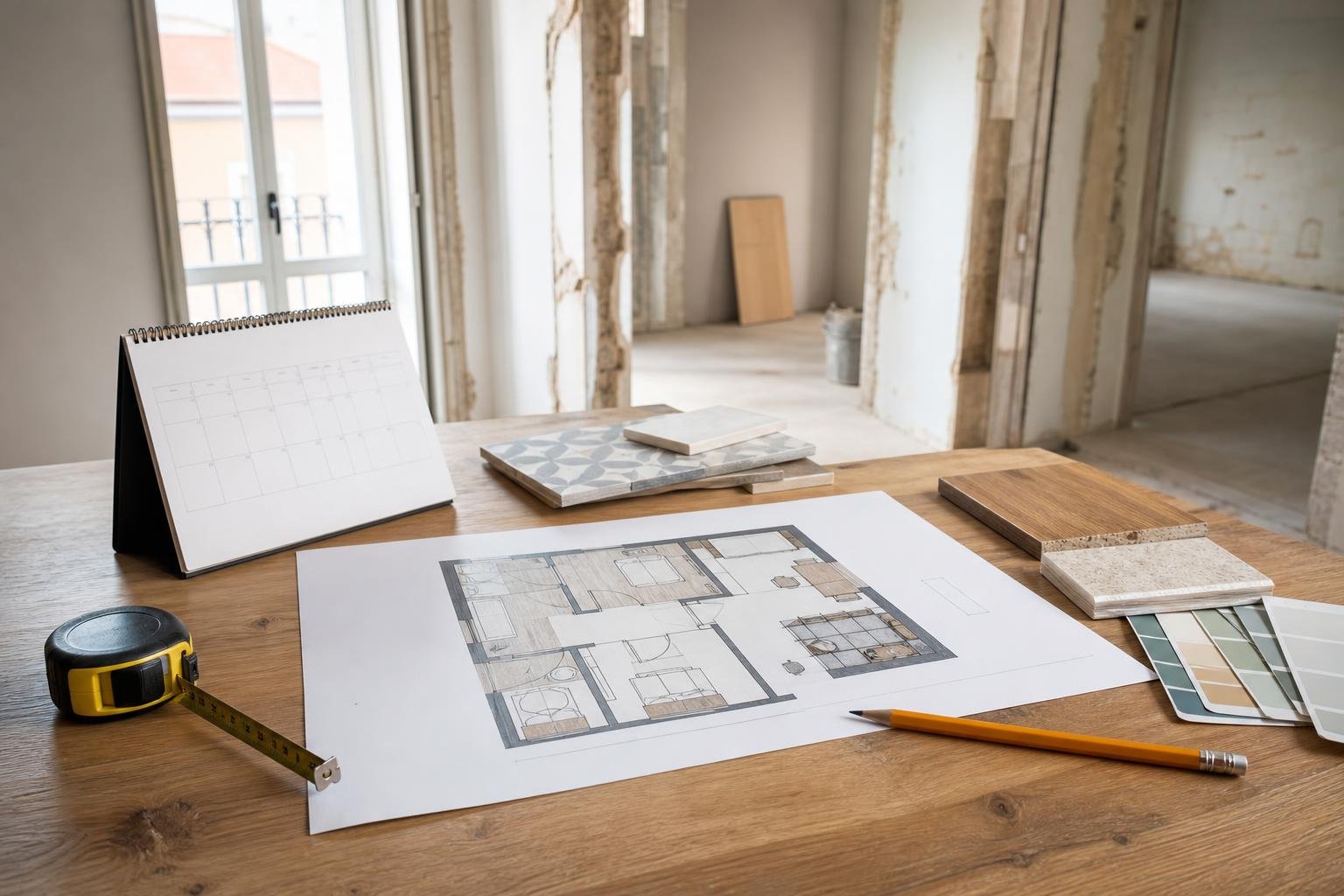
Do not start by choosing the cylinder colour or the size of the cabinet. First draw the escape route: kitchen, corridor, entrance door and the building stairs. Then identify ignition sources, higher-load electrical points, the power shut-off point and, where applicable, the gas shut-off. This small map should be understood by everyone living in the home and by anyone who looks after it.
A renovated kitchen becomes safer when it allows a clear worktop around the hob, suitable ventilation and extraction, dedicated circuits where needed and easy access to the consumer unit. Where gas or combustion appliances are present, check ventilation and maintenance arrangements as well; a carbon-monoxide detector can provide warning, but it cannot correct a defective installation. For a wider household response plan, keep an emergency plan with contacts, routes and service shut-offs.
Finally, run a simple test: every adult knows how to leave, where to isolate electricity and gas when safe, and where the equipment is kept. If the answer involves opening three doors, moving boxes or crossing the kitchen next to the hob, reorganise the space.
Key takeaways
- Keep the extinguisher near an exit, never where you must cross the fire to reach it.
- Use it only for a small fire, with a clear escape route and no dense smoke.
- Never throw water on burning oil or on energised electrical equipment.
- Treat hot sockets, burning smells and repeated electrical faults as reasons to stop and seek an assessment.
If you are renovating a kitchen, garage or utility area, ask Obra Lisboa to include circuits, ventilation, consumer-unit access and an unobstructed escape route in the planning. It is a practical way to address safety before cabinets and finishes remove the available options.
Sources and further reading
- preventing domestic accidents
- DGS guidance on burns
- DGS highlights warning signs including breathing difficulty, altered consciousness and facial burns
- fire-safety rules published in Diário da República
Editorial image; it does not depict an Obra Lisboa project.

Obra Lisboa