An installed heat pump should only count in favour of a purchase once you know that it suits the home, is documented and does not pass a noise, drainage or maintenance problem on to you. Before making an offer, ask about the unit, hear it running and compare it with the energy certificate. The aim is not to calculate a promised saving; it is to establish whether you are buying a usable, repairable system that fits the flat and the building.
Contents
- First, establish what heat pump you are actually buying
- The energy certificate confirms the context, but does not replace a check
- You cannot judge noise from a photograph of the outdoor unit
- Drainage, condensate and access determine whether maintenance is workable
- Ask questions that reveal use and condition, without assuming future bills
- Turn the findings into a practical condition of your offer
First, establish what heat pump you are actually buying
“It has a heat pump” is incomplete information. It may be a domestic-hot-water unit, an air-to-air system for heating and cooling rooms, an air-to-water system serving radiators or underfloor heating, or a hybrid arrangement still reliant on another heat source. Each has different demands for space, electrical capacity, drainage and maintenance.
Ask the seller or agent for a photograph of the rating plate. Check the brand, model, serial number, installation year, output, refrigerant and intended use. Request manuals, installation and service invoices, any live warranty, and the contact details of the maintenance company. Where it exists, consult the Housing Technical File established by Decree-Law No. 68/2004: it describes technical and functional characteristics at completion of the works, so it can help identify the original system without proving its present condition.
- Hot water: look for the cylinder, safety valve, discharge pipe and service access.
- Air-to-air heating and cooling: check indoor units, controls, filters, pipework and condensate drainage.
- Air-to-water: confirm heat emitters, thermostats, pumps and the apparent condition of the hydraulic circuit.
If the only answer is “it works well”, treat the equipment as unverified until you receive specific evidence.
The energy certificate confirms the context, but does not replace a check
An energy certificate is mandatory in property transactions, as ADENE explains in its energy-certification information. Read it as a dated technical record: confirm the property identification, validity, systems considered by the qualified expert and listed improvement measures.
Pay particular attention to the description of domestic hot water and heating or cooling systems. If the certificate names a different solution from the one you see during the viewing — a gas water heater rather than a heat pump, for example — ask when the change took place, whether the certificate was updated and what documents support it. A favourable energy rating does not prove that the appliance is properly set up, fault-free or correctly sized.
Compare the certificate, installation invoice, equipment label and sales listing. The dates and stated purpose should tell the same story. Where they do not, allow for the cost of diagnosis and the possibility of replacement. If you are buying to let, this caution avoids advertising a level of comfort or a system that you cannot later provide.
If the property is in a rehabilitation area, also review what to check before buying in a Lisbon urban rehabilitation area.
You cannot judge noise from a photograph of the outdoor unit
Visit while the system is running, preferably when it is heating water or conditioning the home. Listen beside the unit, then inside bedrooms, the living room and near the adjoining property. Vibration travelling through a wall, a lightweight balcony or a metal support can be more troublesome than the sound heard in the garden.
Study the position. A unit beside a bedroom wall, in a narrow service courtyard or directly facing a neighbour’s window deserves closer attention. In Lisbon, the City Council’s specialist design-project guidance includes heating, ventilation and air-conditioning installations and systems, depending on the planning operation. That does not mean every equipment replacement follows the same procedure; it means you should not assume that a future change to a façade, roof or existing installation will be straightforward.
Ask whether neighbours have complained, whether anti-vibration mounts were installed and whether there are relevant condominium minutes. In a flat, also establish whether the unit sits on common property, an exclusive-use balcony or the façade. Its position may limit future repair, relocation or replacement.

Drainage, condensate and access determine whether maintenance is workable
A heat pump should not be assessed as an isolated technical box. Check where condensate goes, whether there are signs of water running across paving, stains on the façade, rusting supports or water near doors. For hot-water units, also look for the safety-valve discharge, accessible connections and signs of leakage around the cylinder base.
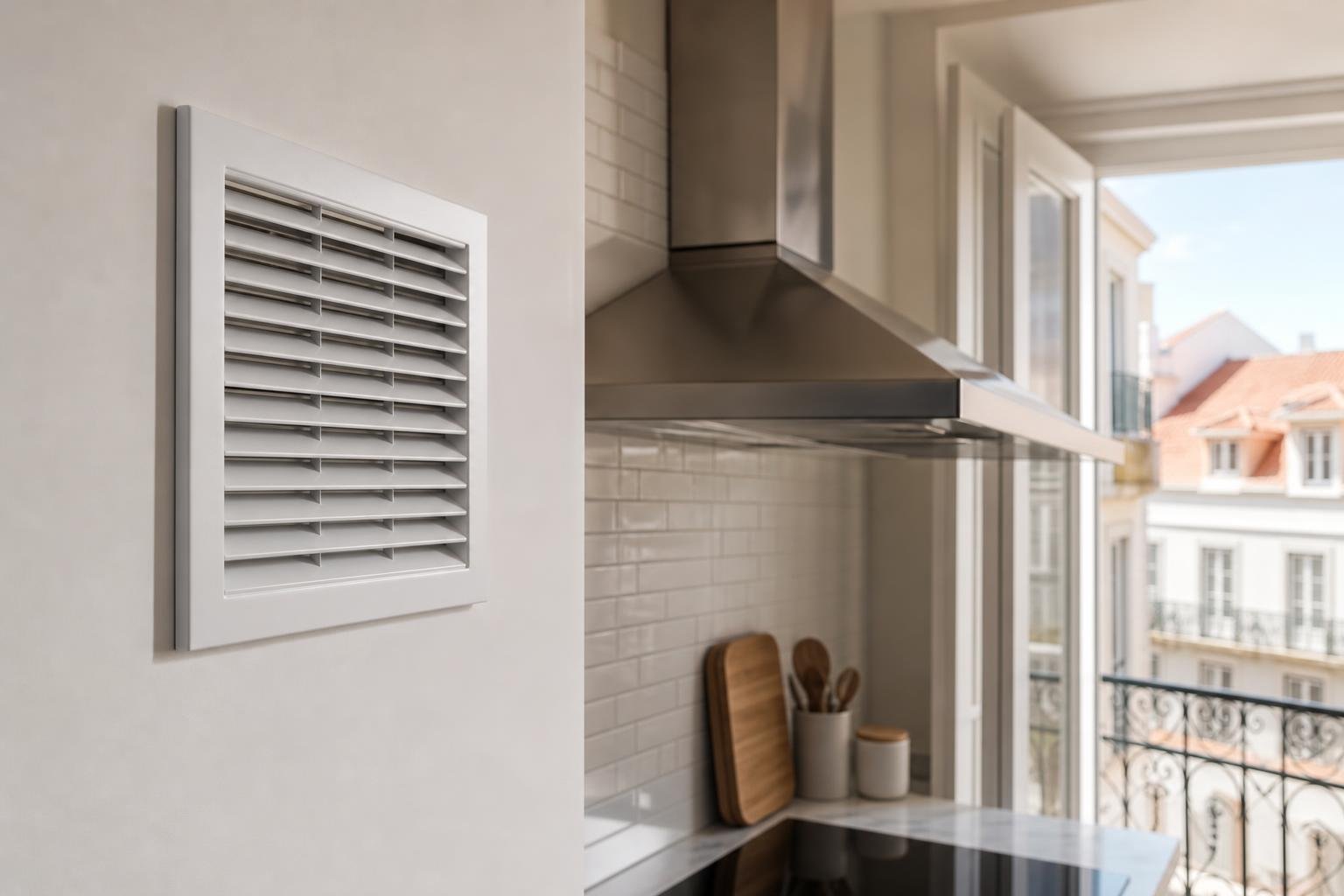
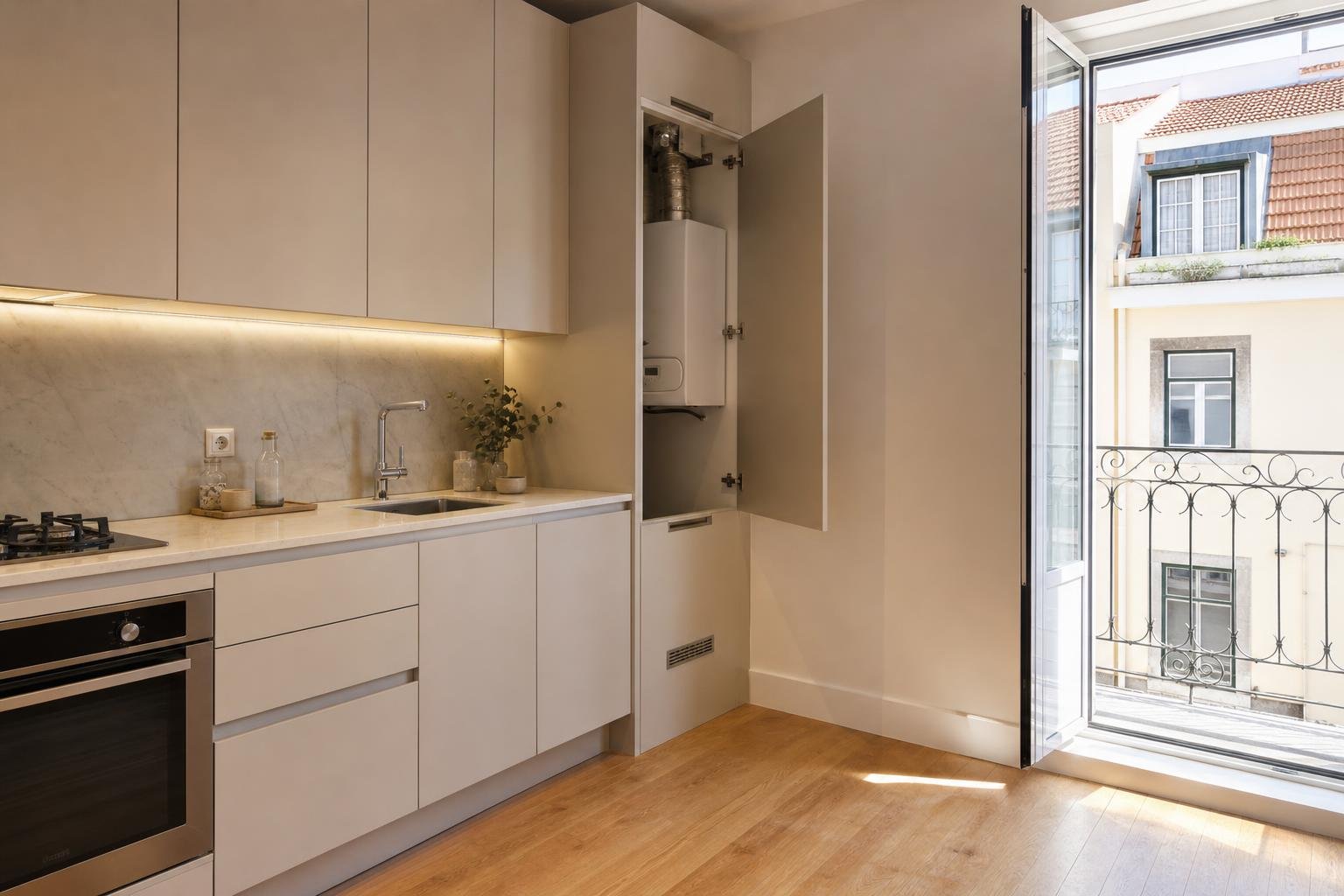
Access matters as much as the model. A unit enclosed behind joinery, mounted high without working room or pressed against a grille makes a routine intervention slower and more expensive. Open technical-cupboard doors, check for any ventilation required by the equipment and establish whether the unit could be removed without dismantling finishes or negotiating an awkward common area.
Ordinance No. 138-I/2021, published in the Diário da República, sets out energy-performance requirements applying to building technical systems. For a buyer, the practical consequence is straightforward: do not value only the label or the presence of the unit; check the complete system, its connections and the access available to maintain or correct it.
Ask questions that reveal use and condition, without assuming future bills
Request recent electricity bills for context only, never as a promise of your future costs. A home occupied by two people behaves differently from one occupied by four; schedules, selected temperatures, insulation, solar exposure and tariffs all change the outcome. The useful information is whether there have been unusual rises, repeated faults or frequent use of an electric backup element.
During the viewing, check:
- Whether hot water reaches its normal temperature without controller alarms.
- Whether the equipment starts and stops without unusual noise, excessive vibration or a burning smell.
- Whether the display shows stored error messages or a pending service visit.
- Whether filters, grilles and drains are clean and accessible.
- Whether radiators, fan coils or indoor units serve every room expected to be heated or cooled.
An inspection by a qualified technician is sensible when the heat pump materially affects the asking price, when noise or condensate is visible, or when an air-to-water system serves much of the home. It does not replace a full property survey, but it can distinguish a foreseeable adjustment from a near-term replacement.
Turn the findings into a practical condition of your offer
Before you submit an offer, separate what has been confirmed from what remains unproven. You do not need a perfect dossier for every older appliance; you do need to prevent vague information from becoming an urgent cost immediately after completion.
- Confirmed: model, purpose, position, documents and observed operation.
- To confirm: maintenance, noise at different loads, drainage, permissions or condominium rules.
- To budget: diagnosis, relocation, anti-vibration mounts, support repairs or replacement.
If you expect to renovate, record these decisions before the works brief is final. A renovation decision and sample register helps prevent the heating solution being left to the last team on site. Where changes affect the exterior, façade or common elements, confirm the applicable procedure with Lisbon City Council through its page on building-work licences.
The cautious decision is to value an installed heat pump when you can identify what it does, where it drains, how it is maintained and how much scope there is to repair or adapt it. Without that information, treat it as equipment to assess, not a benefit already secured.
Key takeaways
- Ask for the model, serial number, invoices, manuals and service history before treating the heat pump as added value.
- Compare the visible equipment with the energy certificate and resolve any difference in dates or systems.
- Listen for noise and vibration while the unit is running, inside the home and near neighbouring properties.
- Budget for diagnosis or adaptation where records are missing, condensate is visible or service access is poor.
If the purchase proceeds and the home needs adaptation, Obra Lisboa can help organise a renovation around clear technical decisions, from identifying what is already in place to coordinating the required works. Gather the equipment records first, then include them in your renovation assessment request.
Sources and further reading
- ADENE explains in its energy-certification information
- Housing Technical File established by Decree-Law No. 68/2004
- Ordinance No. 138-I/2021, published in the Diário da República
- the City Council’s specialist design-project guidance
- building-work licences
Editorial image; it does not depict an Obra Lisboa project.

Obra Lisboa