Only carry out a small repair from a ladder or step ladder when the support, floor and reach allow you to work without stretching, losing balance or improvising. Changing a bulb, touching up paint near the ceiling or cleaning a ventilation grille can look straightforward, yet falls at home are common and can cause serious injuries. Choose the right height, clear the route around you and stop if the task needs force, both hands or contact with electricity.
Contents
- First, decide whether the job suits a step ladder
- Which ladder suits each home repair?
- Prepare the floor and work zone before climbing
- The right position while you work
- Wind, rain and balconies: when to stop without compromise
- Where DIY ends and the next step begins
First, decide whether the job suits a step ladder
Not every high-level repair is a home DIY job. A low, firm step ladder can help you reach a light fitting, a light shelf or a ventilation grille; it is not suitable for prolonged work above a doorway, opening a suspended ceiling, repairing an external shutter or carrying out work on a façade.
Ask this before opening it: can you keep both feet on the same usable step, your body between the stiles and one hand free for support? If you need the top step, need to stand on tiptoe, twist your torso or carry a heavy item, the answer is no.
The Portuguese Directorate-General of Health guidance on accident prevention highlights simple ways to reduce falls at home, including good lighting, routes free of loose cables and attention to unsecured rugs. Where children live in the home, also follow the DGS guidance on preventing accidents involving children, and do not leave ladders open or tools within reach while preparing the job.
- Use a step ladder for short, focused jobs.
- Use a leaning ladder only where there is a secure wall or upper support.
- Postpone the task if you are tired, dizzy or wearing unstable footwear.
- Never replace a ladder with a chair, wheeled stool, table or stacked boxes.
Which ladder suits each home repair?
Choose for reach, not for the size of your storage room. A step ladder that is too short makes you stretch your arms; one that is too tall encourages an uncomfortable working position. To change a bulb in a typical living room, you should reach the fitting without raising your shoulders beyond a controlled position.
Check the manufacturer’s label, stated load limit and the condition of hinges, cross braces and feet. On an extension or telescopic ladder, make sure every locking mechanism has engaged before climbing. Portuguese legal guidance for ladder use at work requires stability, supports on a resistant and immovable surface, and non-slip devices; these are sensible precautions at home too. See the checklist published in the Diário da República.
- Platform step ladder: usually the most stable choice for a short indoor task.
- Leaning ladder: only for reaching a high point with secure support and no sideways movement.
- Articulated or telescopic ladder: needs extra care with locks, joints and the instruction manual.
- Damaged ladder: do not make it safe by asking someone to hold it; repair or replace it.
Prepare the floor and work zone before climbing
The first hazard is often on the floor. Remove rugs, extension leads, toys, bags and loose tools. If the floor is wet, wait until it is dry. On polished tile, waxed timber or smooth stone, check that the rubber feet sit fully on the surface and do not slide.
Open a step ladder fully and lock its spreader bar. With a leaning ladder, place both lower feet on the same level; never make up for unevenness with books, timber offcuts or an upturned bucket. Do not rest a ladder against glazing, an unsecured door, a fragile shutter box or furniture.
Allow enough light to see each step and the place where you will set down a tool. DGS guidance recommends adequate lighting and clear routes to prevent falls, which is especially useful in corridors, storage rooms and internal stairs. If you are updating lighting or opening a ceiling for new cables, read our guide to planning a suspended ceiling without losing height or safety.
- Keep a clear area around the ladder.
- Place small tools in a belt or light tool pouch.
- Ask another adult to keep children and pets outside the area.
- Close or secure doors that could open into the ladder.

The right position while you work
Climb facing the ladder, keeping three points of contact where possible: two feet and one hand, or two feet with your body supported between the stiles. Work with your belt buckle, or the centre of your body, within the ladder’s width. If the point you need to reach is to one side, climb down and move the equipment.
Avoid jobs that mean pulling, drilling for a long time or applying force above your head. Holding a drill, a paint tin or a lighting component changes your balance. Do not pass heavy objects to someone standing on a ladder either; set them down, climb down and move them safely.
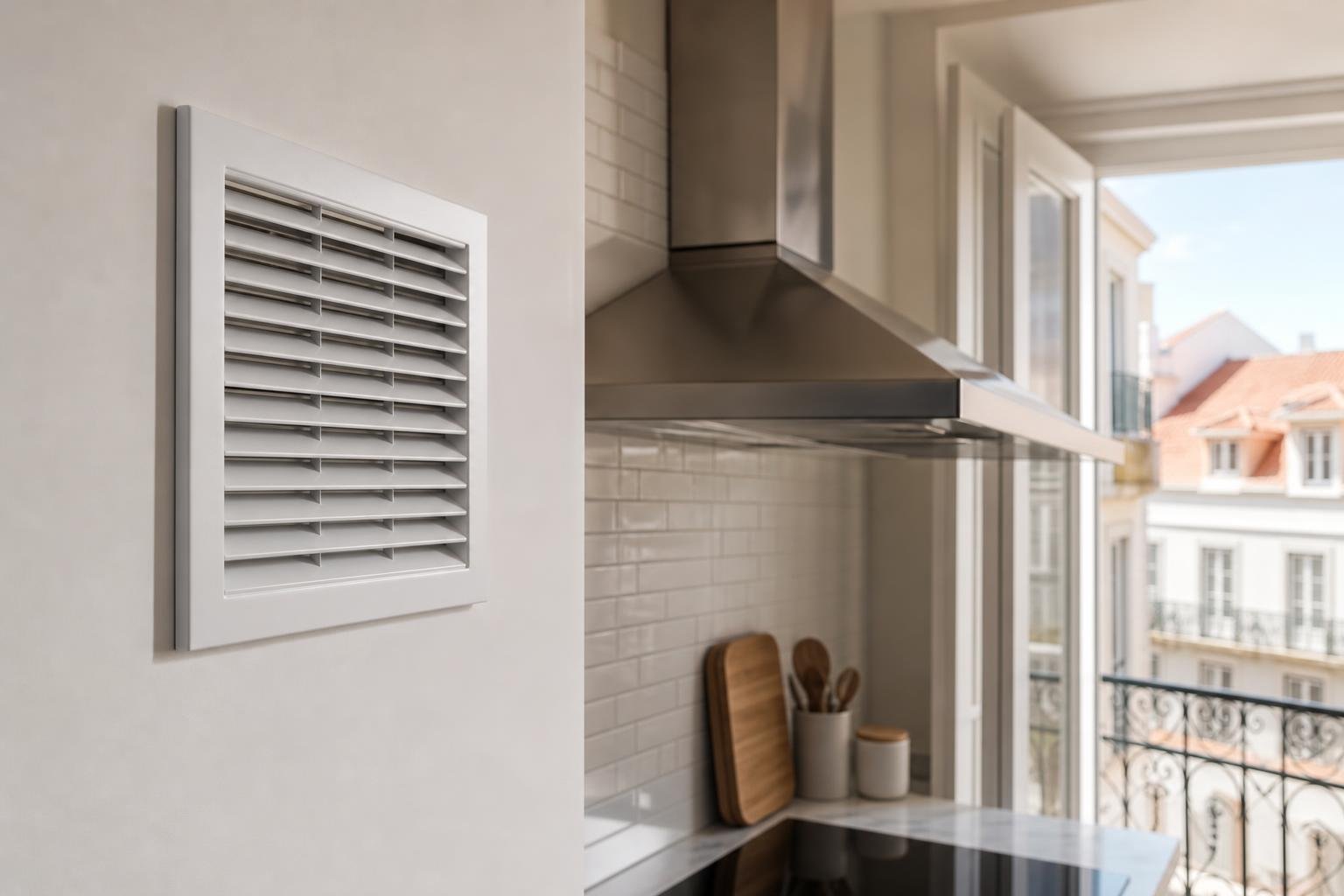
For a high grille, use a vacuum cleaner with an extension from floor level where possible. When painting, complete small areas, climb down before moving the tray and keep the lid on while you reposition. The time saved by avoiding one descent rarely justifies a fall.
Wind, rain and balconies: when to stop without compromise
Outside, the safety conditions change quickly. Do not use ladders on balconies, terraces, sloping patios or near guardrails when there is rain, a wet surface, gusts or a thunderstorm forecast. A leaning ladder is not a solution for reaching the outside of a window or cleaning gutters from a roof.
IPMA sets a yellow wind warning in mainland Portugal for gusts between 70 and 90 km/h. Before any outdoor job, check the IPMA weather-warning criteria and postpone work when there is a warning or an obvious change in conditions. Even without an official warning, wet flooring, irregular gusts or poor light are enough reason to stop.
In an apartment, do not lean beyond a guardrail to reach shutters, condenser units, awnings or window frames. Those jobs can involve a fall from height, electrical hazards or façade elements and should be assessed by properly qualified professionals.
Where DIY ends and the next step begins
Call a professional when a task affects fixed electrical installations, needs walls or ceilings opened, involves gas, façades, roofs, guardrails, structures, high glazing or a ladder supported outdoors. Turning off one breaker does not make an electrical alteration a safe home task; if you cannot identify the circuit with confidence, stop.
It is also worth getting help when an apparently small repair reveals cracking, damp, decayed timber or an unconvincing fixing point. Do not drill into a slab, beam or older wall merely because the accessory comes with wall plugs.
If your list of small interventions already includes painting, lighting, repairs and overhead work, organise the decisions before booking trades. Our three-week plan for a Lisbon renovation helps put tasks, deliveries and review points in a workable order.
Key takeaways
- Choose a ladder height that lets you work without stretching or using the top step.
- Prepare the floor by removing rugs, cables and loose objects before opening the step ladder.
- Climb down and reposition the ladder whenever the work moves sideways.
- Stop when there is rain, wind, fixed electrics, façade work or a need to apply force.
If lighting, ceilings, repairs or other work at height need to be included in a clearly defined renovation, contact Obra Lisboa for help organising the scope, required trades and work sequence.
Sources and further reading
- Portuguese Directorate-General of Health guidance on accident prevention
- DGS guidance on preventing accidents involving children
- checklist published in the Diário da República
- IPMA weather-warning criteria
Editorial image; it does not depict an Obra Lisboa project.

Obra Lisboa