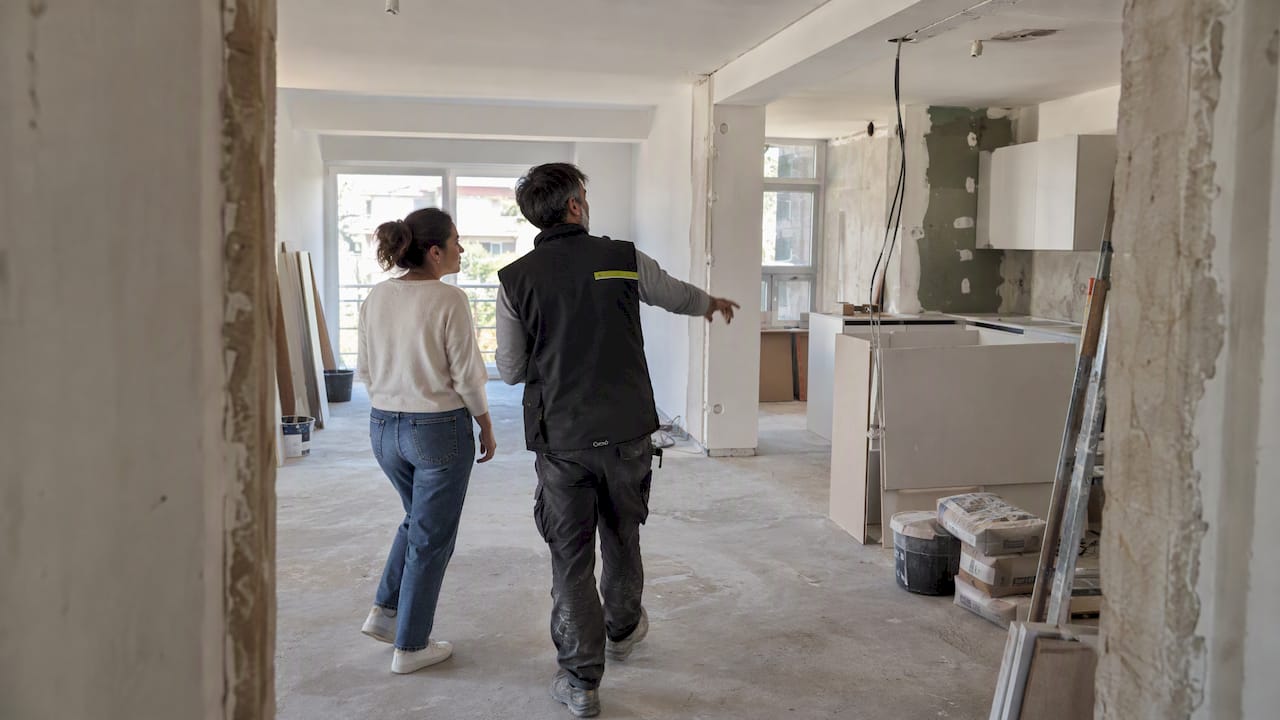
Before any demolition begins, hold a site kick-off meeting and record who decides, what is included, when materials arrive and how the building will be protected. In a Lisbon renovation, day one can be undermined by a delivery with no lift access, an unresolved tile choice or a skip with no agreed procedure. One hour in the flat, with the contractor and the right people present, turns the contract and programme into a working plan.
The meeting does not replace design, permissions or site supervision where they are required. It connects those documents to the practical reality of doors, stairs, neighbours, lifts, working hours, storage and work areas.
Contents
- Who should attend and what should be brought
- Which areas are genuinely available on day one
- How to turn a completion date into a programme the team can use
- Rules that prevent unapproved extras
- Deliveries, waste and street occupation: settle logistics before buying
- What should be recorded at the end of the meeting
Who should attend and what should be brought
The owner, or someone authorised to make decisions, should attend, along with the contractor’s person responsible for coordinating the works. Bring in the designer where there are questions to resolve, and the site supervisor where one has been appointed. Do not leave the meeting solely to the person who sold the project: the discussion needs the person who will organise trades, deliveries and subcontractors.
Bring one current version of the agreed scope, drawings and details, the itemised quotation, initial programme, emergency contacts and a list of outstanding selections. The contract should identify the scope, price, execution period and payment method and dates. For private-work contracts above the applicable legal threshold, a written contract is compulsory; check the IMPIC guidance on construction contracts for the required minimum content.
Open your renovation decision and sample register as well. Every item lacking a final choice needs an owner and a deadline. “Bathroom tile” is not a complete decision: record the reference, size, laying direction, trim detail and fallback option if stock fails.
Which areas are genuinely available on day one
A start date is only realistic when the contractor has useful access to the property. Walk the route from the building entrance: where vans stop, which lift or stair will be used, which shared walls and floors need protection, where keys are held and who can open up if the owner is away.
Set aside a small, controlled work area for tools, consumables and short-term waste. In older Lisbon buildings, narrow landings and small lifts make it unwise to leave boxes, rubble bags or removed doors in shared circulation areas. Photograph the initial condition of the lobby, lift, thresholds and stairs before the first delivery; the record helps organise reinstatement rather than fuel later arguments.
Where noisy work or occupation of the pavement, parking bays or carriageway is expected, confirm the applicable municipal procedure in advance. Lisbon City Council’s information on temporary occupation of public space helps frame requests and restrictions that should not be left until the day before a delivery.
How to turn a completion date into a programme the team can use
Rather than accepting one final completion date, divide the programme into checkable milestones: protection complete, demolition complete, services confirmed before walls close, waterproofing tested where relevant, finishes delivered, joinery measured, installation complete and handover cleaning. Each milestone should name the condition that releases the next stage.
Ask three questions for every work area: what comes before it, what material must be on site and who approves the result? A kitchen does not move forward because the joinery is “coming soon”; it moves forward when final dimensions, appliances, water points, electrical circuits and delivery date are confirmed. Use this three-week Lisbon renovation plan as a straightforward model for linking trades, deliveries and decisions.
Allow time for drying, final measurements and discoveries made after opening walls. Do not hide these in a vague promise about timing: identify what could shift the sequence and how the change will be communicated.

Rules that prevent unapproved extras
The most useful rule is simple: no work outside the agreed scope proceeds solely because it was discussed in the corridor. When a surprise appears — deteriorated pipework, a wall different from the drawings, a threshold that requires a revised detail — record four points before proceeding: description, reason, cost impact and time impact.
A dated photograph can explain the reason, but it does not replace written approval. Set the valid channel at the beginning: email, a project-management app or a shared record. Messages scattered across several phones make it hard to establish the latest accepted instruction. The approval should say whether it is additional work, a substitution within the agreed price or correction of a defect.
If the change affects the planning process, do not assume that an on-site decision is enough. Read when a change may require a procedural amendment in the article on changes during a Lisbon renovation, then confirm with the responsible technician before ordering or demolishing.
Deliveries, waste and street occupation: settle logistics before buying
List critical deliveries in sequence: windows, tiles, shower trays, kitchen equipment, doors, sanitaryware and made-to-measure furniture. For each one, confirm the address, site contact, delivery window, route to the flat, protection needed and temporary unloading position. A delivery arriving too early fills the property; one arriving too late leaves trades waiting.
When works exempt from licensing or prior notification require public-space occupation for scaffolding, material storage, equipment or skips, Lisbon City Council states that a licence and occupation plan may be required. Its guidance on public-space occupation for works exempt from prior control also explains that changing the equipment used or the area occupied can require an amendment to the licence.
Also agree the waste-removal routine: frequency, route, cleaning of shared areas and who confirms that nothing is left obstructing exits or access. Logistics belongs in the works programme, with dates and named responsibilities, in the same way as any installation or finish.
What should be recorded at the end of the meeting
Send short minutes on the same day, adding photographs only where they clarify a point. Include:
- planned start date and normal working hours;
- contact details for the site lead and owner;
- access, keys, protection and condominium rules;
- programme milestones and materials with critical dates;
- outstanding decisions, owner and deadline;
- the method for approving extras, measurements and payments;
- the next meeting and the condition for holding it.
Ask the contractor to confirm the identification and qualifications applicable to the work. IMPIC states that the responsible company must display a sign in a visible place at the site entrance showing its company name and licence number. See the IMPIC note on company identification on site.
Good minutes do not try to predict every problem. They give the team a shared reference for making quick decisions when problems arise.
Key takeaways
- Hold the meeting on site before the first delivery or demolition work.
- Give every unresolved choice an owner and a decision deadline.
- Record any change to scope, price or timing before it is carried out.
- Treat access, protection and street occupation as work tasks, not administrative afterthoughts.
If you are preparing a Lisbon renovation, gather the scope, drawings and decisions already made before requesting quotations. Obra Lisboa can help turn that information into a start-up plan, site coordination and a work sequence suited to the property.
Sources and further reading
- IMPIC guidance on construction contracts
- IMPIC note on company identification on site
- temporary occupation of public space
- public-space occupation for works exempt from prior control
Editorial image; it does not depict an Obra Lisboa project.

Obra Lisboa