A renovation deposit is useful only when it is tied to a defined scope, a realistic start date and a clear rule for what will be bought or completed before the next payment. In Lisbon, transferring money simply to reserve the team without separating materials, labour, permits and logistics leaves the client with no practical way to check progress. Before paying, turn the appointment into a short control plan: attached documents, responsibilities, milestones and evidence.
Law no. 41/2015 sets rules for construction activity, and the IMPIC guidance on private-work contracts identifies minimum contract content where written form is required, including the scope, price, completion period and payment method and dates. Even where a written contract is not legally required, these four points prevent many avoidable disputes.
Contents
- What should be settled before you pay a deposit?
- Are a deposit, an order payment and completed work the same thing?
- How can you set payment stages that follow the work?
- How should early purchases be handled without losing traceability?
- Which logistics costs belong in a Lisbon start-up plan?
- What should happen when price or timing changes?
What should be settled before you pay a deposit?
Do not pay a deposit based only on a total price and a promised start. The appointment document should identify the property, company, accepted quotation version, date, total including VAT and exclusions. Attach the work schedule, relevant drawings or sketches, the list of finishes already selected and building-access conditions.
Also check who signs for the company and whether the qualification stated belongs to the entity you are appointing. The IMPIC search portal lets you check companies holding contractor licences or certificates, as well as entities whose titles have recently been cancelled. That search does not replace reading the contract, but it prevents a company name on a proposal from being treated as sufficient evidence. If work is due to start shortly, also see how to avoid qualification-application delays at IMPIC.
- Scope: demolition, preparation, services, finishes, fitting and final cleaning.
- Exclusions: for example appliances, municipal charges, painting shared areas or hidden repairs.
- Programme: mobilisation date, intended sequence and events that may pause work.
- Payment: deposit, stages, supporting documents and payment period.
If choices that affect dimensions or materials are still open, do not attempt to solve that uncertainty with a larger deposit. Set a decision deadline instead and keep that item out of the purchasing stage.
Are a deposit, an order payment and completed work the same thing?
No. An initial payment can serve different purposes, and the contract should keep them separate. A deposit may reserve a work slot and fund agreed planning or mobilisation; money for specified materials should be linked to an order, supplier, model, quantity and estimated delivery date; a progress payment should correspond to visible, confirmed work.
This distinction matters particularly for made-to-measure kitchens, windows, natural stone, joinery or special tiles. These items have their own lead times and may need ordering before their work area is ready. Ask for an order reference, product sheet and supplier payment evidence when funds are intended for that purpose. If the item is stored away from the property, agree where it will be kept, who is responsible for custody and how it will be identified.
Avoid the vague formula of 50% at the start and 50% at the end for a project involving several trades. It places too much value ahead of confirmation that services, waterproofing and preparation have been completed as intended.
| Payment type | What should support it | Useful record |
|---|---|---|
| Appointment deposit | Agreed team reservation, planning and mobilisation | Signed contract and receipt or invoice |
| Material advance | Order for identified products | Supplier proposal, reference and proof of payment |
| Stage payment | Completed and checkable work | Simple certificate, photographs and snag list |
| Final balance | Agreed handover and defined corrections | Handover record, invoices and completion file |
How can you set payment stages that follow the work?
Stages should follow points that the client can check before work becomes concealed. Rather than using dates floating in the calendar, use physical milestones: demolition and removal completed; water, drainage and electrical services tested before walls are closed; waterproofing checked before tiling; fitted furniture installed; finishes and cleaning ready for handover.
You do not need heavy administration. For each stage, define in one line the included work, amount, person who confirms it and expected evidence. A short site visit, dated photographs and a snag list are enough for a normal-scale home renovation. What matters is not confusing delivered materials with installed materials, or a closed wall with a tested installation.
- Mark the work that will become hidden.
- Create a confirmation point immediately before it is covered.
- Link payment to the completed milestone, rather than the beginning of a week.
- Record every additional item in writing before it is carried out.
To organise the first day, review the renovation kick-off meeting: access, protection, contacts, hours, materials and outstanding decisions directly affect the first billable stage.
How should early purchases be handled without losing traceability?
Not every material should be bought early. Standard products that are easy to replace and have short lead times can wait until the substrate is ready. A made-to-measure door, stone worktop or window system may need to be ordered in advance. The decision should follow manufacturing time, confirmed measurements and storage risk, rather than pressure to make use of the initial payment.
For every early purchase, create a simple record with five fields: product, quantity, approved version, supplier and delivery condition. Add photographs of approved samples where colour, grain, sheen or profile matters. If stock runs out, any substitute can then be compared against what was approved instead of being decided at installation time.
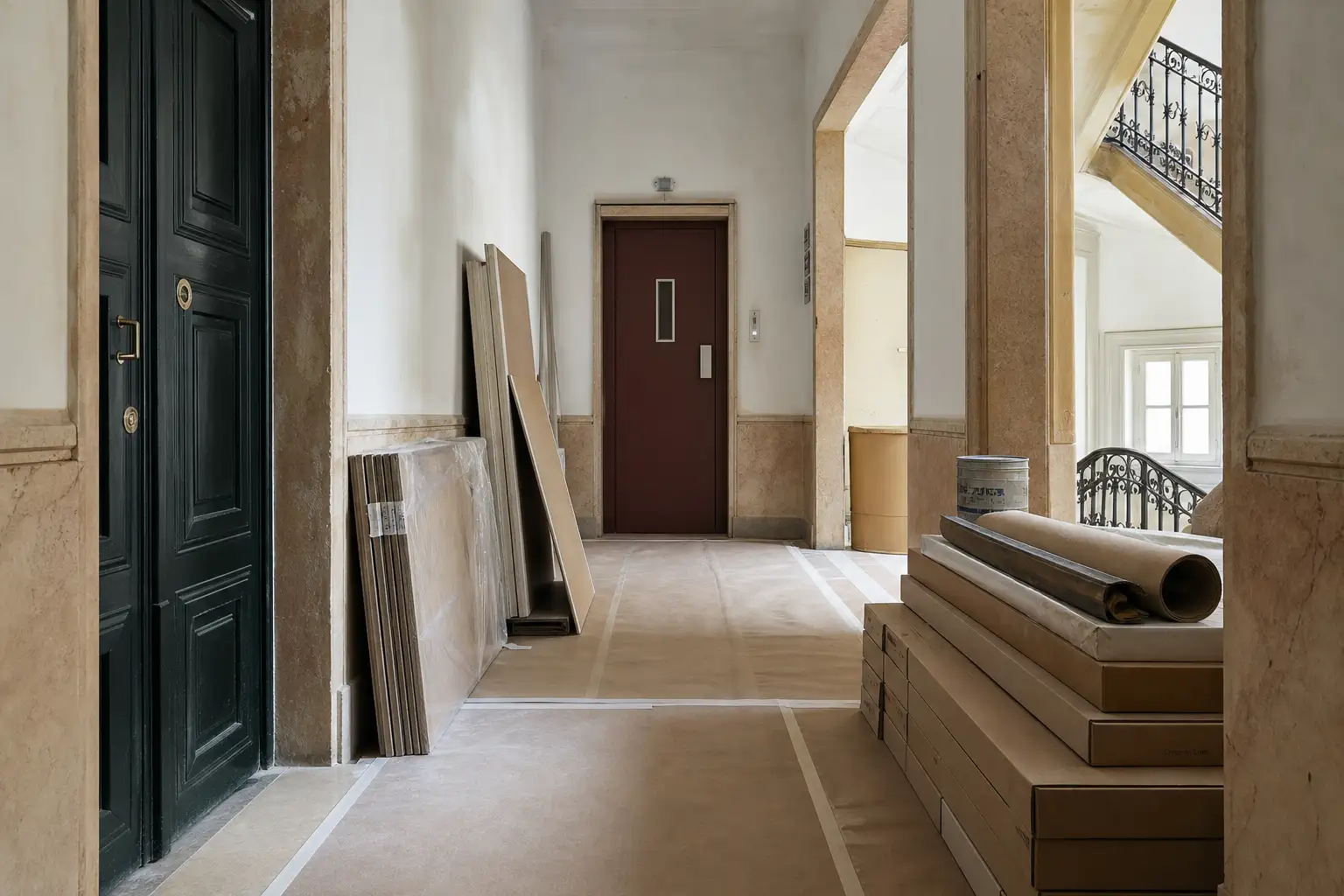
In older apartment buildings, also confirm how long or heavy pieces will enter, whether the lift can be used and where items can wait temporarily. A good ordering sequence reduces interruptions, but it does not remove the need to protect floors, corners and shared areas.
Which logistics costs belong in a Lisbon start-up plan?
An internal renovation can look straightforward in a quotation and become difficult on the day of the first delivery. Skips, material storage, scaffolding or other structures in the street may require a public-space occupation notice or licence. Lisbon City Council explains that even some works exempt from prior planning control may need a licence or notice when support equipment occupies public space; occupation can proceed only under the authorised terms. Check the guidance on public-space occupation for exempt works before committing to delivery dates.
At the start, identify who deals with the application, charges, information board where applicable, lift protection and daily cleaning of the entrance. Set a contact for deliveries and a place that does not block stairs, fire doors or neighbours’ routes. These costs should not appear as a surprise in the first payment certificate: they are either included in the price or shown as an identified, approved item.
When there are several deliveries, keep a shared list with expected date, time slot, responsible person and acceptance condition. It is a simple tool that stops a worktop arriving before access is available or a team waiting for a part that has already been paid for.
What should happen when price or timing changes?
A change should move to payment only after four points are clear: what changes, why it changed, how much it costs and what effect it has on the programme. This applies equally to a repair uncovered after demolition and to a voluntary finish upgrade. A site conversation may explain the issue; it does not replace written approval with a price or calculation method.
Do not offset a delay with advance payments without redefining the plan. If a critical purchase is late, review the sequence: is there another useful work area that can proceed without rework? Is there an acceptable alternative material? The answer should appear in the decision record and revised programme.
At the end, do not leave communication until the final invoice. Make an objective snag list, state the expected correction and agree a review date. The final balance should follow the handover set out in the contract, including keys, manuals, warranties and invoices where applicable. To prepare that control from the quotation stage, also read how to protect timing and scope in a renovation quote.
Key takeaways
- Pay a deposit only after linking it to a contract, a defined scope and agreed mobilisation.
- Keep material advances separate from payments for completed and confirmed work.
- Create check points before services, waterproofing or other concealed layers are covered.
- Approve any price, material or programme change in writing before it is carried out.
Before appointing a contractor, gather the quotation, confirmed selections and the building’s constraints. If you are planning a renovation in Lisbon, ask Obra Lisboa for a proposal that identifies scope, work stages and logistics requirements.
Sources and further reading
- IMPIC guidance on private-work contracts
- IMPIC search portal
- public-space occupation for exempt works
- Law no. 41/2015
Editorial image; it does not depict an Obra Lisboa project.

Obra Lisboa