A living room used for relaxing, dining and working functions better when each activity has its own light and easy-to-reach controls. Rather than asking one central fitting to do everything, combine soft general light, directed task light and a few supporting points. The room becomes more orderly without gaining a single square metre: the laptop is no longer in shadow, the table stops feeling like an office desk at dinner, and the sofa has enough light for reading.
Contents
- Start with real routines, not the ceiling layout
- Which light needs to be on in each area?
- How to light the dining table without shadows or glare
- How to make a work zone disappear at the end of the day
- Colour temperature and brightness: choose by use
- Avoid too many downlights and prepare controls you will use
Start with real routines, not the ceiling layout
Before choosing fittings, describe a normal day in the room. In a Lisbon one-bedroom flat, the table may host breakfast, a laptop, homework and dinner; the sofa may be used for conversation, television or reading. Each moment needs a different direction of light and, often, its own control.
Make a simple plan. Mark windows, doors, curtains, sockets, tall furniture, the table, sofa and the route to the balcony or kitchen. It is a quick way to find conflicts before work starts: a pendant outside the table axis, a desk by the window with no nearby socket, or a switch eventually hidden behind shelving.
The Portuguese health authority’s home-working guidance advises adapting available light to visual demands and using localised lighting when necessary. This is particularly useful when the work area only takes up one end of the living room.
- Decide where you sit to read and where you open the laptop.
- Confirm whether the table is fixed, extendable or moved aside to clear space.
- Keep a route free from cables, low stools and badly positioned floor lamps.
- Only then select ceiling points, wall lights, switches and sockets.
Which light needs to be on in each area?
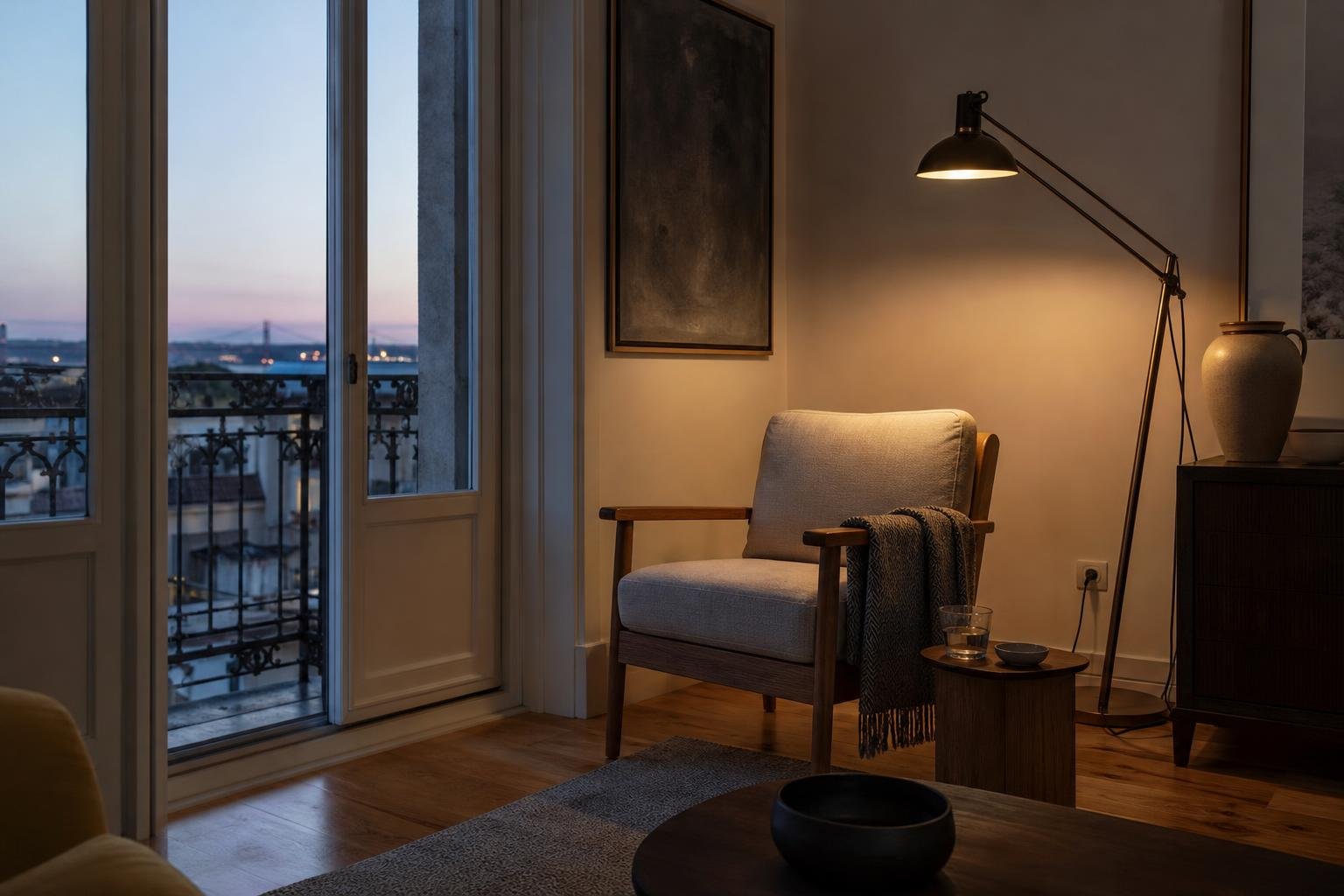
Ambient light lets you enter, talk and move around without dark patches. It can come from a ceiling fitting, a discreet track or indirect light, provided it does not glare at people sitting down. Task light serves the table, desk or reading chair. Accent light adds depth to a wall, a lightly filled shelf or artwork.
In a narrow room, two or three moderate light points tend to feel more comfortable than one overly intense central fitting. A table against a wall can benefit from an adjustable wall light or supporting lamp, so the pendant no longer has to light the entire room.
Record these choices in a renovation decision and sample register. The tabletop position, chair height, table extension and chosen curtain all change the right location for a fitting. Buying the light first and adapting the furniture afterwards often creates awkward compromises.
| Layer | Where to use it | Practical decision |
|---|---|---|
| Ambient | Centre and circulation | Soft source with a simple control by the entrance |
| Task | Table, desk and armchair | Directed light close to the activity |
| Accent | Wall, shelf or architectural feature | One or two points switched separately |
How to light the dining table without shadows or glare
The pendant should follow the table, rather than the geometric centre of the room. With a round table that never moves, a central fitting works well. If the table is rectangular, extendable or moved aside to open up the route through the room, choose a fitting that follows its useful length or use two smaller points.
When the same table is a desk, check where the screen sits. A lamp reflected directly in the monitor forces an uncomfortable posture or closed blinds in full daylight. Look for light that reaches the tabletop without entering the seated person’s direct field of view.
Avoid exposed bulbs at seated eye level. A diffuser, a lower-output source or a dimmer may solve the discomfort without replacing the fitting. If the table is against a wall, an adjustable wall light can illuminate the top and leave the ceiling for general light. With new wiring, separating the table circuit from the ambient circuit lets you lower dinner light without leaving the route through the room dark.

How to make a work zone disappear at the end of the day
An occasional desk does not have to turn the living room into a permanent office. Provide soft side or front light, an accessible socket and room for a task lamp. Light behind the monitor leaves the face in shadow on video calls; light directly in front of the screen can cause reflections. An articulated lamp beside the workstation gives more control.
Beside a window, the curtain, blind and artificial light should be treated as one system. Daylight changes through the day and can be excessive in a south- or west-facing room. A filtering curtain, task light and ambient light let you adjust the setting without working under the ceiling fitting all day.
Plan cables from the outset. A socket behind a sideboard and a ventilated box for chargers prevent an extension lead from crossing a route through the room. The DGS accident-prevention guidance recommends good lighting and no loose wires to help prevent falls at home. If shelving is added beside the desk, assess the wall and fixings too with this guide to securing tall shelves and furniture to older walls.
Colour temperature and brightness: choose by use
You do not have to use one light colour throughout the room. Warmer light usually suits the sofa area at the end of the day; more neutral light can help at the table when it is used for detailed tasks. The important point is to avoid visible light sources that feel unrelated when switched on together.
Choose the intended effect and fitting first. Then check light output, dimming capability, lamp base or driver, and how easy the lamp is to replace. Wall colour changes the result too: matte paint reduces hard reflections, while glossier finishes reflect more light and may reveal surface imperfections.
Before painting, coordinate the sample with the lighting plan and decisions about mineral paints for interior walls. Dimmers are useful when the table alternates between work and meals, but the lamp, driver and dimmer must be compatible. Flickering, humming or faults at lower output should not be accepted as normal.
Avoid too many downlights and prepare controls you will use
Recessed downlights can help above circulation, a specific wall or a storage area. In a small living room, however, they are often an automatic choice. A ceiling full of points creates multiple shadows, adds holes and makes later changes less straightforward. For every downlight, identify what it will light. If there is no specific answer, it is probably unnecessary.
At the entrance, one control for general light is enough for safe arrival. By the sofa, another control for reading or resting saves getting up. By the table, controlling the pendant without returning to the door can be useful. ADENE includes more efficient LED lighting among measures considered for homes; separating circuits helps keep on only the area that is needed.
When the work includes new circuits, junction boxes, dimmers or changes to the electrical panel, leave that work to a qualified professional. Do the same if there is a burning smell, loose sockets, unusual heat or lamps that trip protective devices.
Key takeaways
- Map routines, circulation and furniture before marking any lighting point.
- Separate ambient, task and accent light through simple circuits or controls.
- Make the fitting follow the table and activity, not the centre of the room.
- Use compatible LED lamps and dimming to shift the room between work and rest.
If you are opening walls, renewing ceilings or reorganising an entire room, include the lighting plan in the decision schedule before requesting prices. Speak with Obra Lisboa about incorporating light points, sockets, finishes and furniture into the scope of your renovation.
Sources and further reading
- Portuguese health authority’s home-working guidance
- DGS accident-prevention guidance recommends good lighting and no loose wires
- ADENE includes more efficient LED lighting
Editorial image; it does not depict an Obra Lisboa project.

Obra Lisboa