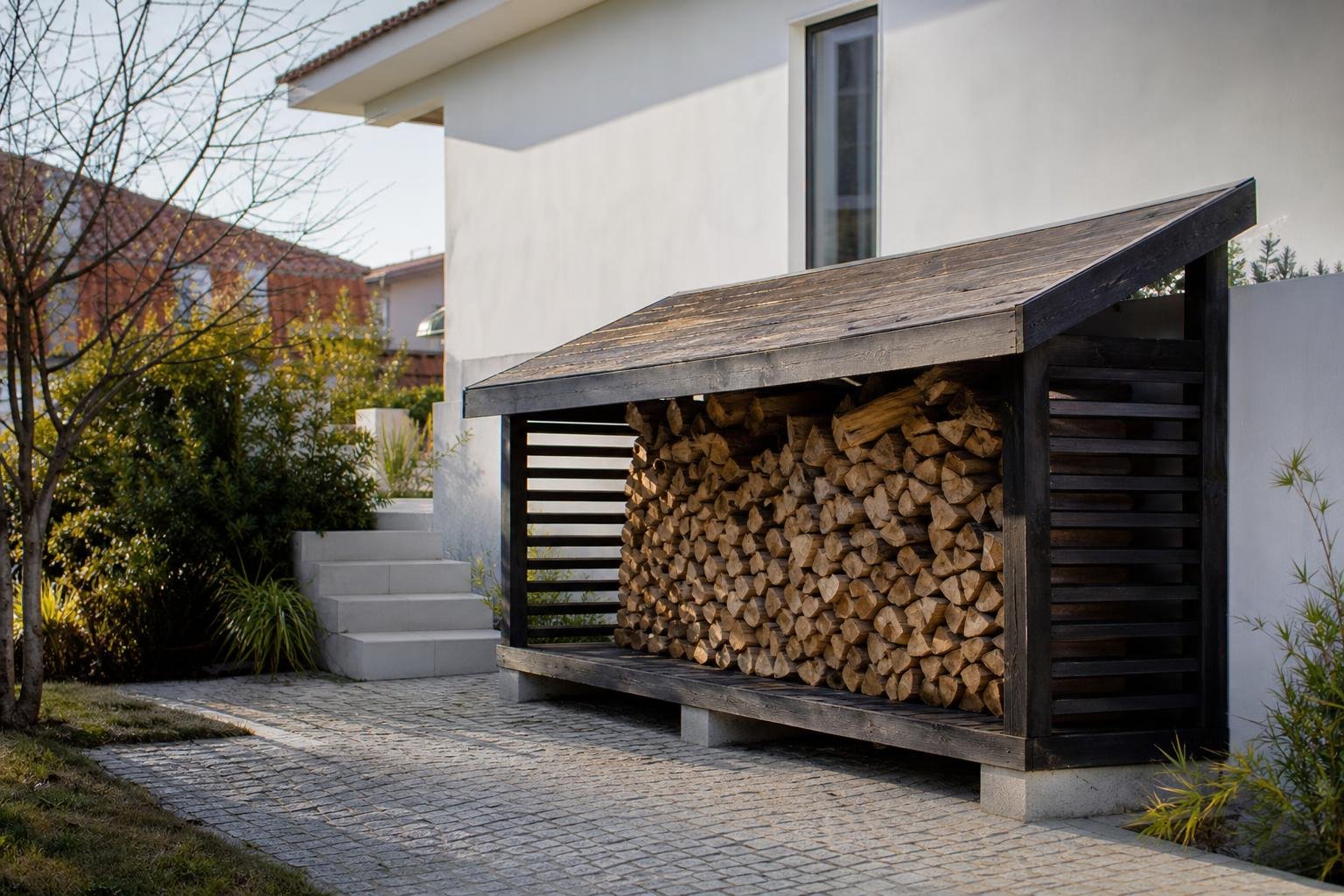
Keeping logs under a tarpaulin, against the house wall or directly on soil may solve an immediate storage problem. It rarely works well over time. Timber picks up moisture from below, the stack becomes unstable, the wall loses ventilation and carrying logs indoors becomes hardest on wet days.
For a house in Lisbon, a firewood shelter should answer four questions before anyone chooses boards, metal sheeting or roof tiles: where does water arrive, where does it leave, how does air move, and how will logs be collected safely? The local climate alternates between a very dry summer and a wetter autumn and winter. At Lisbon’s Instituto Geofísico station, the IPMA climate normal records average rainfall of 97.7 mm in October, 127.5 mm in November and 126.2 mm in December; see the IPMA Lisbon climate normal when planning for the seasonal conditions the shelter must handle.
This guide sets out how to create a simple, accessible and low-maintenance outdoor log store without treating it as a decorative object disconnected from the ground, the house and the planning rules that may apply.
Choose the site before choosing the shelter
The right position protects the logs and makes everyday use easier. Look for an outdoor area with a direct route from the gate, garage or kitchen, but one that does not require carrying logs across a narrow stair, waterlogged lawn or shared route. A shelter placed too far from the house often leads to an untidy secondary pile closer to the door.
Do not build hard against the façade. It makes it harder for the wall to dry and for you to inspect cracks, gutters and finishes, while a compact stack can hold leaves, dust and moisture against the building. Leave enough room to walk, clean and inspect both the wall and the back of the shelter. Avoid inspection chambers, drainage grilles, service taps and escape routes as well.
Read the ground after rain. A dark mark at the base of a wall, a recurring puddle and washed-out soil reveal far more than a plan made on a dry day. If the available spot receives water from planting beds, a roof or a neighbouring plot, solve that drainage issue first. For outside work that changes the built footprint, roof, boundaries or planning conditions, check the formal position with the municipality; Lisbon’s prior information request service is a route for clarifying the feasibility of a proposal before committing to a permanent build.
Raise the logs and keep them off the ground
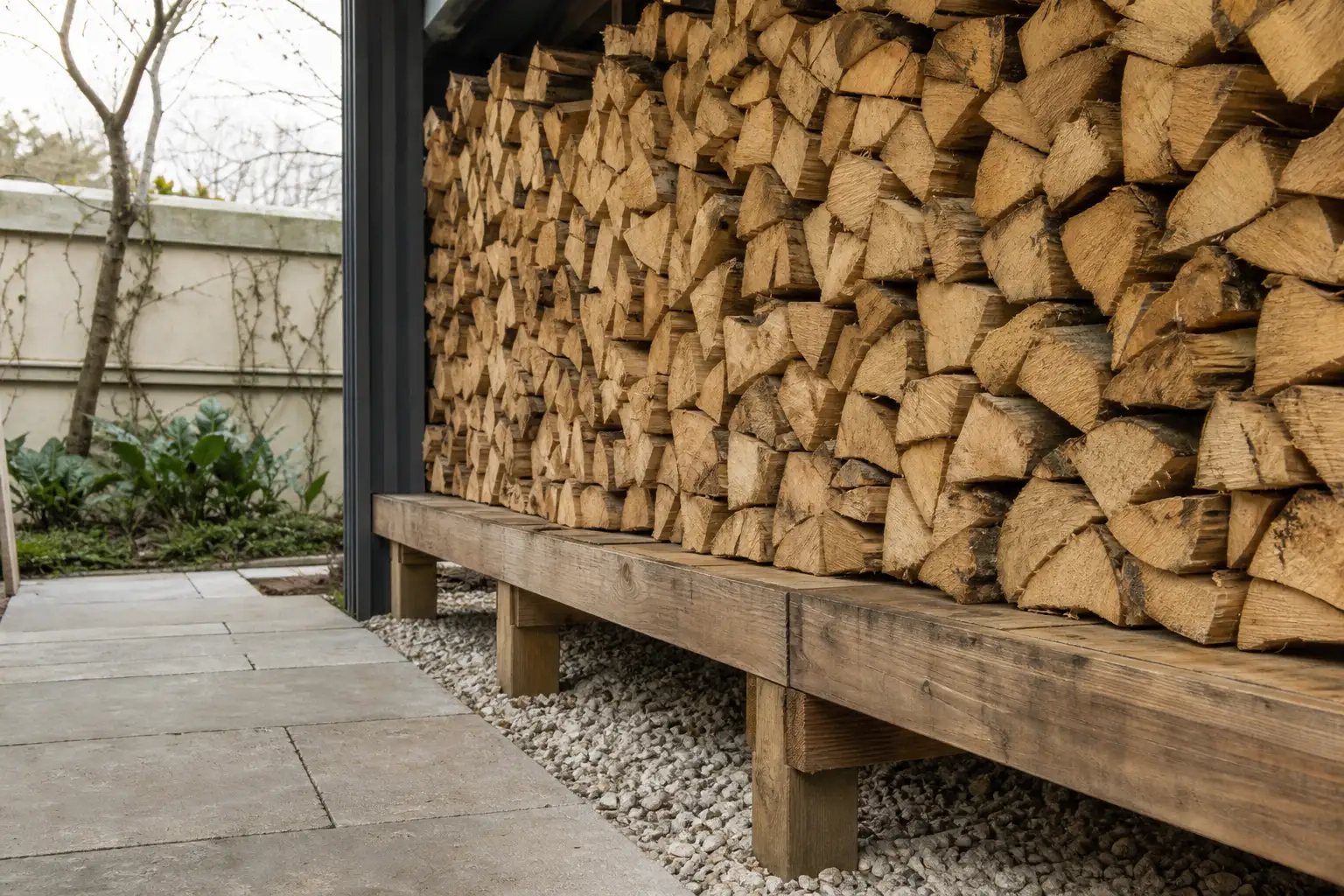
The key detail is not the roof but the surface beneath the stack. Firewood placed on soil, grass or sand takes on moisture through contact, gets splashed during rain and creates a hidden area that is difficult to clean. Logs should be lifted on durable bearers, a ventilated base or robust supports, leaving enough clearance for air to move underneath.
A properly prepared mineral base can work well in a garden: levelled ground, drainage layers appropriate to the soil, separation where needed and a stable final surface. In an already paved courtyard, assess the existing falls and do not obstruct gullies. A detail that seems tidy, such as closing every gap with a plinth, can trap leaves and water inside the shelter.
Size the footprint for the amount of wood you genuinely use and for a modest handling area. Two lower, accessible stacks are usually safer than one very tall, heavy and unstable wall of logs. Keep the front clear so that the oldest wood can be used first; this prevents forgotten bags from collecting dust, damp and insects for years.
If the shelter needs new paving, a roof or fixed elements, do not assume that its small size removes the need for checks. Lisbon’s Municipal Urbanisation and Building Regulation sets local rules and examples of minor urban works, but the individual plot, applicable plan and exact design still matter.
Keep rain out without sealing ventilation in
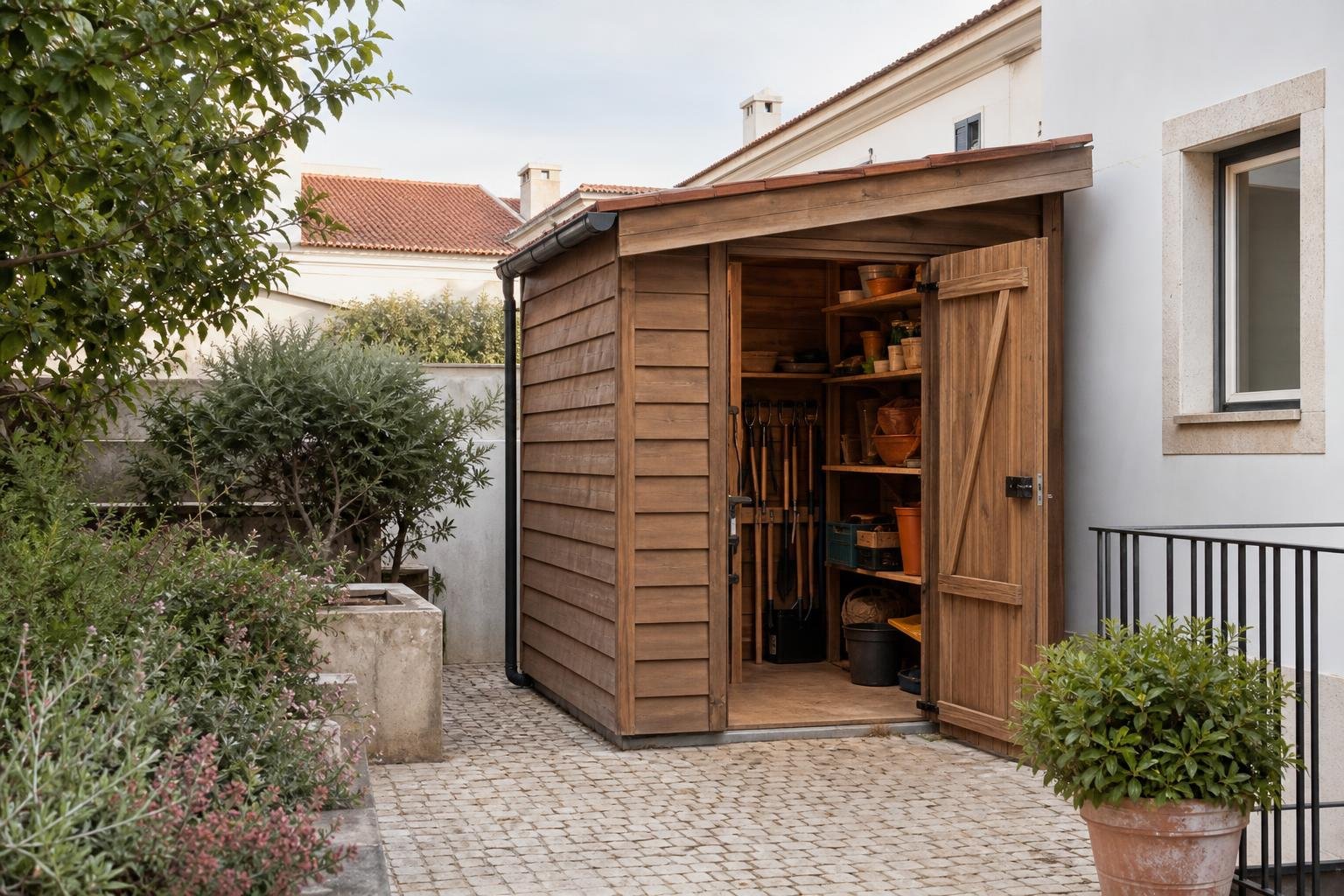
Dry firewood needs a roof, not an airtight box. The most effective arrangement usually combines a waterproof roof, an overhang that keeps direct rain away from the face of the stack, and open or slatted sides. The purpose is to stop rain reaching the wood while allowing residual moisture to escape.
A single-pitch roof is straightforward to build and maintain, provided it discharges water onto a draining area rather than the access route. Check the drip line carefully: constant dripping at the edge of the stack or beside a threshold speeds up wear and makes the floor slippery. If a gutter is used, plan for cleaning and discharge; do not create a downpipe that empties onto the log base.
On the faces most exposed to wind-driven rain, a partial side screen can help. Do not turn it into a solid wall all the way to the ground. Retain upper and lower gaps, use spaced battens or leave one face open. A door is only useful when it also protects other materials; for firewood alone, it commonly reduces ventilation and adds hardware, maintenance and an obstacle to carrying logs.
In Lisbon, where average rainfall is concentrated between October and March, inspect the shelter at the end of summer: tighten fixings, check flashings, remove leaves and follow the drainage route. This short task is preferable to discovering a leak during the first sustained spell of rain.
Deal with drainage before water reaches the wood
A dry shelter does not depend on a good roof alone. Water can arrive sideways from the fall of the garden, bounce from hard paving or gather beside the structure. Before assembly, test with a hose or watch a moderate rainfall: where does the water travel after reaching the ground? If the answer is “into the log-storage area”, revise the levels, fall or finish before stacking timber.
Do not discharge roof water against walls, foundations, service doors or a neighbouring property. Where the flow and conditions of the plot justify it, direct it to a solution designed to receive that water while respecting existing drainage infrastructure. Do not cover inspection chambers or gullies with pallets, loose gravel or logs: maintenance must remain possible without taking the shelter apart.
The route to the logs deserves the same attention. A stable surface with grip when wet reduces the chance of a fall while carrying weight. If the design includes a side door or service route, coordinate it with the choices discussed in exterior service doors for houses: threshold detail, drainage and opening direction should not be left until the end.
Limit pests, clutter and everyday risks
Firewood can bring soil, loose bark and small insects with it. That does not mean the shelter should be sprayed indiscriminately. The most useful measures are to keep the wood dry, raised, orderly and away from the house. Do not stack bags against doors, ventilation grilles, timber-clad walls or places where food is stored.
Use a simple rotation rule: newly delivered logs on one side, older wood on the side used for collection. Clear leaves and loose bark from the base when replenishing stock. If you repeatedly find signs of attack in the shelter structure, severely degraded timber or pest activity near the house, seek technical assessment rather than hiding the issue under another coat of paint.
Avoid stacks higher than the level at which logs can be removed without pulling pieces from the base. Stack with stable faces outward, keep kindling in a separate container, and never store liquid fuels, gas cylinders or hot equipment in the same enclosure. A log store is not general-purpose storage.
Where children use the garden, make sure the logs do not become a climbable wall: limit stack height, remove exposed nails and sharp edges, and keep tools out of reach. Clear access and orderly storage generally improve safety more than a heavy lock fitted as an afterthought.
Use materials that can be maintained in real life
Treated timber kept well above ground can sit naturally within a garden, but it needs periodic inspection at cut ends, fixings and places exposed to water. A metal structure can be slimmer, provided it has suitable protection and does not create hazardous edges. Masonry offers mass and durability, but still needs ventilation, proper flashings and foundations; it is not automatically the driest option.
Rather than copying a catalogue image, establish a language that suits the house: a restrained roof, proportions that make sense, deliberate water discharge and materials that can be repaired. If the shelter is visible from the street or sits near boundaries, check condominium rules, easements and municipal requirements before ordering materials.
During the work, approach the shelter as a small building. Measure the stack, the opening required to move a bag or trolley, the height of the people using it and the path water will take. This attention to detail is equally valuable on larger projects, as explained in our guide to courtyard and patio drainage in Lisbon.
A firewood shelter may be small, but it brings together siting, drainage, materials and safety. If you are incorporating one into an exterior renovation, Obra Lisboa can help coordinate the decisions before work begins.
AI-generated editorial image; it does not depict an Obra Lisboa project.

Obra Lisboa