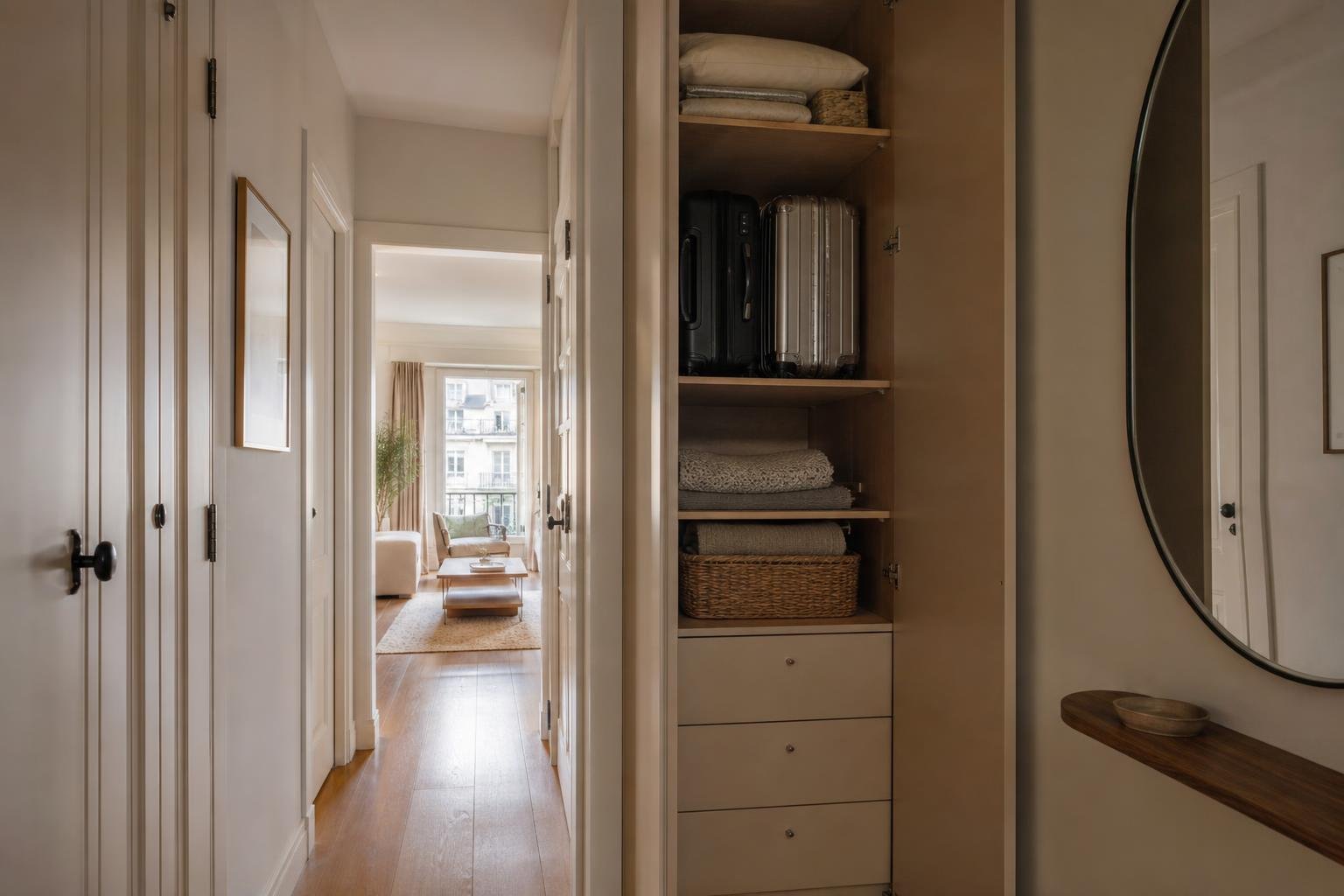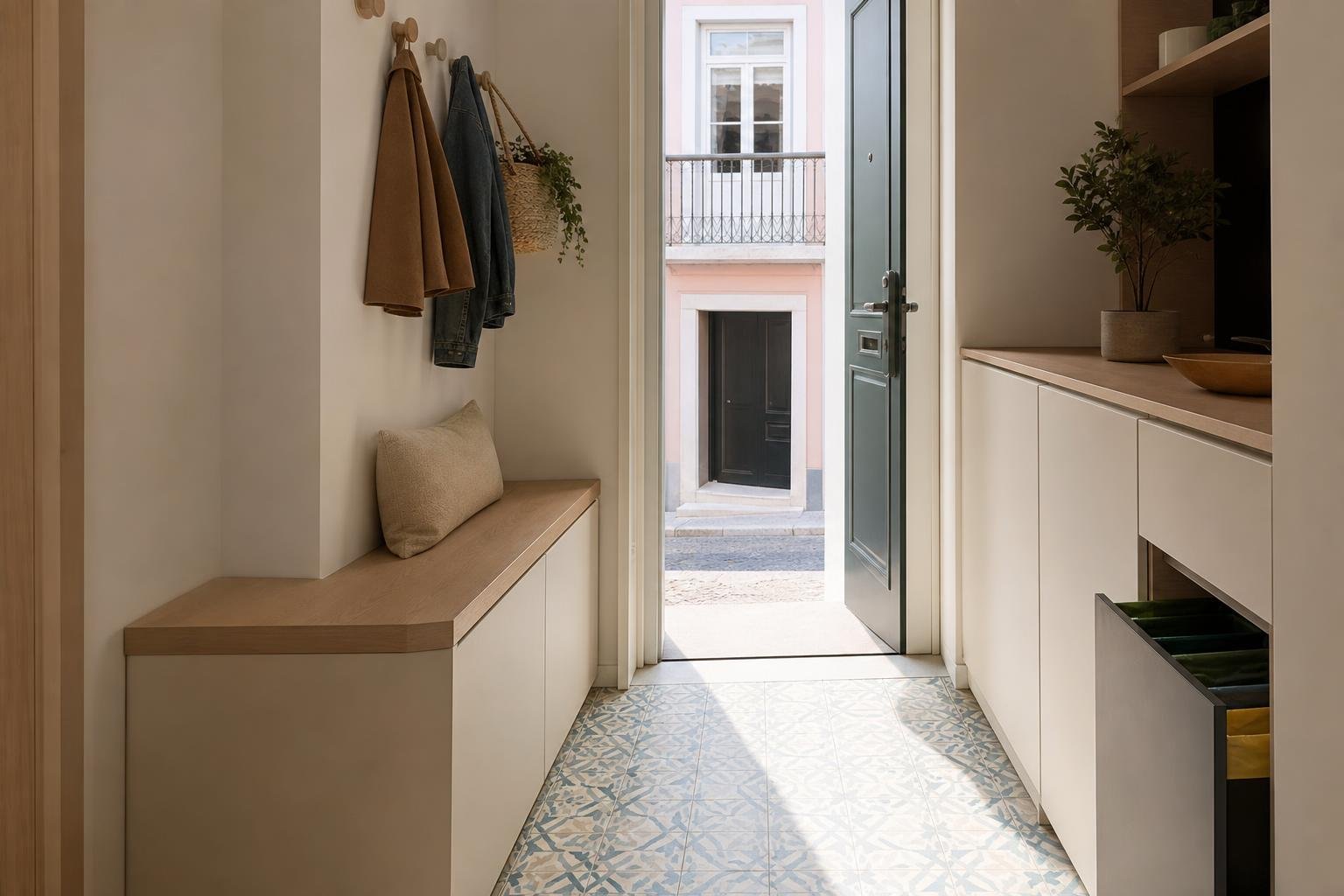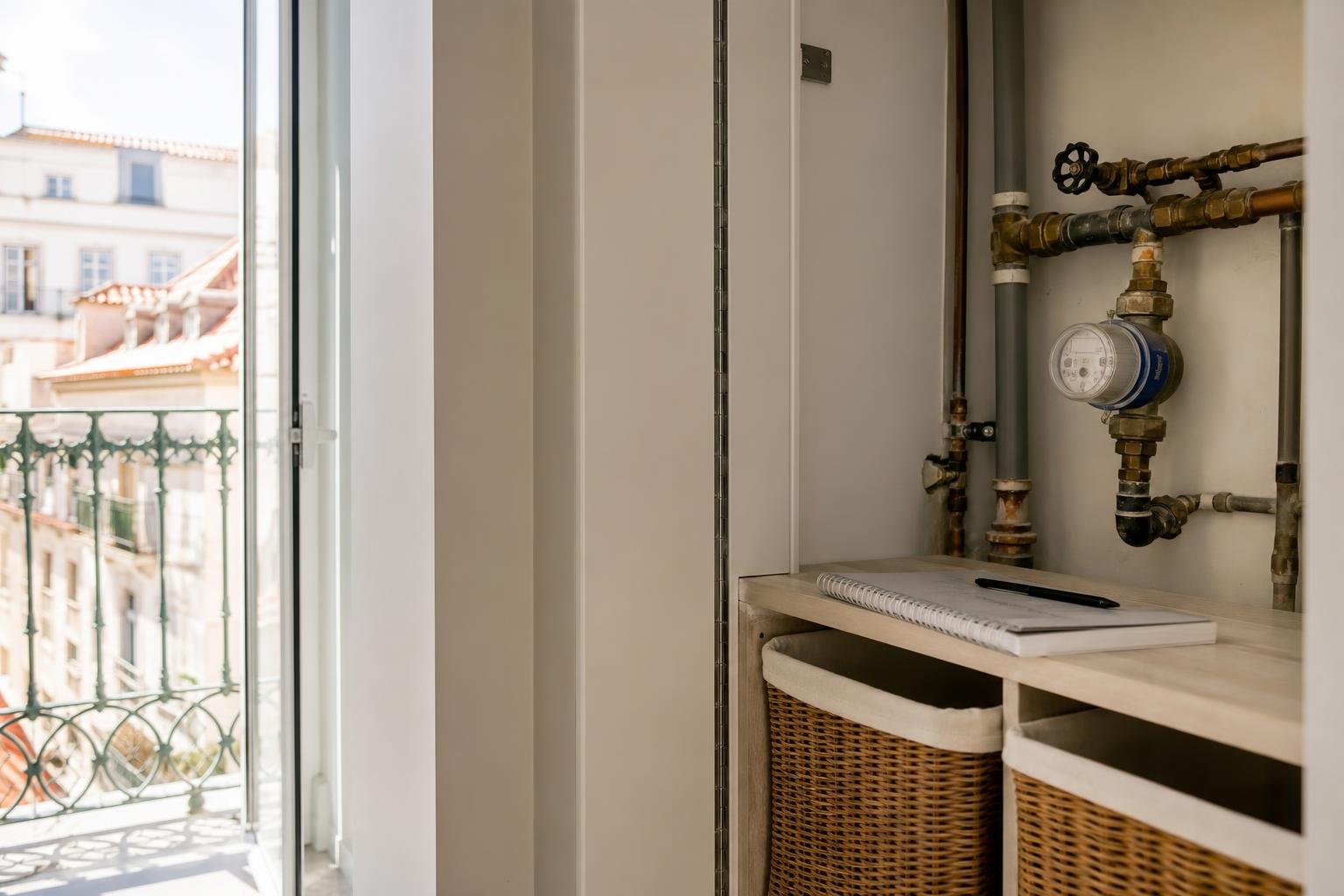

A linen cupboard feels like a minor detail until sheets take over half the wardrobe, duvets are crushed at the back and towels start to smell enclosed. In small Lisbon apartments, where each cupboard often has several jobs, the answer is not more storage boxes. It is deciding what must stay within reach, what can rotate by season and how air will move around the textiles.
This guide starts with a practical principle: bed linen should be close to where it is used, but it does not need to occupy the most valuable part of the bedroom. A shallow cupboard in the hall, an upper wardrobe module or a tall unit near the laundry area can all work well, provided the layout respects the real bulk of the items and does not conceal an existing moisture problem.
Start with the inventory, not the cabinet
Before planning shelves, take everything out and sort it by set: sheets, duvet covers, pillowcases, blankets, bath towels, hand towels and guest items. Then divide everyday use from occasional use. For a bed used every day, two complete sets in rotation are usually enough; a third can make sense with children, pets or less frequent laundry. The real surplus is often made up of loose textiles that no longer belong to any matching set.
Make a straightforward list of what the cupboard needs to hold and measure items when folded, not laid flat. A bulky duvet cover needs a taller shelf than a sheet set, while a stack of towels is easier to manage when you can remove one without disturbing the rest. This selection should happen before commissioning joinery or buying organisers.
In an apartment, a cupboard that properly accommodates the textiles you genuinely use is more valuable than a large unit that turns into a dumping ground. For ideas on module layout and access, see our guide to built-in wardrobes in a renovation.
Choose the location around the daily route
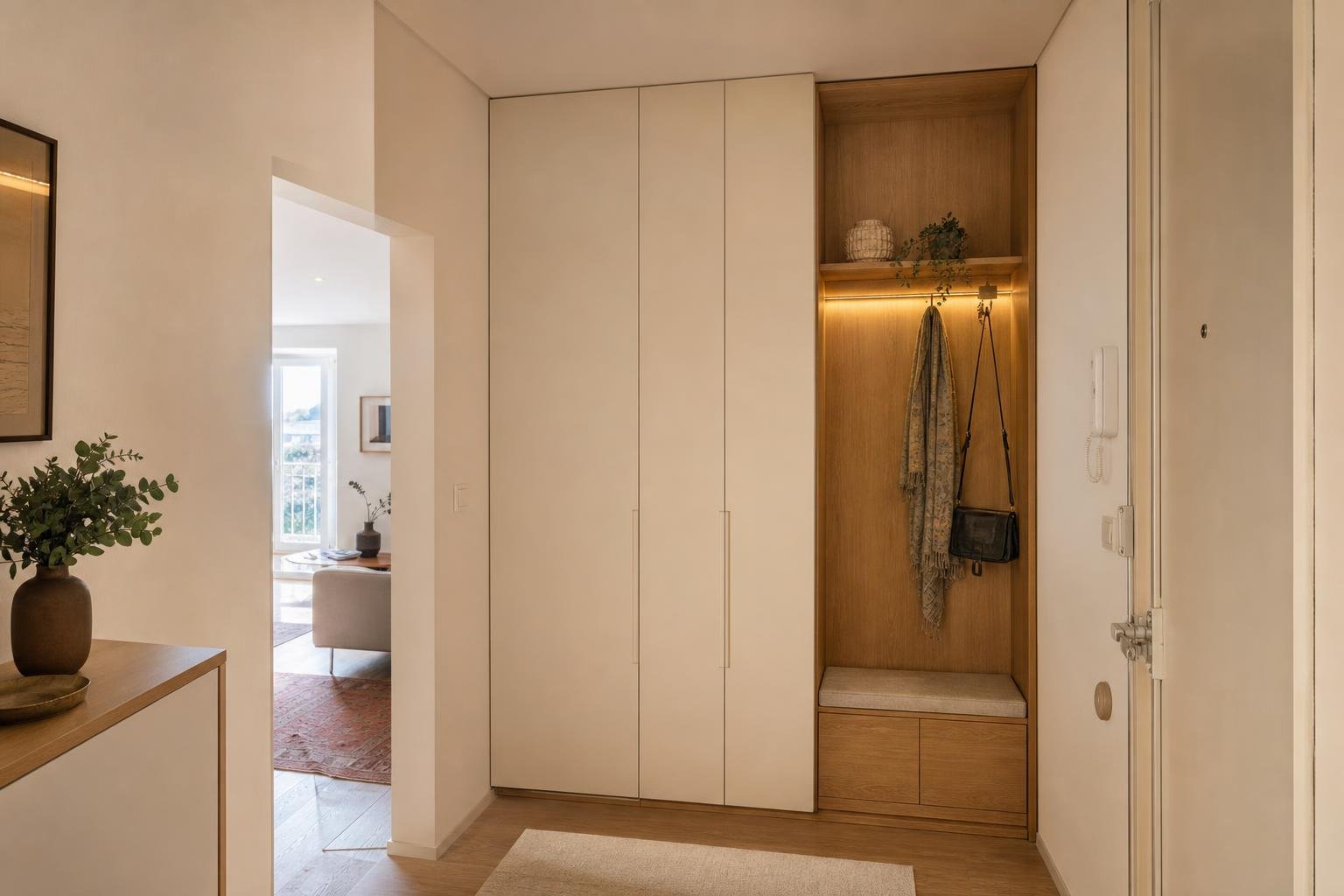
The hall between bedrooms is often the best position: it shortens the trip with clean laundry and frees bedroom wardrobes for personal clothes. In a one-bedroom apartment, a tall unit near the bathroom or washing machine can work just as well, as long as it does not obstruct doors, circulation or technical access. Under-bed storage is a reasonable option for seasonal items, but it does not replace an everyday storage point if it means lifting heavy boxes at every bed change.
Avoid placing the cupboard against a wall with signs of water ingress, ongoing condensation or flaking paint. Portugal’s Directorate-General of Health notes that controlling indoor humidity and increasing ventilation are key to preventing mould. Clean textiles should never become a cover-up for a wall problem. Read the DGS guidance on damp and mould in homes before closing off a questionable area with furniture.
If the solution involves a new cupboard front, a light partition or work inside the apartment, check the scope before proceeding. In Lisbon, internal alterations that do not affect structural stability, façades, roofs or façade tiles may be exempt from prior planning control, but the specific conditions matter. Consult the municipality’s information on interior works exempt from prior control and seek technical advice where there is any uncertainty.
Set depths, widths and shelf heights that can be used
For folded bed linen, a shallow cupboard can be more efficient than a standard wardrobe. A depth of roughly 35 to 45 cm allows stable stacks and lets you see the back without losing items. If the unit is 60 cm deep, offset that depth with pull-out baskets, trays or dividers; otherwise, the back becomes forgotten territory for duvets and unidentified bags.
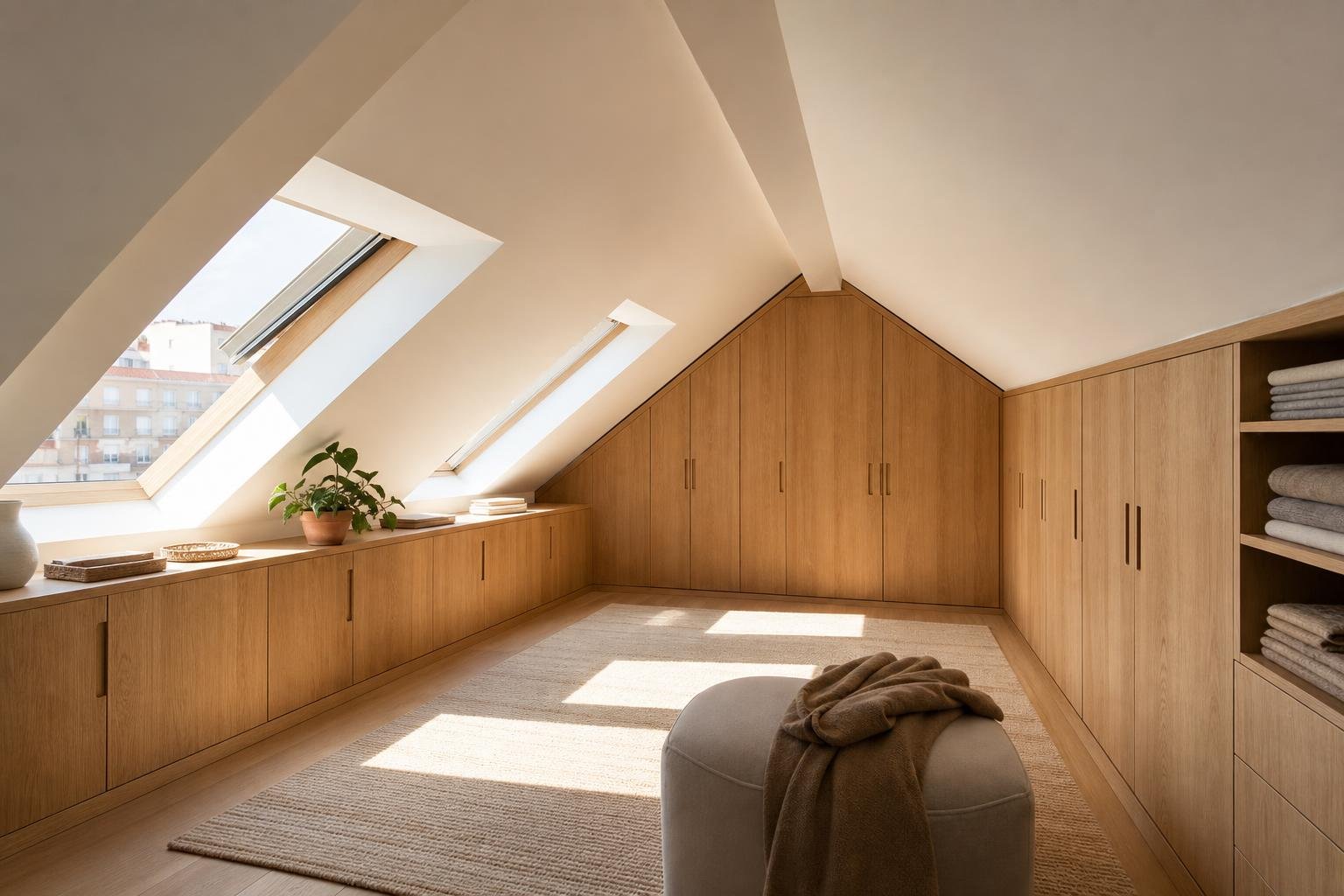
Allow for shelves with different clear heights. Lower shelves, between waist and shoulder level, should hold the sets used every week. Higher shelves are better for duvets, thick blankets and guest pillows. A narrower section, with around 20 to 25 cm of clear height, can suit sheets and pillowcases; towels and duvet covers generally need more room. There is no single universal measurement: the aim is to avoid shelves so tall that stacks become unstable, or so low that fabric must be compressed.
With hinged doors, check the clear space in front of the cabinet. In narrow passageways, sliding doors can preserve circulation, but they require disciplined organisation because only part of the interior is available at any one time. Compare that choice with the benefits and limits of sliding doors in a renovation.

Organise by frequency and by complete set
The simplest method is to store each sheet set inside one of its matching pillowcases. The fitted sheet, top sheet and spare pillowcase then stay together, rather than being searched for across several shelves. Duvet covers can form their own stack, particularly if they are only used in certain seasons. Fold items consistently, not for appearance alone, but so that you can immediately see what is available.
Divide the cupboard into three access levels:
- daily zone: sheets and towels in rotation, within easy reach;
- weekly or monthly zone: spare sets, light blankets and guest towels;
- seasonal zone: duvets, heavy blankets and guest bedding.
Use open baskets only for smaller, lightweight items such as loose pillowcases or cloths, and choose boxes that will not crush fabrics for seasonal storage. Discreet labels can help, but they do not replace a clear system. When every household member has an assigned stack, putting laundry away stops depending on memory.
Treat ventilation as part of storage planning
A linen cupboard should not be an airtight box. Leave a little space between stacks and walls, do not fill every shelf right to the front and avoid storing textiles while they are still warm or even slightly damp. Opening the doors for a few minutes after airing the bedroom can help refresh the cupboard, especially in homes with limited natural ventilation.
Portugal’s General Regulation for Urban Buildings highlights the importance of lighting and ventilation in habitable rooms, while expressly treating small pantry, dressing and storage spaces as exceptions to the direct-ventilation rule. That does not mean a cupboard can disregard indoor air quality. It means its performance depends on the home’s overall ventilation rather than on having a window inside the cabinet. See the General Regulation for Urban Buildings for this distinction.
If you notice a musty smell, dark spots on the back panel or towels that feel damp when removed, stop reorganising and investigate the cause. A hygrometer can help show whether the issue follows ventilation habits or suggests water ingress; our guide explains how to interpret humidity at home.
Build in maintenance so the cupboard keeps working
Once each season, remove the less-used items, vacuum inside the cabinet and inspect corners, hinges, plinths and the rear wall. This is especially useful before storing winter or summer textiles. Wash or air blankets and duvets according to the manufacturer’s instructions before putting them away; storing a used, damp item in a sealed bag creates more problems than it solves.
Do not automatically use strong fragrances, liquid air fresheners or moisture absorbers in response to odours. First establish whether ventilation is inadequate, laundry is being stored before fully dry, there is a leak, or condensation is forming. Only then consider supplementary measures that will not stain fabrics or be accessible to children. A well-organised cupboard is one where you can count the items, remove one without dismantling the whole shelf and quickly spot any change in smell or moisture.
When storage calls for bespoke joinery, adjusted partitions or integration into a wider renovation, the most useful decision is to design the contents before designing the cabinet. It prevents attractive shelves that cannot hold the volumes your home uses every day.
Planning a renovation and want storage that supports daily life without compromising circulation, ventilation or access? Obra Lisboa can help turn the way your home is actually used into a coherent renovation plan.
AI-generated editorial image; it does not depict an Obra Lisboa project.

Obra Lisboa