
Phones, alarm clocks, reading lights, smart watches and sometimes laptops now compete for space beside the bed. When the electrical installation has not kept pace, the result is often a tangle of extension leads, stacked adapters and cables crossing the room. In a renovation, this may look like a minor drawing decision, yet it has a major effect on everyday comfort.
Planning bedside charging points is not simply a matter of adding more outlets. It means deciding where equipment will be used, what demand it creates, how to avoid local overload and how to keep the arrangement accessible for years. The aim is a calm, orderly and safe bedside area, rather than a permanent collection of temporary fixes.
The residential guidance published in the Portuguese Official Gazette recommends at least one outlet per bedside position in bedrooms, two at a study area and one near the entrance door. That is a useful starting point; a thoughtful renovation should then adapt it to the actual routine of the people using the room.
Start with habits, not with the outlet design
Before choosing USB-A, USB-C or wireless charging, make a simple inventory. How many people use the room? Do they charge phones overnight? Are there fixed reading lights or table lamps? Is a laptop, CPAP machine, diffuser, occasional heater or another device used by the bed? These answers shape the number of useful points and the electrical provision required.
It is sensible to distinguish low-demand uses, such as phone charging, from equipment that may need more power. An integrated USB port is convenient for a phone, but it should not be treated as a universal replacement for a conventional outlet. A laptop, lamp, vacuum cleaner or health-related device may need its own socket and unobstructed access.
Rather than hiding a power strip behind the bedside table, plan a clear combination: conventional outlets for flexible use, USB-C for everyday charging and, where appropriate, one additional spare point. That reserve avoids replacing all the wall accessories when devices or habits change.
For a broader approach to preventing last-minute workarounds, see How to Avoid Common Renovation Problems.
Set the position and height using the real furniture layout
The best outlet is of little value if it disappears behind a headboard or is crushed by a bedside cabinet. Before walls are chased, confirm bed width, headboard thickness, furniture design, switch positions and door clearances. An electrical layout should always be read alongside the furniture plan, never on its own.
In many bedrooms, it works well to place points beside the bed and above the bedside-table surface, within easy reach. The exact solution depends on the furniture and intended appearance. What matters is that a plug can be inserted without sharply bending the cable, a charger is protected from knocks, and it can be unplugged without moving heavy furniture.
If the bed has a continuous headboard, timber panelling or upholstered cladding, define the boxes, cable routes and maintenance openings in advance. Do not rely on drilling through completed finishes later. In a compact room, a slim technical side panel can be a good alternative, keeping connections accessible and away from loose fabrics.
This coordination between design and site execution is one reason why construction supervision matters, particularly when several elements are concealed.
USB-C, standard outlets and wireless charging: give each one a role
Integrated USB ports can reduce loose chargers and make the bedside surface feel less cluttered. USB-C is generally the more adaptable option for current devices, but the choice should reflect the equipment in use and the actual capability of the selected module. Do not judge by the connector alone: check available power, compatibility and the manufacturer’s instructions.
Conventional outlets remain essential. They allow for future chargers, lamps, medical equipment and other devices that do not run directly from USB. A balanced solution usually combines both rather than replacing every outlet with USB ports. This prevents the room from depending on one technology built into the wall.
Wireless charging can be convenient on a bedside table, but it needs a stable surface, a compatible phone and attention to heat. It should not be concealed in a way that restricts ventilation or makes its power supply impossible to reach or replace. Treat it as a complement to a well-positioned outlet, not as the only answer.
It is also worth planning reading-light switches and ambient lighting from the outset. Sockets and switches in a renovation explains why these choices belong in the design before walls are closed.
Avoid overload and permanent extension-lead solutions
A bedside area filled with adapters usually points to insufficient planning. Power strips and extension leads can be useful temporarily and must remain within their rated capacity, but they are not a permanent solution to a foreseeable need. Daisy-chaining adapters, hiding connections under rugs or trapping cables between furniture makes damage harder to spot and can create avoidable risk.
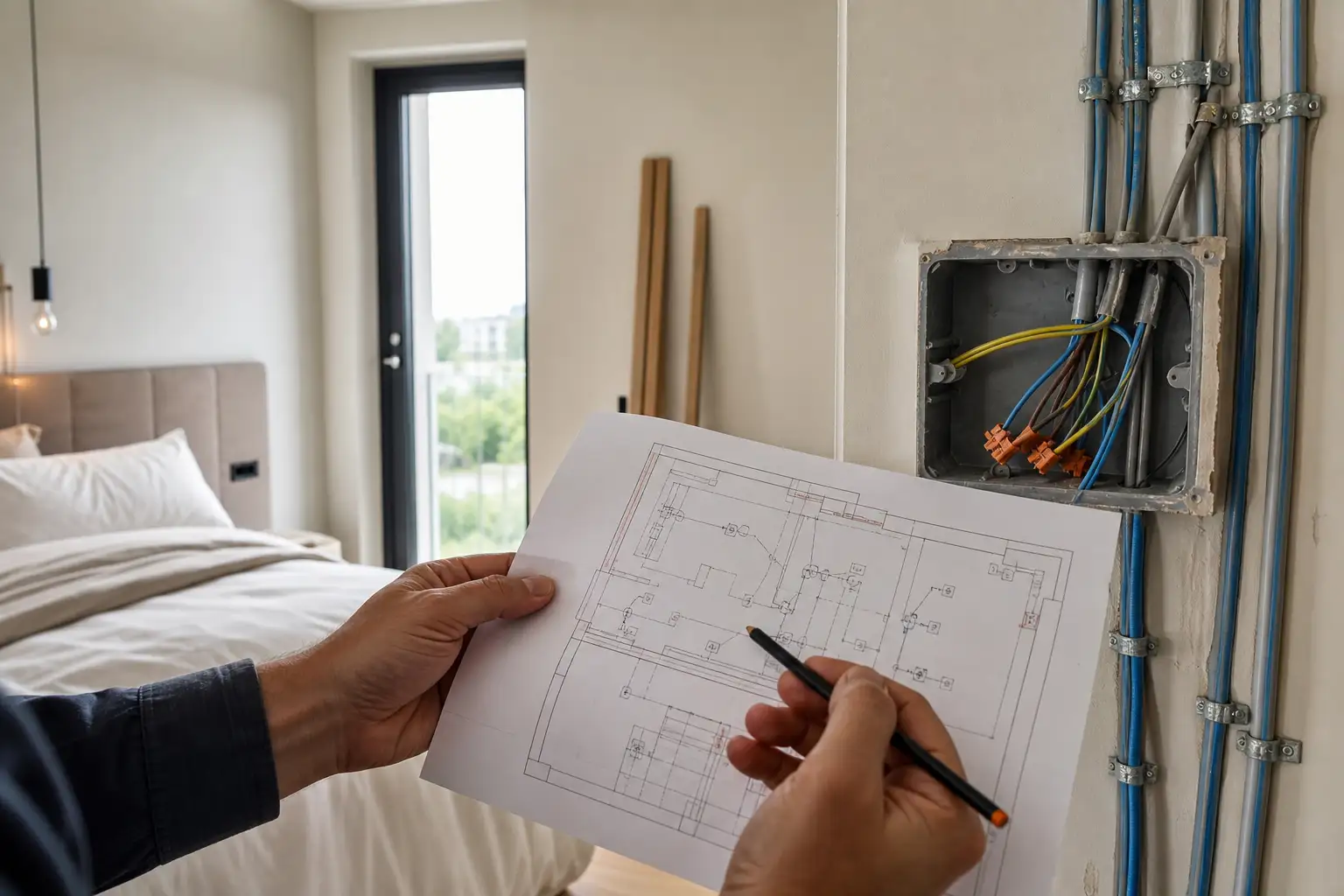
The issue is not only the number of visible outlets. The circuit condition, protections in the consumer unit, conductor sizing, conduit routes and expected demand in both the room and the home need to be checked. Adding one point may be straightforward; changing an older installation without a proper assessment may not be.
The IMPIC classification of construction activity identifies low-voltage electrical installations as a specific work category. In practical terms, changes to wiring, boxes, circuits or the electrical board should be assessed and carried out by suitably qualified professionals, using appropriate materials and final verification. Never improvise wall connections or reuse cables of unknown origin.
If breakers trip repeatedly, outlets feel warm, there is a burning smell, faceplates are cracked or chargers become unusually hot, stop using the affected point and request a technical assessment.
Consider energy used while the room is not in use
Chargers and devices on standby may appear insignificant individually, but continuous consumption builds over a year. ADENE’s guidance on hidden household consumption explains standby use and suggests unplugging unused equipment or using suitable switching solutions where appropriate.
That does not mean everything must be switched off every night. An alarm clock, medical device or appliance that needs to remain powered should stay connected according to the relevant instructions. The point is to avoid leaving chargers, bases and unused devices drawing power permanently through habit or because they are difficult to reach.
A simple approach is to keep one conventional outlet permanently available and, where the design genuinely calls for it, connect another to an accessible switch for non-essential loads. This needs coordination with the electrician so that it cannot turn off necessary equipment and remains obvious to the person using the room.
At the same time, choose certified chargers, undamaged cables and quality wall accessories. Saving money on built-in components rarely pays off if replacement later means removing panelling, repairing paintwork or disturbing finishes.
Complete the plan before the walls are finished
The right time to make these decisions is before final finishes. Ask the professional to mark every point on site, check measurements against an actual or scaled bed and bedside tables, and mentally test routine actions: plugging in a phone, switching on a light, putting down a book, vacuuming the room and reaching an outlet.
Photograph cable routes before walls and ceilings are closed. Keep the consumer-unit schedule, circuit labels and documentation for the installed USB modules. This information makes maintenance, future changes and component replacement much simpler.
In Lisbon apartments, an internal change may appear limited, but work still needs to respect the building’s nature, common areas and applicable requirements. The municipality notes that internal alteration work which does not affect structural stability, façades, the roof or other specified elements may fall within work exempt from prior municipal control; the specific situation should always be checked before proceeding.
A well-equipped bedside area is not about excess. It is a discreet arrangement, sized for current needs, able to adapt and installed safely.
Planning a bedroom renovation or reorganising your home’s electrical layout? Obra Lisboa can help coordinate furniture, lighting, outlets and site execution, so the details used every day are resolved before the finishes go in.
AI-generated editorial image; it does not depict an Obra Lisboa project.

Obra Lisboa